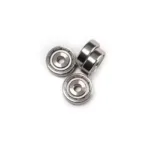
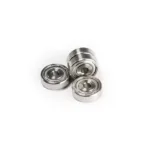
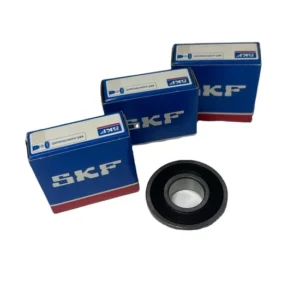
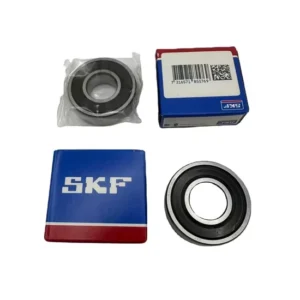
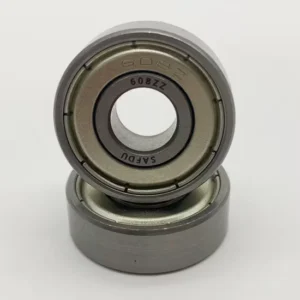
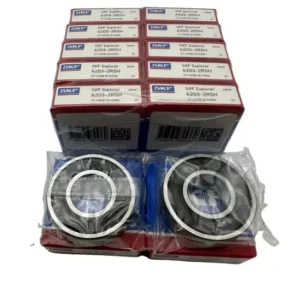
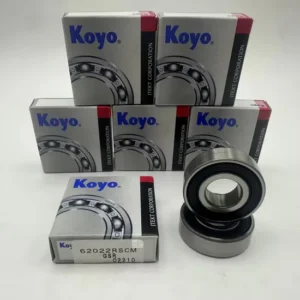
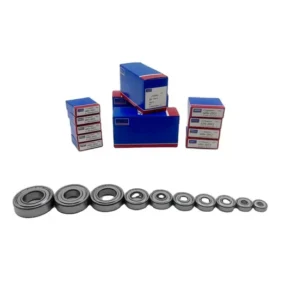
Multi-Brand Sourcing Unified — Consolidating SKF, FAG, and domestic lines into a single shipment eliminates multi-vendor coordination for your corrosion-resistant projects.
Technical Specifications
| Parameter | Value |
|---|
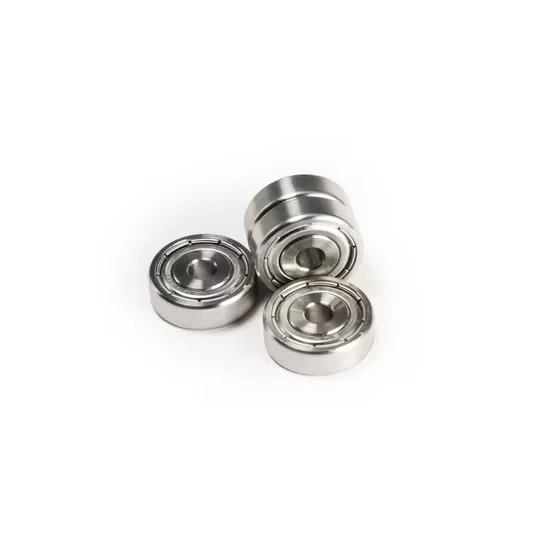
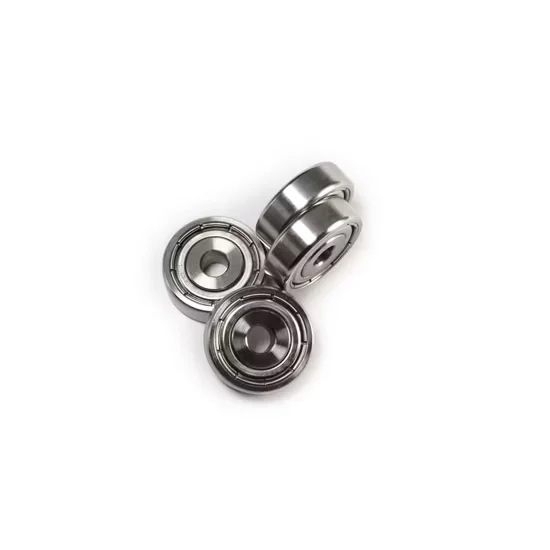
| Product Type | Deep Groove Ball Bearing |
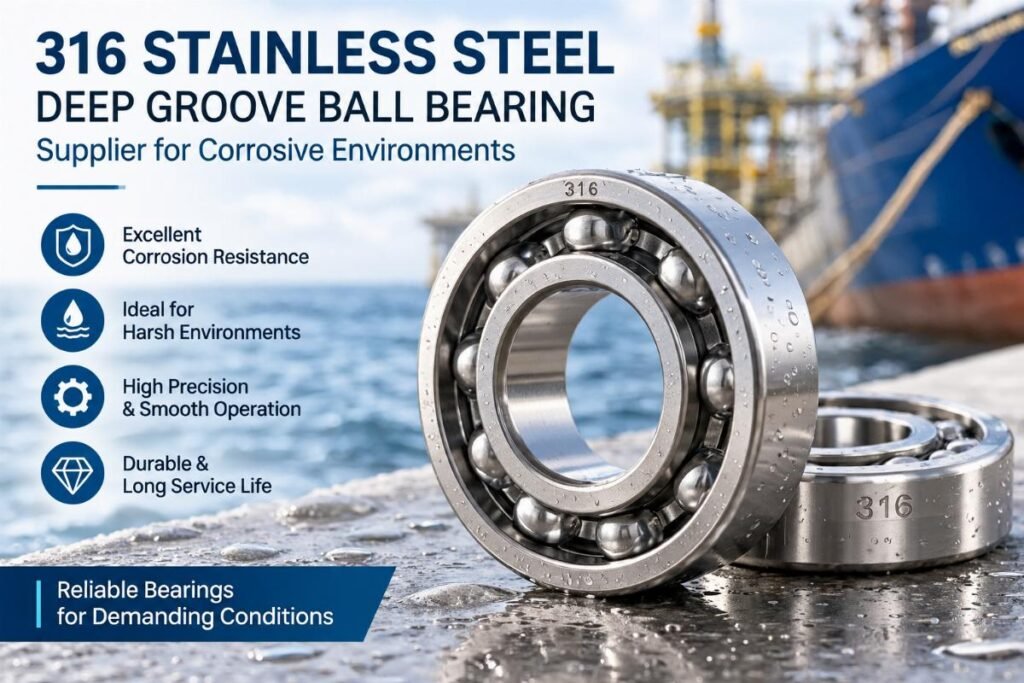
| Material Options | 316 Stainless Steel |
| Number of Rows | Single Row |
| Precision Class | P0 |
| Clearance Class | C0 |
| Feature | Anti-Rust |
| Noise Level | Low Noise Design |
| Friction | Low Friction Coefficient |
| Origin | Shandong, China |
Application Suitability
| Industry | Typical Applications |
|---|
| Food & Beverage Processing | Washdown conveyors, packaging machinery, bottling lines |
| Marine & Shipbuilding | Deck equipment, winches, exposed pump assemblies |
| Chemical Processing | Agitators, metering pumps, corrosive fluid transfer systems |
| General Mechanical Equipment | Motorcycles, electric motors, gearboxes operating in high humidity |
Why Moisture Exposure Destroys Standard Bearings Before the Warranty Expires
Standard bearing steel simply cannot survive continuous washdown or high-humidity transit without seizing.
Early in my career handling export documentation for Latin American routes, a food processing line shipped to Brazil used standard deep groove ball bearings. The high-humidity maritime transit combined with local operational moisture caused them to rust solid within months, triggering massive warranty claims and halting production. Sourcing a reliable 316 stainless steel deep groove ball bearing supplier prevents these catastrophic field failures by ensuring the base material inherently resists corrosive degradation. When standard carbon steel is exposed to chlorinated cleaning agents or salt spray, the protective oxide layer breaks down rapidly. This leads to deep pitting and raceway spalling, which compromises the entire mechanical assembly. By prioritizing material compatibility from the initial design phase, engineers can avoid the devastating financial impact of premature equipment breakdowns and maintain consistent operational uptime across challenging environments [NEED_CITE: rolling bearing failure mode classification per ISO 15243].
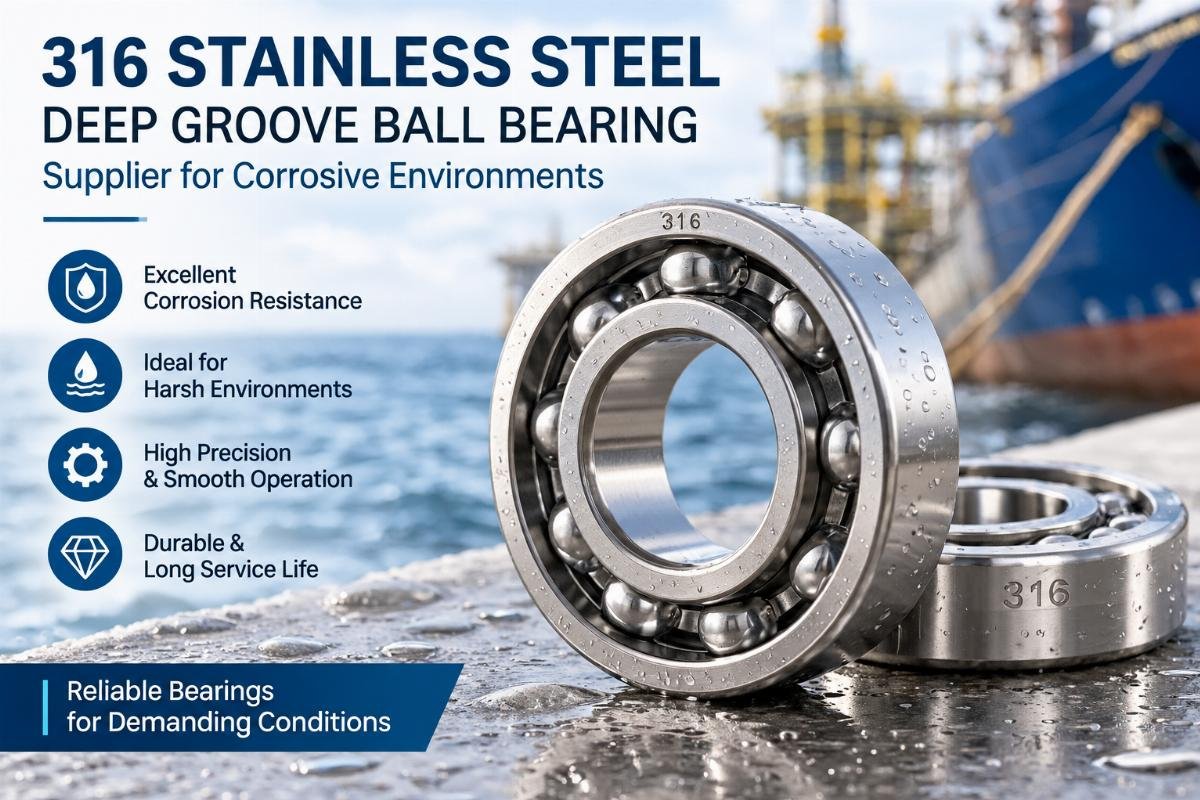
Matching Material Options to Washdown and Marine Environments
When specifying components for food processing, chemical transfer, or marine applications, the primary selection dimension is environmental exposure rather than just radial load capacity. A dedicated 316 stainless steel deep groove ball bearing supplier provides options that maintain structural integrity when exposed to aggressive cleaning protocols or continuous saltwater immersion. The single-row design efficiently handles the radial loads typical in conveyor systems, pump shafts, and electric motors while keeping the friction coefficient exceptionally low. Selecting the correct material variant ensures that the bearing surfaces do not pit, degrade, or generate metallic contaminants that could compromise product purity in food and beverage lines. This proactive approach to material selection aligns the component's inherent properties with the harsh realities of the operating environment, ensuring long-term reliability and reducing the frequency of unplanned maintenance interventions.
Managing High-Humidity and Corrosive Operational Challenges
In rigorous washdown environments, standard lubricants easily wash away, allowing moisture to penetrate the raceway and initiate rapid corrosion. Selecting the right material option, such as 316 stainless steel, ensures the bearing surfaces resist pitting and degradation when exposed to aggressive chemical sanitizers. Furthermore, maintaining a low friction coefficient is critical in high-speed electric motors and gearboxes where excessive heat generation could otherwise compromise the anti-rust properties and accelerate wear. Temperature fluctuations in these settings also affect internal clearance, making it vital to consider how thermal expansion interacts with the selected clearance class. Proper sealing arrangements must also be evaluated to balance the need for contaminant exclusion against the friction heat generated by contact seals, ensuring the bearing operates smoothly without overheating or ingesting corrosive fluids [NEED_CITE: impact of moisture ingress on bearing fatigue life].
Decoding Material and Clearance Selections for Corrosive Service
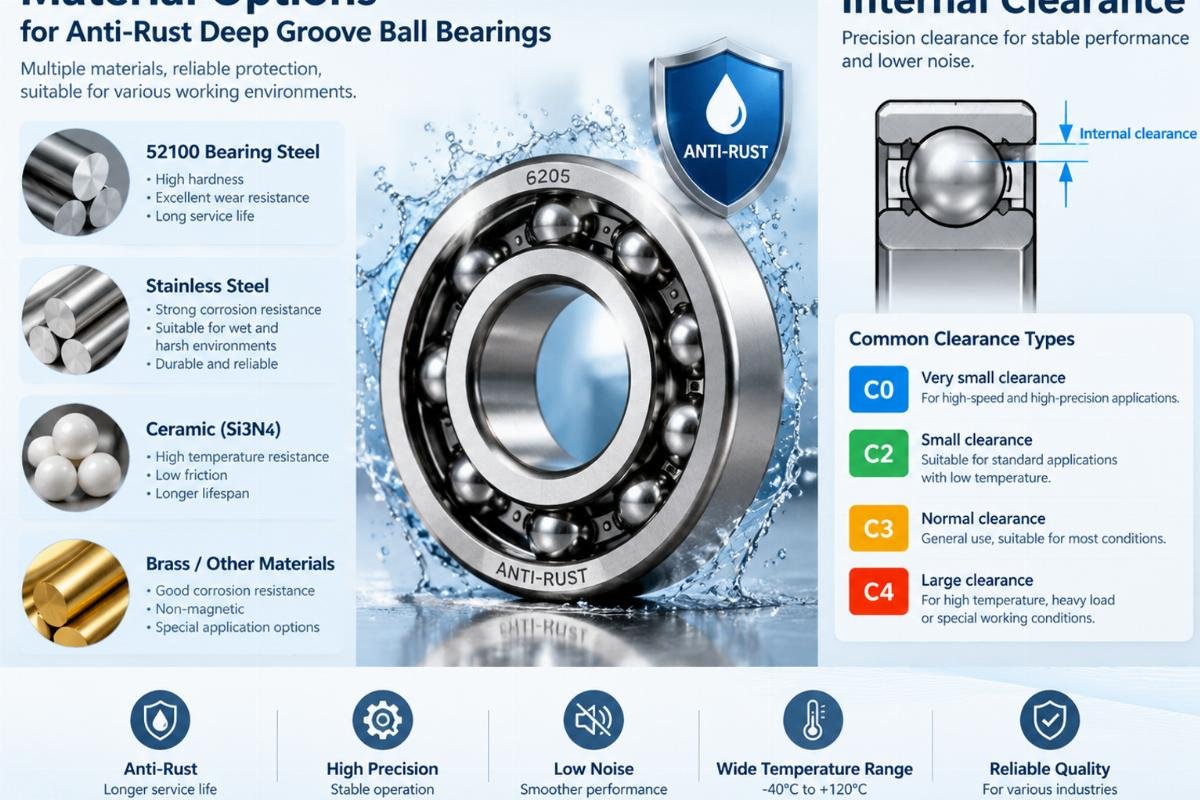
While standard bearing steel offers high load capacity, it requires protective coatings that eventually wear off in abrasive washdown settings, exposing the vulnerable substrate. Opting for 316 stainless steel variants provides essential anti-rust properties for high-moisture environments without relying on temporary surface treatments that degrade over time. The P0 precision and C0 clearance represent standard dimensional tolerances and internal clearances, ensuring reliable general mechanical operation across a wide range of industrial equipment. For applications involving significant temperature fluctuations or tight press-fit installations, verifying the internal clearance class is crucial to prevent the bearing from running too tight once mounted in the housing. Understanding how these standard specifications interact with the austenitic structure of the stainless material allows engineers to predict performance accurately and avoid unexpected binding or excessive play during operation.
The Hidden Costs of Ignoring Environmental Compatibility
Specifying standard steel bearings for corrosive applications inevitably leads to unplanned downtime, premature failure, and compromised product quality. When rust particles contaminate the lubricant, they act as harsh abrasives, causing catastrophic damage to the raceways and rolling elements. This not only voids equipment warranties but also forces frequent, costly maintenance interventions that disrupt production schedules. Aligning material selection with the actual operating environment, as outlined in ISO 281 life calculation adjustments, is essential to avoid these compounding operational costs. Ignoring the specific chemical and moisture profile of the application often results in a cascade of mechanical failures, where a single seized bearing can damage adjacent shafts, seals, and drive components, exponentially increasing the total cost of ownership and repair [NEED_CITE: ISO 281 life modification factors for contaminated environments].
Securing Traceability and Technical Alignment
Sourcing genuine corrosion-resistant components from a verified 316 stainless steel deep groove ball bearing supplier requires more than just matching a generic part number; it demands verified material traceability and rigorous quality control. We provide spectrometer testing reports to confirm the 316 stainless steel composition, ensuring you receive the exact anti-rust properties required for your specific application. Our engineering team assists with cross-brand equivalent model consultation, preventing the common mistake of substituting a lower-grade stainless variant that fails under heavy radial loads. Additionally, we consolidate mixed-brand orders, allowing you to source premium global brands alongside reliable domestic lines in a single, consolidated shipment. This comprehensive approach eliminates the administrative burden of coordinating multiple suppliers while guaranteeing that every component meets the stringent demands of high-moisture and corrosive operating environments.
Documentation & Authenticity
- Spectrometer testing report confirming 316 stainless steel material composition.
- Dimensional and tolerance inspection verifying P0 precision and C0 clearance compliance.
- Original manufacturer batch traceability documentation for premium brand equivalents.
- Certificate of Conformity detailing the specific anti-rust material specifications.
- Running accuracy inspection confirming low noise design parameters before dispatch.
Storage, Handling & Mounting
- Store the 316 stainless steel components in original packaging to prevent surface contamination from carbon steel tools.
- Maintain consistent storage temperature to avoid condensation inside the single-row bearing packaging before installation.
- Use clean gloves during handling to preserve the anti-rust surface finish of the stainless steel raceways.
- Verify the C0 internal clearance is maintained during press-fit mounting to avoid excessive preload on the P0 precision rings.
- Apply compatible food-grade or marine-grade lubricants if the application requires supplemental greasing beyond the factory fill.
Engineering Review and Selection Guidance
To determine the exact bearing model for your equipment, please provide the specific installation dimensions, operating speeds, and radial load requirements. Sharing details about the environmental exposure, such as the concentration of cleaning chemicals, frequency of washdowns, or direct saltwater contact, allows our engineering team to confirm if 316 stainless steel is the optimal material choice. We will then cross-reference your OEM equipment parameters to recommend the precise part number, verify the L10 life expectancy, and suggest appropriate sealing configurations. This collaborative technical review ensures that the selected component perfectly aligns with your operational demands, preventing costly misapplications and ensuring long-term reliability in the field.
Frequently Asked Questions
Q: How do I determine the exact bearing model based on my equipment parameters?
A: Provide your equipment's installation space dimensions, operating speed, and radial load requirements. Our engineering team will cross-reference these parameters with OEM specifications to identify the precise model. We also evaluate environmental factors like moisture and chemical exposure to confirm if 316 stainless steel is the correct material option for your specific application.
Q: What are the material selection differences between 316 stainless steel and 440C for corrosive environments?
A: Martensitic grades like 440C offer higher hardness and load capacity but lower corrosion resistance compared to austenitic 316 stainless steel. For high-moisture washdown or marine applications where anti-rust performance is critical, 316 stainless steel variants are preferred. We evaluate your specific exposure to chemicals and salt to recommend the most suitable material option for your operational needs.
Q: What are the common failure modes of stainless steel bearings in high-moisture applications?
A: In high-moisture environments, inadequate sealing can lead to lubricant washout and subsequent surface corrosion, even on stainless components. This corrosion generates abrasive particles that accelerate wear and cause premature seizure. Proper material selection, combined with appropriate sealing solutions and compatible lubricants, mitigates these failure modes and ensures reliable operation in demanding conditions.
Q: How should we handle custom sizes and MOQ for stainless steel bearings?
A: We accommodate both single-unit emergency spare-part orders and full container consolidation shipments for mixed-brand packages. For non-standard dimensions or specific application requirements, our sourcing network can locate specialized manufacturing runs. We evaluate your project volume and urgency to provide flexible sourcing solutions without compromising on material traceability or quality assurance.
Q: What are the maintenance and lubrication intervals for anti-rust deep groove ball bearings?
A: Maintenance intervals depend heavily on the operating speed, load, and severity of the washdown environment. While sealed variants require no relubrication, open or shielded designs in aggressive environments need regular regreasing with compatible anti-washout lubricants. We provide application guidance to help you establish an optimal maintenance schedule that preserves the low friction coefficient and extends service life.