Pump Bearing Lists for Common Centrifugal Pumps Wholesale Supplier
Copying an OEM parts list does not guarantee pump reliability.
Selecting the correct bearing for a centrifugal pump requires matching specific bearing types to actual operating conditions, such as axial thrust and radial load, rather than blindly following generic model lists. A Pump Bearing Lists for Common Centrifugal Pumps Wholesale Supplier must prioritize application-specific engineering over simple part number substitution to prevent premature failures.
The smell of burnt oil in a West African mining plant is distinct. It mixes with the dust of crushed ore and the humidity of the coast. I stood next to a slurry pump that had failed three times in as many months. The local maintenance team insisted they were using the exact bearings specified in the original equipment manufacturer’s catalog. They showed me the box: standard deep-groove ball bearings. I asked them to split the housing. The inner race was spinning on the shaft, and the cage was shattered into metallic confetti. The issue was not the brand or the price. The issue was that the generic list did not account for the heavy axial loads generated by the high-density slurry. We replaced them with sealed spherical roller bearings paired with angular contact combinations. The pump ran without intervention for years. This experience highlights why a reliable Pump Bearing Lists for Common Centrifugal Pumps Wholesale Supplier must look beyond the baseline model. [NEED_CITE: impact of misalignment and axial load on bearing life per ISO standards]
Generic lists fail because they assume ideal conditions. Real-world sites have misalignment, vibration, and variable media densities. Relying solely on a static list ignores these dynamic forces.
Why Generic Pump Bearing Lists Fail in Real Applications?
Site conditions dictate bearing life, not just the baseline model number.
A generic bearing list is a starting point, not a final solution. It assumes perfect alignment, clean lubrication, and steady loads. In reality, centrifugal pumps operate in harsh environments. A pump handling clear water at a municipal plant has different needs than one moving abrasive slurry in a mine. When buyers request a Pump Bearing Lists for Common Centrifugal Pumps Wholesale Supplier, they often expect a direct cross-reference. However, direct substitution without analyzing the duty cycle leads to repeated failures.
Consider the case of a chemical processing facility in Southeast Asia. They used a standard list for their corrosive media pumps. The bearings failed every few weeks due to seal leakage and corrosion ingress. The generic list specified open bearings with standard grease. By upgrading to sealed angular contact combinations with corrosion-resistant materials, the maintenance cycle extended from weeks to years. The key was not just the bearing type, but the sealing and material compatibility with the process fluid. [NEED_CITE: guidelines for bearing selection in corrosive environments from industry associations]
Another common failure mode is thermal expansion. High-speed water pumps generate significant heat. If the bearing clearance is not optimized for the operating temperature, the internal fit becomes too tight. This leads to overheating and premature seizure. A generic list rarely specifies the required clearance class for high-RPM applications. A knowledgeable supplier will adjust the specification to include C3 or C4 clearance where necessary, ensuring the bearing can expand without binding.
The lesson is clear. A static list cannot capture the dynamic reality of industrial operations. Engineering judgment must override simple part number matching.
Essential Bearing Types for Common Centrifugal Pumps
Matching bearing geometry to pump duty prevents catastrophic failure.
Not all bearings are created equal. Each type has a specific role in managing load and motion. Understanding these differences is crucial for anyone sourcing from a Pump Bearing Lists for Common Centrifugal Pumps Wholesale Supplier.
Deep-groove ball bearings are the most common. They handle moderate radial and axial loads. They are suitable for small to medium-sized pumps with low thrust. However, they are vulnerable to misalignment. If the shaft bends slightly under load, the ball tracks become uneven, leading to early fatigue.
Spherical roller bearings are the workhorses for heavy-duty applications. They can accommodate significant misalignment and heavy radial loads. In mining slurry pumps, where the shaft may deflect due to the weight of the impeller and the density of the slurry, spherical rollers are essential. They also handle moderate axial loads in both directions. Their self-aligning capability makes them forgiving in less-than-perfect installations.
Angular contact ball bearings are designed for high axial loads. They are often used in pairs to handle thrust from both directions. In high-speed pumps or those with large impellers, axial thrust can be substantial. Using deep-groove bearings in these positions leads to rapid failure. Angular contact bearings provide the necessary stiffness and load capacity. [NEED_CITE: load rating calculations for angular contact vs deep groove bearings]
| Bearing Type | Radial Load Capacity | Axial Load Capacity | Misalignment Tolerance | Typical Application |
|---|---|---|---|---|
| Deep-Groove Ball | Moderate | Moderate (Single Direction) | Low | Small Water Pumps |
| Spherical Roller | High | Moderate (Both Directions) | High | Slurry Pumps, Large Industrial Pumps |
| Angular Contact | Moderate | High (Single Direction) | Low | High-Speed Pumps, High-Thrust Applications |
| Cylindrical Roller | Very High | None | Low | Heavy Radial Load Applications |
Choosing the wrong type is a common error. A buyer might select a spherical roller for a high-speed, low-load application, resulting in excessive friction and heat. Conversely, using a deep-groove bearing in a high-thrust environment leads to immediate damage. A competent Pump Bearing Lists for Common Centrifugal Pumps Wholesale Supplier will guide the selection based on these mechanical principles.

The right bearing type extends service life and reduces downtime. It is not about using the most expensive option, but the most appropriate one.
How to Calculate Loads and Select the Right Spec?
Step-by-step methodology for evaluating axial thrust and radial loads ensures optimal selection.
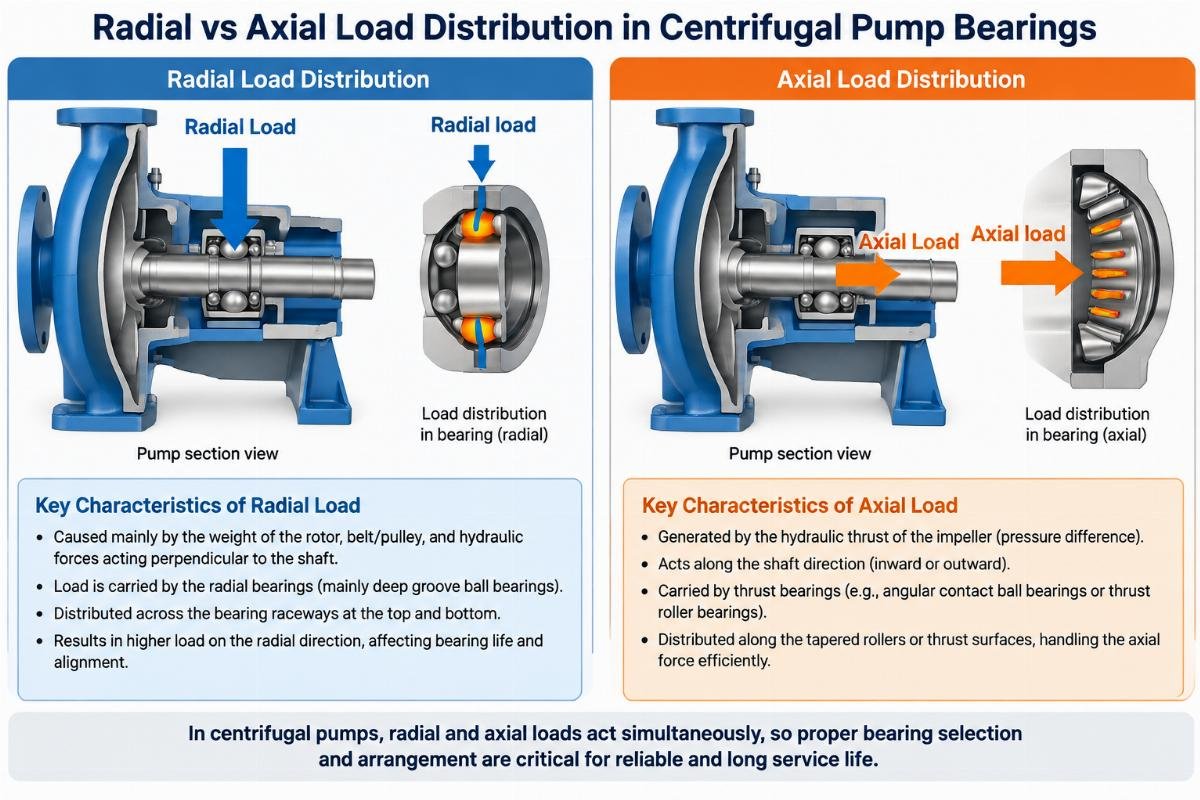
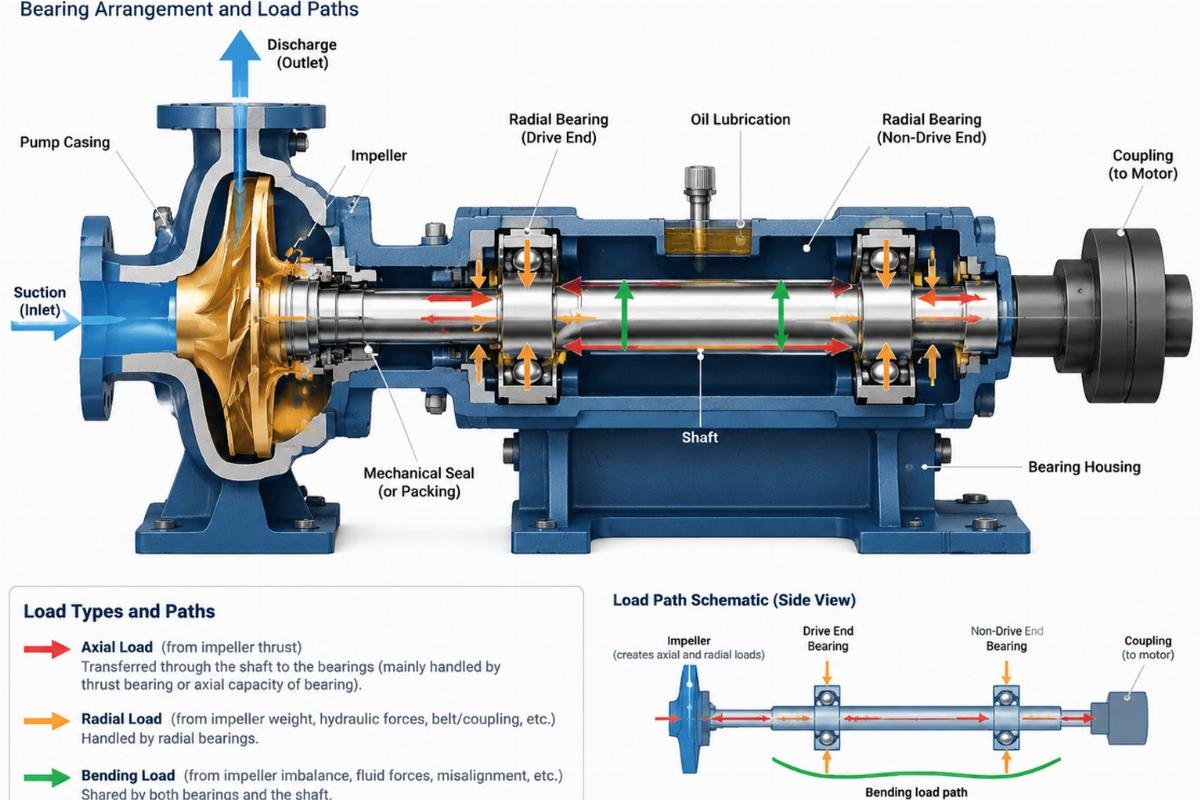
Selecting a bearing is not a guessing game. It requires calculating the forces acting on the shaft. This process involves determining both radial and axial loads. Radial loads come from the weight of the impeller and belt drives. Axial loads come from hydraulic thrust within the pump.
First, identify the radial load. This is often provided by the pump manufacturer. If not, it can be estimated based on the impeller weight and drive configuration. Next, calculate the axial thrust. This is more complex. It depends on the pump design, discharge pressure, and impeller geometry. Hydraulic thrust can be significant in multi-stage pumps. [NEED_CITE: methods for calculating hydraulic thrust in centrifugal pumps]
Once the loads are known, select a bearing with a dynamic load rating that exceeds the calculated equivalent load. The L10 life calculation, based on ISO standards, helps estimate the expected service life. This calculation considers the load, speed, and basic dynamic load rating of the bearing.
Lubrication is another critical factor. The type of grease and the relubrication interval depend on the operating speed and temperature. High-speed applications require low-viscosity grease to reduce churning losses. Heavy-load applications need high-viscosity grease to maintain the film thickness. Incorrect lubrication is a leading cause of bearing failure.
A common mistake is ignoring the housing fit. The bearing outer ring must be supported properly. If the housing is too loose, the ring will creep, causing wear and heat. If it is too tight, the bearing may distort, reducing its internal clearance. A professional Pump Bearing Lists for Common Centrifugal Pumps Wholesale Supplier will provide guidance on housing tolerances and fits.

Accurate load calculation prevents over-engineering and under-engineering. It ensures the bearing lasts as long as intended.
Real-World Failure Analysis and Upgrades
Case insights reveal how wrong selections cause keepers to shatter and how to fix them.
Failure analysis provides valuable lessons. In one instance, a steel mill in the Middle East experienced frequent failures in their cooling water pumps. The bearings were failing due to electrical fluting. The motor current was leaking through the shaft into the bearing, causing small craters on the raceways. The solution was not a stronger bearing, but an insulated bearing or a shaft grounding ring. This case shows that the root cause is not always mechanical.
Another case involved a cement plant in Latin America. Their kiln feed pumps were suffering from premature wear. The investigation revealed that the standard grease was washing out due to water ingress. The upgrade involved switching to bearings with enhanced sealing and a water-resistant grease. The failure rate dropped noticeably.
In the mining sector, vibration is a major enemy. A quarry operator reported short bearing life in their dewatering pumps. The analysis showed that the pump was operating far from its best efficiency point, causing excessive vibration. The bearing selection was correct, but the operating condition was wrong. The solution involved adjusting the pump curve and using bearings with higher vibration resistance. [NEED_CITE: relationship between pump operation point and bearing vibration]
These cases highlight the importance of holistic analysis. A Pump Bearing Lists for Common Centrifugal Pumps Wholesale Supplier must offer more than just parts. They must provide technical support to diagnose and solve underlying issues. This includes offering cross-reference consultation and genuine inventory to help buyers upgrade specs.

Learning from failures prevents recurrence. It turns maintenance from a reactive task into a proactive strategy.
Conclusion
Correct bearing selection is an engineering decision, not a clerical one.
Generic lists are insufficient for demanding industrial applications. Matching bearing types to specific loads, speeds, and environmental conditions is essential for reliability. A trusted Pump Bearing Lists for Common Centrifugal Pumps Wholesale Supplier provides the technical expertise and genuine products needed to optimize pump performance. By focusing on application-specific solutions, operators can reduce downtime and extend equipment life.

Written by
authorEditor covering global sourcing, supplier verification, and industrial product knowledge. Content is compiled from manufacturer specifications, industry standards, and hands-on experience with international B2B buyers. Every article is fact-checked before publishing to help procurement professionals make informed decisions.
View all posts


Leave a Reply