Wrong Cage Substitution Speed Failures: Genuine Bearing Supplier
A plastic cage is not a universal downgrade for brass; it is a speed-limited component that fails catastrophically when centrifugal forces exceed its material threshold.
Substituting original bearing cages without verifying speed limits and thermal expansion coefficients leads to immediate high-speed motor bearing maintenance crises. The core failure mechanism is not dimensional mismatch but dynamic instability under rotational stress. To prevent this, operators must match cage material properties to the application’s specific RPM and temperature profile, ensuring that any replacement maintains the original design’s clearance and kinetic integrity. Sourcing genuine bearings with complete traceability is the only reliable method to avoid these costly operational errors.
I have walked through pulp mill floors in Southeast Asia where the air smells of wet wood and burnt insulation. In one instance, a maintenance team replaced a failed high-speed motor bearing, swapping the original brass cage for a lighter, cheaper polyamide alternative. The dimensions matched perfectly on the bench. However, within hours of restarting the line at full operational speed, the cage fragmented. The resulting debris locked the rollers, seizing the rotor and causing days of unplanned downtime. This was not a manufacturing defect in the new part; it was a fundamental misunderstanding of how cage materials behave under centrifugal load. [NEED_CITE: relationship between cage material density and critical speed limits]

This scenario repeats across industries because the visual similarity of bearing components masks their distinct mechanical limitations. Understanding why these substitutions fail requires looking beyond static dimensions to dynamic performance limits.
Why Do Cage Substitutions Fail at High Speeds?
Centrifugal force increases with the square of rotational speed, imposing stresses that lightweight materials cannot withstand without specific reinforcement.
When a bearing rotates, the cage experiences significant outward force. Brass and steel cages possess high tensile strength and density, allowing them to maintain structural integrity at high RPMs. Polyamide or other polymer cages, while lighter and offering better lubrication retention in some contexts, have lower tensile strength and higher thermal expansion rates. If a polymer cage is used in an application designed for metal, the centrifugal force can cause the cage pockets to deform or fracture. [NEED_CITE: ISO standards for bearing cage speed ratings]
The failure is often sudden. A brass cage might wear gradually, giving warning signs through vibration analysis. A polymer cage operating beyond its speed limit tends to fail catastrophically, shattering into fragments that embed themselves in the rolling elements and raceways. This turns a simple replacement job into a major overhaul requiring shaft and housing inspection.
Consider a conveyor drive system in a mining operation. The original specification called for a steel cage due to the high radial loads and moderate speeds. A substitute bearing with a polymer cage was installed because it was readily available. The initial run seemed fine, but the friction generated by the cage deforming under load caused rapid temperature rise. The heat softened the polymer further, accelerating deformation until the bearing seized. This thermal runaway is a direct consequence of ignoring the material’s thermal limits in favor of dimensional compatibility.

The key takeaway is that speed limits are not arbitrary numbers; they are derived from the material’s ability to resist centrifugal deformation and manage heat generation. Ignoring these limits guarantees premature failure.
How to Select the Right Cage Material for Your Application?
Match the cage material to the specific RPM, temperature, and lubrication conditions of your machinery rather than assuming interchangeability based on size.
Selecting the correct cage material involves evaluating three primary factors: speed, temperature, and lubrication. Each material offers distinct advantages and limitations that must align with the operating environment.
| Material | Speed Capability | Temperature Resistance | Lubrication Requirement | Typical Application |
|---|---|---|---|---|
| Brass | High | Moderate | Standard | High-speed motors, generators |
| Steel | Very High | High | Standard | Heavy loads, high temperatures |
| Polyamide (PA66) | Moderate | Low to Moderate | Enhanced | Low noise, light loads, moderate speed |
| Bronze | High | High | Standard | Harsh environments, high load |
[NEED_CITE: comparative material properties for bearing cages per manufacturer technical catalogs]
Brass cages are common in high-speed applications because they offer a good balance of strength and weight. They are also relatively soft, which reduces wear on the rolling elements if contact occurs. Steel cages are used for very high speeds or heavy loads where maximum strength is required. Polyamide cages are popular for their low weight and ability to retain lubricant, but they are sensitive to heat and certain chemicals. Their speed rating is significantly lower than that of metal cages.
In a pump application I observed, a mixed-brand substitution was made without verifying the speed rating. The new bearing had a polyamide cage, but the pump operated at a speed near the upper limit of what that material could handle. The lack of margin for error meant that any slight increase in temperature or load pushed the cage beyond its limit, leading to unexpected rotor lock. This highlights the importance of checking the specific speed rating (nA) for the cage material, not just the bearing type.

When selecting a replacement, always consult the manufacturer’s catalog for the specific speed limits of the cage material. Do not assume that a bearing from a different brand with the same dimensional code has the same internal construction or material specifications.
What Are the Hidden Risks of Mixing Brands and Clearances?
Improper clearance matching with substituted cages causes rapid thermal expansion issues, leading to seizure even if the bearing fits the shaft.
Internal clearance is critical for high-speed bearings. As a bearing operates, it generates heat, causing the inner ring, outer ring, and rolling elements to expand. The initial clearance must account for this expansion to prevent preloading, which generates excessive heat and premature failure. Different brands may use different standard clearances for the same bearing code, or they may interpret tolerance classes differently.
When you mix brands, you risk combining a cage with a thermal expansion coefficient that does not match the rest of the bearing assembly. For example, a polyamide cage expands more with heat than a brass cage. If the initial clearance was set for a brass cage, the additional expansion of the polyamide cage can reduce the effective clearance to zero, causing the bearing to bind. [NEED_CITE: thermal expansion coefficients of common bearing cage materials]
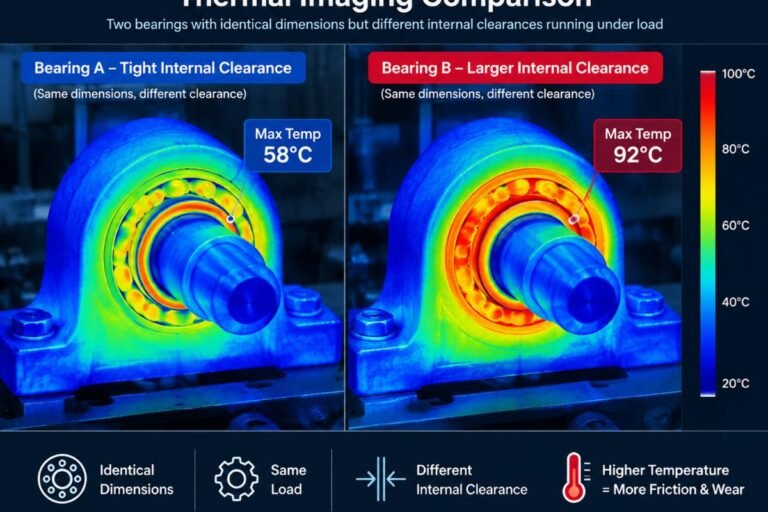
A regional distributor once supplied a batch of bearings that were dimensionally correct but had different internal clearances than the originals. The maintenance team installed them in a series of fans. Within weeks, several fans experienced overheating and vibration. Investigation revealed that the substituted bearings had tighter initial clearances, which became negative clearance under operating temperatures. The cage material exacerbated this issue by expanding faster than the rings, locking the rollers in place.
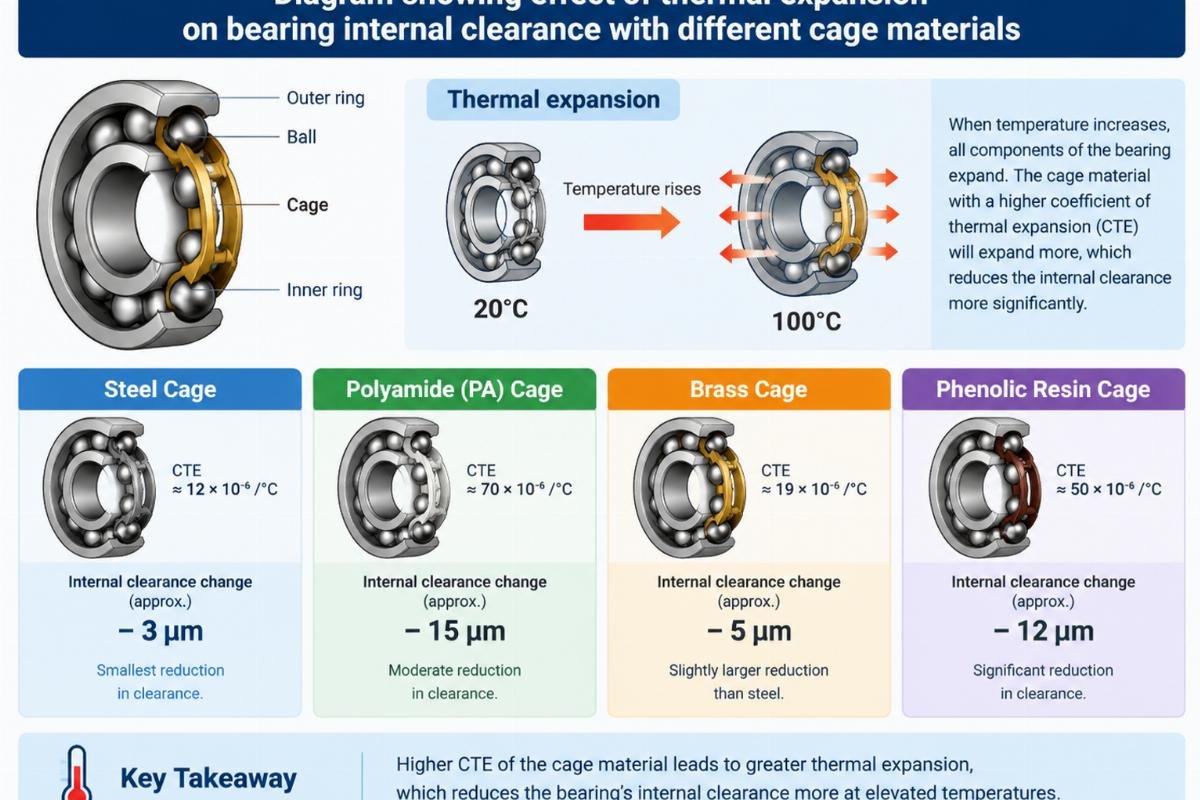
To avoid this, always verify the internal clearance class (e.g., C3, C4) of the replacement bearing and ensure it matches the original specification. Do not rely solely on the external dimensions. If the original bearing is unavailable, consult with a technical expert who can cross-reference the internal specifications of different brands to find a true equivalent.
How to Verify and Source Genuine Replacement Bearings?
Traceability and material certification are essential to ensure that the bearing you receive matches the original design specifications.
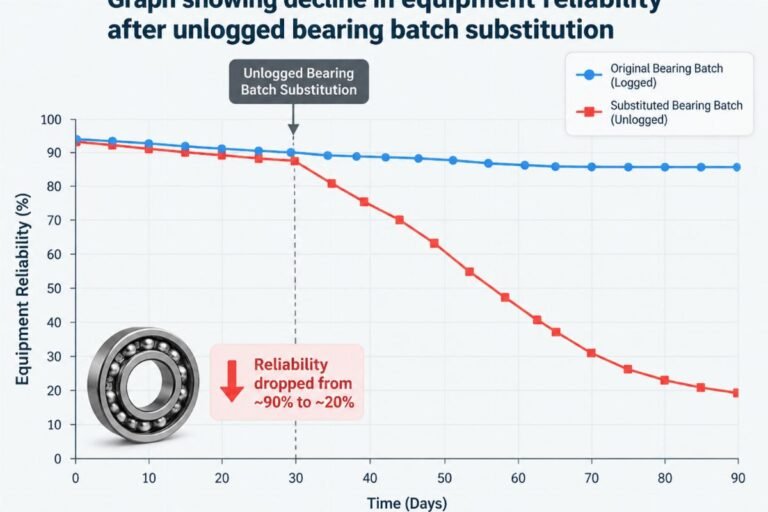
Sourcing genuine replacements requires more than finding a part with the same number. It requires verifying that the internal components, including the cage, match the original design. Counterfeit or non-genuine bearings often use inferior materials or incorrect constructions to cut costs. These parts may look identical but fail under load.
To verify authenticity, request material certificates and traceability documentation from your supplier. Genuine manufacturers provide detailed records of the materials used, including the cage material and heat treatment processes. [NEED_CITE: importance of traceability in preventing counterfeit bearing failures]
Avoid unverified “equivalents” from unknown sources. These parts often lack the rigorous testing and quality control of established brands. Instead, work with a supplier who offers cross-brand technical consultation. They can help you identify true equivalents that match not just the dimensions, but also the performance characteristics of the original bearing.
In my experience, having access to a broad inventory of genuine brands allows for flexible sourcing without compromising on quality. When a specific brand is unavailable, a knowledgeable supplier can recommend a compatible alternative from another reputable manufacturer, ensuring that the cage material and clearance are appropriate for the application. This approach minimizes the risk of wrong substitutions and ensures long-term reliability.

Building a relationship with a supplier who understands the technical nuances of bearing selection is crucial. They can provide the technical support needed to make informed decisions, especially in emergency situations where time is critical.
Conclusion
Wrong cage substitutions are a preventable cause of high-speed bearing failures.
Understanding the limitations of cage materials and the importance of internal clearance is essential for reliable machinery operation. Always verify speed ratings and thermal properties before replacing a bearing. Sourcing genuine parts with complete traceability ensures that your replacements meet the original design specifications, protecting your equipment from catastrophic failure.

Written by
authorEditor covering global sourcing, supplier verification, and industrial product knowledge. Content is compiled from manufacturer specifications, industry standards, and hands-on experience with international B2B buyers. Every article is fact-checked before publishing to help procurement professionals make informed decisions.
View all posts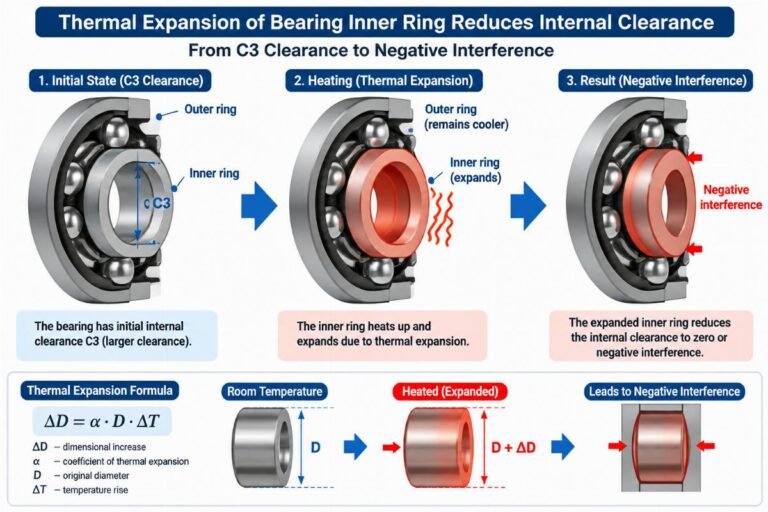
Leave a Reply