1207 Self-Aligning Ball Bearing: Wholesale Supplier for Sale
Buying a 1207 bearing based solely on its 35x72x17mm dimensions is the fastest route to premature failure.
The core specification of a 1207 self-aligning ball bearing is not just its size, but the precise alignment of internal clearance, cage material, and tolerance class with your specific operating environment. Selecting the right variant requires matching these technical parameters to real-world conditions such as temperature fluctuations, shaft misalignment, and load types, rather than treating it as a generic commodity item.
I still remember the chill in the air at the Linyi electromechanical market early one morning, watching a container being loaded for Central Asia. The client was furious. Their harvesters had stopped dead in the field during a cold snap. We pulled a seized 1207 self-aligning ball bearing from the wreckage. It wasn’t defective; it was simply the wrong clearance for sub-zero temperatures under heavy radial load. The standard CN clearance had vanished as the steel contracted, locking the balls in place. That incident shifted my focus from moving boxes to understanding the physics inside them. Now, when I inspect stock, I look beyond the part number to the suffix codes that dictate performance. [NEED_CITE: ISO 15243 failure mode classification for clearance-related seizures]

Understanding these nuances separates a reliable supply chain from a costly downtime event. Let’s break down what actually matters when sourcing this component.
What Are the Core Dimensions of a 1207 Bearing?
The 35x72x17mm envelope defines the physical limits, but tolerance classes define the fit.
Many buyers assume all 1207 self-aligning ball bearing units with these basic dimensions are interchangeable. They are not. The critical differentiator lies in the dimensional tolerances, typically P0 (Normal) or P6 (Class 6). For general industrial applications, P0 is standard. However, for high-speed fans or precision gearboxes, the tighter geometric tolerances of P6 reduce vibration and heat generation. [NEED_CITE: ABMA standard tolerance classes for radial ball bearings]
| Parameter | Standard Value (P0) | Precision Value (P6) | Application Impact |
|---|---|---|---|
| Bore Diameter Tolerance | Standard range | Tighter range | Affects shaft fit tightness |
| Outer Diameter Tolerance | Standard range | Tighter range | Affects housing fit stability |
| Width Tolerance | Standard range | Tighter range | Critical for axial positioning |
| Radial Runout | Higher allowance | Lower allowance | Reduces vibration at speed |
A European machinery OEM once rejected an entire batch because the outer diameter variance, while within P0 limits, caused micro-movement in their pressed-fit housings. Switching to P6 resolved the issue. When you request quotes, specify the tolerance class explicitly. Without this, suppliers may default to the cheapest standard grade, which might not suit your assembly process.

How Do Load Ratings and Speed Limits Dictate Application?
Matching the dynamic load capacity and limiting speed to actual工况 prevents premature fatigue.
The 1207 self-aligning ball bearing is designed primarily for radial loads. Its ability to handle axial loads is strictly limited due to the small contact angle of the balls. A common mistake is using it in applic*cage wear and ball skidding. [NEED_CITE: Dynamic load rating calculation methods per ISO 281]
Consider a conveyor system with slight shaft misalignment. The self-aligning feature compensates for angular errors, but if the axial load exceeds the design limit, the benefit is lost. In such cases, the limiting speed becomes a critical factor. Grease-lubricated units typically have a lower speed limit compared to oil-lubricated ones. Exceeding these limits generates excessive heat, breaking down the lubricant and causing metal-to-metal contact.
| Operating Condition | Risk Factor | Recommended Focus |
|---|---|---|
| High Radial Load | Cage deformation | Steel or brass cage material |
| Moderate Axial Load | Ball skidding | Verify axial load capacity limits |
| High Speed | Heat buildup | Oil lubrication or high-speed grease |
| Shock Load | Raceway brinelling | Higher static load rating requirement |
A textile mill in Southeast Asia experienced repeated failures in their drying rollers. The issue wasn’t the radial weight of the rollers but the thermal expansion causing axial thrust. The standard 1207 self-aligning ball bearing couldn’t cope. Switching to a variant with a reinforced cage and verifying the axial load limits extended the service life significantly. Always cross-reference your actual load profile with the manufacturer’s catalog data, not just the basic dynamic rating.
Why Does Clearance Selection Matter More Than the Model?
Choosing between CN, C3, or C4 clearances based on temperature and load is the key to longevity.
This is where most procurement errors occur. The internal radial clearance determines how much room the balls have to move within the races. Standard clearance (CN) works for normal temperatures and moderate loads. But in hot environments or where the inner ring is press-fitted onto a shaft, the effective clearance decreases. If it drops to zero, the bearing seizes. [NEED_CITE: Effect of fit and temperature on internal radial clearance]
Conversely, selecting too large a clearance, like C4, for a standard application can cause excessive vibration and noise. The balls rattle instead of rolling smoothly. It’s a balancing act. For agricultural machinery operating in varying climates, C3 is often preferred to accommodate thermal expansion without sacrificing stability.
| Clearance Group | Typical Application | Temperature Range | Fit Consideration |
|---|---|---|---|
| CN (Normal) | General industrial | Ambient | Standard shaft/housing fits |
| C3 | Motors, pumps, agriculture | Elevated | Press fits on shaft |
| C4 | Heavy industry, dryers | High | Significant thermal gradient |
I recall a project involving grain silo fans. The initial specification called for CN clearance. During summer operation, the bearings overheated and failed. The heat expanded the inner ring, eliminating the clearance. Switching to C3 cleared the issue. When sourcing, ask your supplier about the recommended clearance for your specific temperature range. Don’t assume standard is best. The right 1207 self-aligning ball bearing for your application might need a non-standard suffix.

How to Verify 1207 Specs When Sourcing Globally?
Requesting dimensional reports and material certificates ensures you get genuine, spec-compliant stock.
In the global market, visual inspection isn’t enough. Counterfeit or sub-spec bearings often look identical to genuine ones but fail under stress. Verification starts with documentation. Reputable manufacturers provide test reports detailing dimensional accuracy, hardness, and clearance measurements. [NEED_CITE: Importance of material certification in bearing quality assurance]
Look for traceability. Each batch should have a unique identifier linking it to production records. This is crucial for MRO buyers who need to replicate exact replacements. Also, check the packaging. Genuine products from brands like SKF, FAG, NSK, or ZWZ have specific labeling standards, including holograms or QR codes for verification.
| Verification Step | Action Required | Expected Outcome |
|---|---|---|
| Documentation Review | Request material certs | Confirms steel grade and heat treatment |
| Dimensional Check | Sample measurement | Verifies tolerance class compliance |
| Visual Inspection | Check markings/packaging | Identifies counterfeit indicators |
| Traceability Check | Batch number lookup | Ensures authenticity and origin |
A distributor in Latin America once received a shipment that looked perfect but failed prematurely. Lab tests revealed inferior steel quality. The lack of proper material certificates was the red flag they missed. By insisting on full traceability docs, you protect your inventory and reputation. Our approach involves consolidating mixed-brand orders while maintaining strict documentation standards for each item, ensuring every 1207 self-aligning ball bearing shipped meets its stated specs.

Conclusion
Specs are not just numbers; they are the blueprint for reliability.
Selecting the right 1207 self-aligning ball bearing demands a deep understanding of clearance, load, and tolerance interplay. Avoid the trap of buying by dimension alone. Verify your source, demand documentation, and match the technical parameters to your operational reality. This diligence turns a simple component into a cornerstone of equipment longevity.

Written by
authorEditor covering global sourcing, supplier verification, and industrial product knowledge. Content is compiled from manufacturer specifications, industry standards, and hands-on experience with international B2B buyers. Every article is fact-checked before publishing to help procurement professionals make informed decisions.
View all posts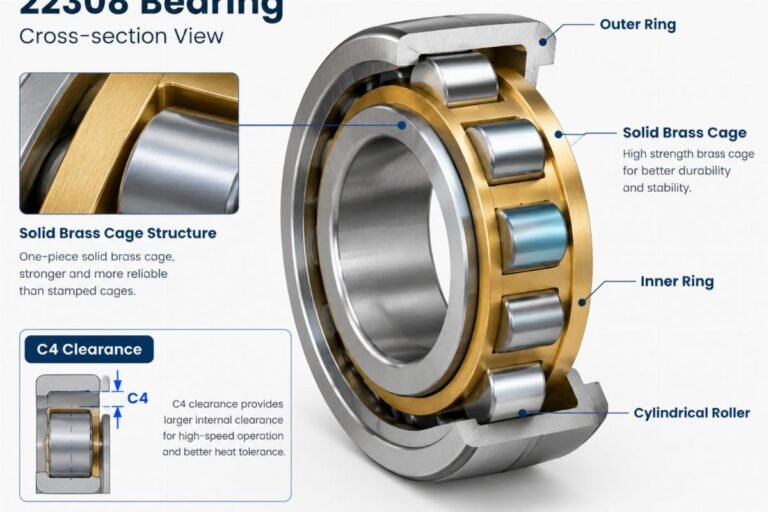


Leave a Reply