NU 310 Bearing Dimensions & Uses: Wholesale Supplier for Sale
Exact dimensions do not guarantee performance.
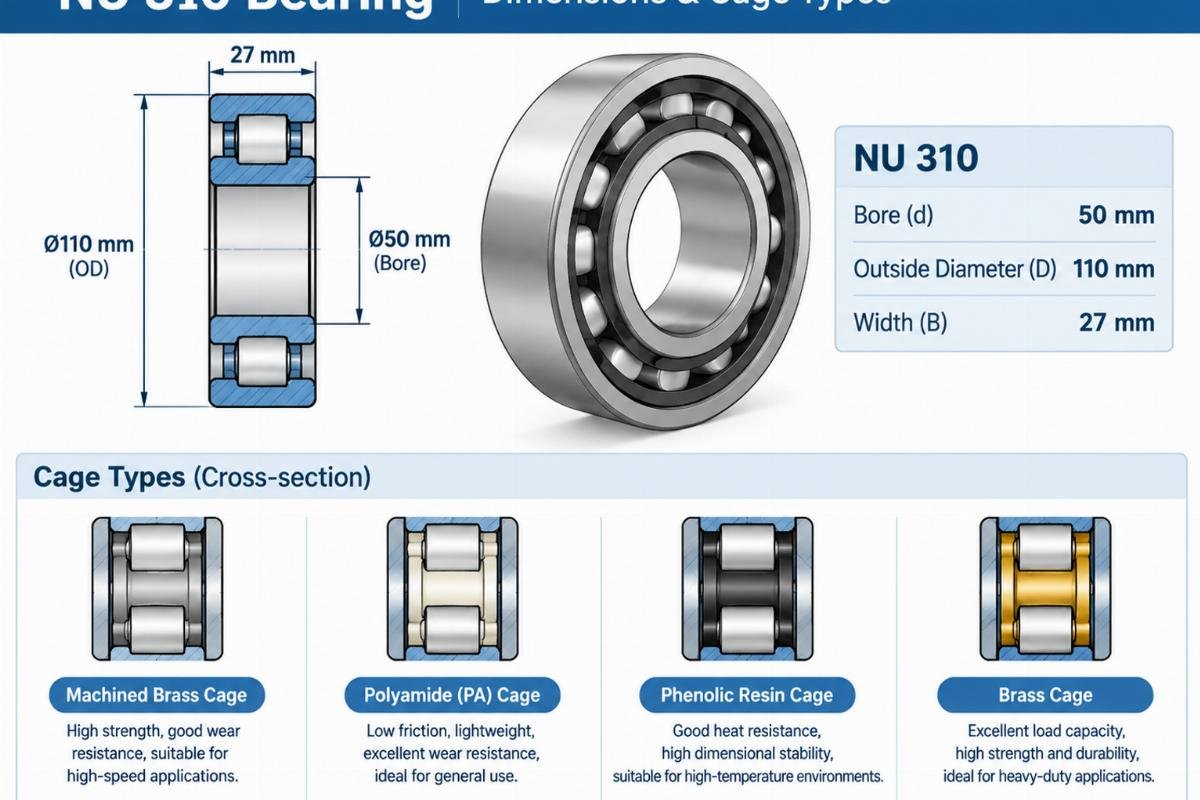
The NU 310 bearing features a 50 mm bore, 110 mm outer diameter, and 27 mm width. These ISO-standardized dimensions ensure interchangeability across major brands, but the critical selection factors are radial internal clearance (C3/C4) and cage material, which determine survival in high-speed or heavy-load applications.
I learned this the hard way in a humid workshop in Suzhou, years before I moved into international trade. We were preparing a shipment of cylindrical roller bearings for a motor manufacturer in Vietnam. The purchase order listed only the part number: NU 310. My team checked the calipers. Inner diameter 50 mm. Outer diameter 110 mm. Width 27 mm. Everything matched the drawing. We shipped the batch with standard clearance and stamped steel cages to save cost.
Three weeks later, the client called. The motors were seizing. The bearings had locked up due to thermal expansion because the standard clearance was insufficient for the operating temperature, and the stamped cages fractured under the high-speed vibration. That return shipment cost us more than the profit from ten successful orders. Since then, I never look at a NU 310 bearing without asking about the speed, temperature, and load profile first. Dimensions are just the entry ticket; the internal geometry is what keeps the machine running [NEED_CITE: ISO 15 dimensional standards for rolling bearings].
Understanding the difference between a drawing fit and an operational fit is what separates a parts supplier from a technical partner. Let’s break down why the NU 310 bearing dimensions are only half the story.
What Are the Exact Dimensions of an NU 310 Bearing?
The NU 310 is a single-row cylindrical roller bearing with non-locating outer ring ribs and double inner ring ribs.
This design allows for axial displacement of the shaft relative to the housing, making it ideal for applications where thermal expansion occurs. The basic dimensions are standardized globally, meaning a NU 310 from one major brand will physically fit into the housing designed for another. However, tolerances matter. While the nominal dimensions are fixed, the actual manufactured size falls within specific tolerance classes defined by international standards [NEED_CITE: ISO 199:2013 Rolling bearing tolerances].
| Dimension Parameter | Value | Tolerance Class (Normal) |
|---|---|---|
| Bore Diameter (d) | 50 mm | Standard P0 |
| Outer Diameter (D) | 110 mm | Standard P0 |
| Width (B) | 27 mm | Standard P0 |
| Chamfer Dimension (r) | Min 2.0 mm | N/A |
For most general industrial applications, standard P0 tolerance is sufficient. But for precision machine tools or high-speed spindles, you might need P6 or P5 precision grades. The key here is that the “NU” designation means the outer ring has no flanges, while the inner ring has two. This structural detail dictates how the bearing handles axial loads. It cannot support any axial load on its own. If your application has even slight axial forces, you must pair the NU 310 with another bearing that can handle thrust, or use an NJ or NUP variant instead.
Many buyers focus solely on the 50x110x27 mm envelope. They assume that if it fits, it works. But fitting is static. Running is dynamic. The internal space within those dimensions is where the real engineering happens. The roller complement, the cage pocket design, and the raceway curvature are all optimized within this fixed envelope. Changing the brand does not change these fundamental geometric constraints, but it can change the quality of the steel and the precision of the grinding [NEED_CITE: ABMA/ISO standards for cylindrical roller bearing design].

How Do NU 310 Dimensions Dictate Load and Speed Limits?
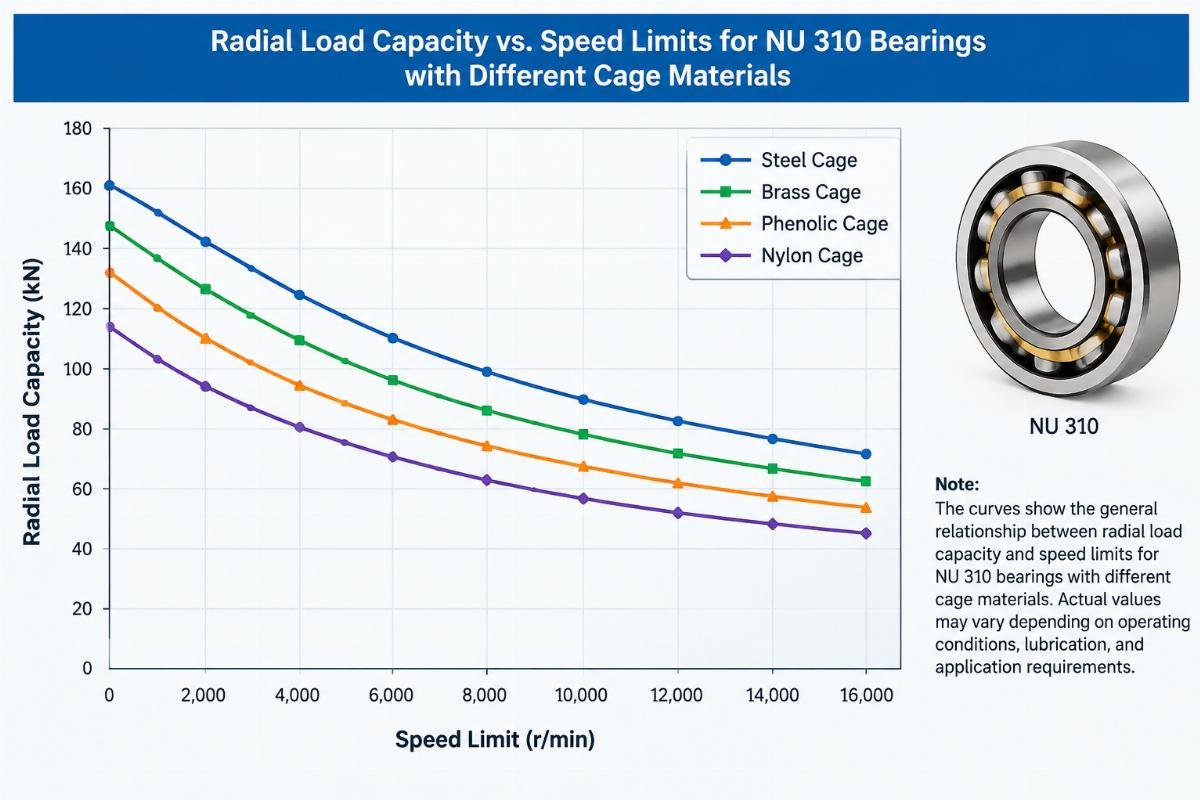
Radial load capacity is determined by the roller contact area, while maximum speed is limited by internal friction and cage stability.
The NU 310 bearing dimensions provide a specific volume for rollers. Larger rollers mean higher radial load capacity. However, this same mass creates inertia. At high speeds, the centrifugal force pushes the rollers against the outer ring, increasing friction and heat generation. This is why a bearing with high static load capacity might fail prematurely in a high-speed application.
The dynamic load rating (Cr) and static load rating (Cor) are calculated based on the geometry defined by the NU 310 dimensions. But these ratings assume ideal conditions: perfect alignment, adequate lubrication, and normal operating temperatures. In the real world, misalignment is common. Cylindrical roller bearings are sensitive to angular misalignment. Even a small deviation can cause edge loading on the rollers, leading to rapid fatigue failure.
Speed limits are not fixed numbers. They depend on the cage type. A stamped steel cage can handle moderate speeds, but a machined brass cage offers better guidance and heat dissipation, allowing for higher rotational speeds. The limiting speed is often defined by the cage material’s ability to withstand centrifugal forces without deforming or fracturing [NEED_CITE: Manufacturer technical catalogs for speed ratings].
Consider a gearbox application. The NU 310 might be selected for its high radial load capacity to support the gear shaft. But if the gearbox operates at high RPMs, the standard cage might become unstable. The solution is not to change the bearing size—the NU 310 dimensions are dictated by the shaft and housing design—but to upgrade the internal components. Switching to a machined brass cage can significantly extend the life of the bearing in high-speed scenarios without changing the external footprint.
Why Do NU 310 Bearings Fail in High-Speed Applications?
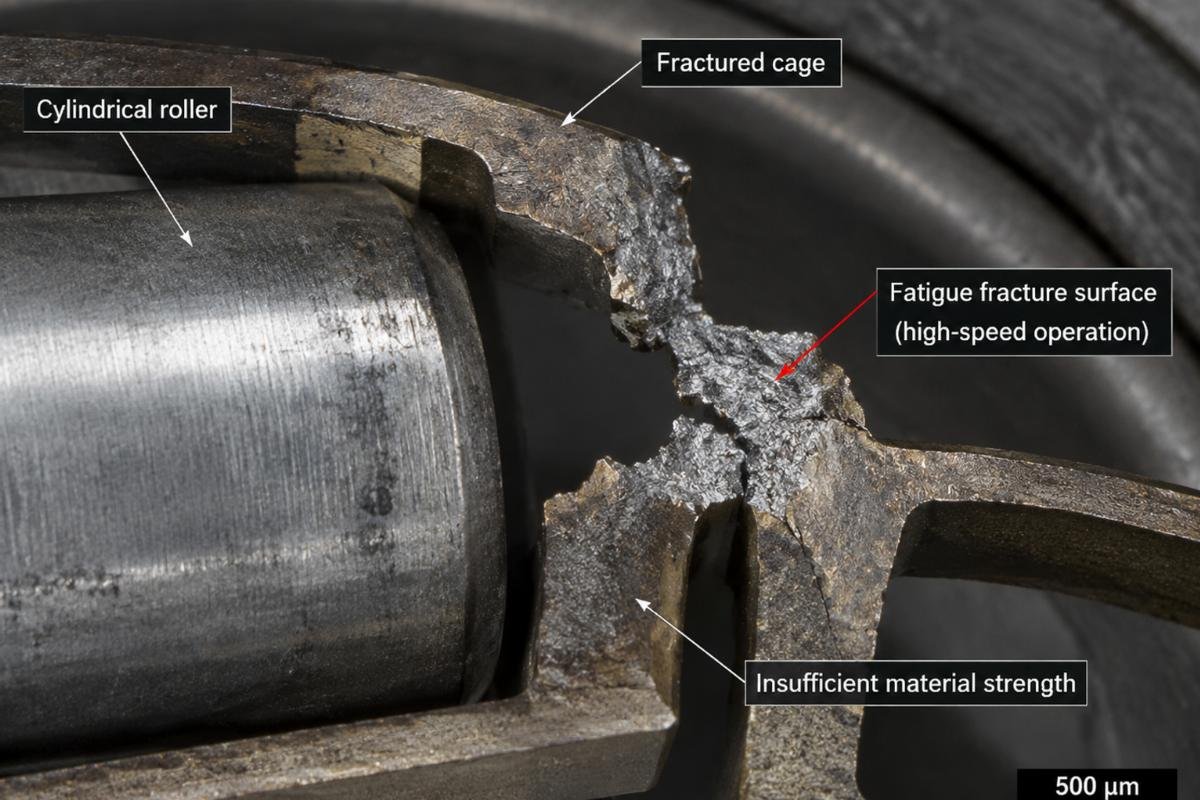
Standard clearance and stamped cages are the primary causes of thermal lock-up and cage fracture in high-speed operations.
I recall a case with a European wind farm operator. They were experiencing frequent failures in the generator bearings. The initial analysis pointed to lubrication issues. But upon closer inspection, we found that the bearings were running with standard internal clearance. As the generator heated up during operation, the inner ring expanded more than the outer ring due to the temperature gradient. This reduced the internal clearance to zero, causing the rollers to bind. The resulting friction generated even more heat, leading to a thermal runaway and eventual seizure.
This is a classic example of why clearance matters more than dimensions. The NU 310 bearing dimensions remain constant, but the internal space changes with temperature. For high-speed or high-temperature applications, C3 or C4 radial internal clearance is essential. These larger clearances accommodate thermal expansion, ensuring that the bearing maintains a functional oil film even when hot [NEED_CITE: ISO 5753-1:2009 Radial internal clearance].
Another common failure mode is cage fracture. Stamped steel cages are cost-effective but have lower strength and poorer heat dissipation compared to machined brass or polyamide cages. In high-speed applications, the cage guides the rollers. If the cage material cannot handle the stress, it will deform or break. Once the cage fails, the rollers lose their spacing, collide with each other, and destroy the bearing in seconds.
The lesson here is that the NU 310 bearing is not a one-size-fits-all solution. The “standard” version is designed for general-purpose use. For demanding applications, you must specify the correct clearance and cage material. Ignoring these details is like buying a sports car and putting regular tires on it. It might look right, but it won’t perform safely.
How to Select the Right NU 310 Variant for Your Application?
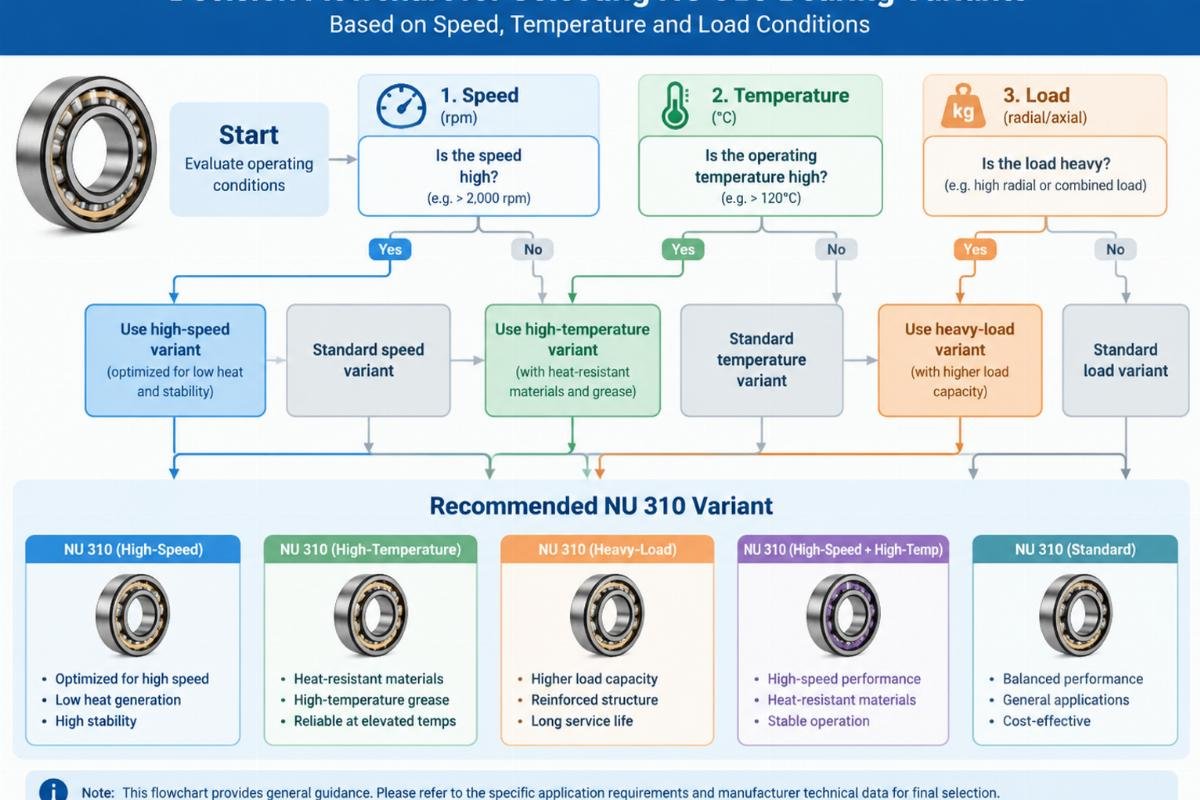
Match the radial internal clearance and cage material to your specific thermal and vibration profiles.
Selecting the right NU 310 variant requires a systematic approach. First, define the operating conditions. What is the speed? What is the load? What is the temperature range? Is there vibration? Once you have these parameters, you can make informed decisions about clearance and cage type.
- Determine Clearance: For normal temperatures and speeds, standard clearance (CN) is usually sufficient. For higher temperatures or speeds, choose C3. For very high temperatures or significant shaft expansion, consider C4. Always consult the manufacturer’s guidelines for specific recommendations based on your operating conditions [NEED_CITE: Technical selection guides for bearing clearance].
- Choose Cage Material: For moderate speeds and costs, stamped steel is acceptable. For higher speeds, better guidance, and improved heat dissipation, select machined brass. For very high speeds or corrosive environments, polyamide or other engineered plastics might be suitable.
- Verify Lubrication: Ensure that the lubricant is compatible with the cage material and operating temperature. Grease life is often the limiting factor in bearing life. Calculate the grease replenishment interval based on speed and temperature.
- Check Housing Fit: The housing fit affects the outer ring expansion. A tight fit can reduce internal clearance. Account for this in your clearance selection.
A Middle East steel mill once faced premature wear in their conveyor rollers. They were using standard NU 310 bearings in a dusty, high-load environment. The dust ingress was accelerating wear, and the standard clearance was not enough to handle the thermal expansion from the heavy loads. We recommended switching to sealed variants with C3 clearance and machined brass cages. The replacement cycle extended noticeably, reducing unplanned downtime and maintenance costs.
This experience highlights the importance of holistic selection. The NU 310 bearing dimensions provide the framework, but the internal details determine the performance. By carefully matching the clearance and cage material to the application, you can maximize the life and reliability of your machinery.
Conclusion
Dimensions fit the shaft; clearance and cage keep it running.
The NU 310 bearing is a robust component for radial load applications, but its success depends on selecting the right internal configuration. Do not rely solely on the 50x110x27 mm dimensions. Consider the operating speed, temperature, and load to choose the appropriate clearance and cage material. This approach ensures reliability and minimizes downtime.

Written by
authorEditor covering global sourcing, supplier verification, and industrial product knowledge. Content is compiled from manufacturer specifications, industry standards, and hands-on experience with international B2B buyers. Every article is fact-checked before publishing to help procurement professionals make informed decisions.
View all posts


Leave a Reply