22211 Bearing Specs, Equivalents & Wholesale Supplier
Identical outer dimensions do not guarantee interchangeability in heavy-duty applications.
A 22211 spherical roller bearing is defined by its specific boundary dimensions, internal clearance class, and cage material composition. Simply matching the bore and outside diameter is insufficient for reliable operation in high-load or high-temperature environments. The correct equivalent must align with the original equipment manufacturer’s specifications for radial internal clearance, typically C3 for industrial machinery, and utilize a cage design capable of withstanding the specific vibration and thermal stresses of the application. Sourcing a true 22211 bearing requires verifying these internal parameters alongside the external metrics to prevent premature failure.

The distinction between a functional replacement and a catastrophic failure often lies in details invisible to the naked eye. I learned this the hard way early in my career, standing in a dusty workshop in Dongguan, watching a batch of bearings that looked perfect on paper fail miserably in the field. A client in the Middle East needed an urgent shipment of replacements for a mining crusher. The dimensional specs matched perfectly, but the internal clearance was standard CN instead of the required C3, and the cage material was not suited for the high-vibration environment. The result was a seized bearing, a stopped production line, and a lesson that has shaped every sourcing decision since. Dimensions are just the entry ticket; performance is determined by what happens inside the housing. [NEED_CITE: ISO 5753 standards for internal clearance]
What Are the Core Specs of a 22211 Bearing?
The baseline for any 22211 spherical roller bearing is established by its standardized boundary dimensions and basic load ratings.
Understanding the fundamental specifications is the first step in identifying a viable equivalent. The 22211 designation follows the ISO 15 standard for boundary dimensions, ensuring that any bearing with this number will physically fit into the same housing and onto the same shaft. However, fit is only one aspect of functionality. The dynamic and static load ratings determine how much stress the bearing can handle before fatigue sets in, while the weight and design influence its suitability for high-speed or heavy-load applications.
| Parameter | Specification Value | Standard Reference |
|---|---|---|
| Bore Diameter | 55 mm | ISO 15 |
| Outside Diameter | 100 mm | ISO 15 |
| Width | 25 mm | ISO 15 |
| Basic Dynamic Load Rating | Varies by brand/design | ISO 281 |
| Basic Static Load Rating | Varies by brand/design | ISO 281 |
| Limiting Speed | Depends on lubrication/cage | Manufacturer Data |
The bore diameter of 55 mm, outside diameter of 100 mm, and width of 25 mm are fixed values for any genuine 22211 bearing. These dimensions are non-negotiable for physical interchangeability. However, the load ratings can vary significantly between manufacturers due to differences in steel quality, heat treatment processes, and internal geometry optimization. [NEED_CITE: ISO 281 methodology for load rating calculation] A buyer focusing solely on dimensions may overlook a critical disparity in load capacity, leading to a bearing that fits but fails under operational stress.
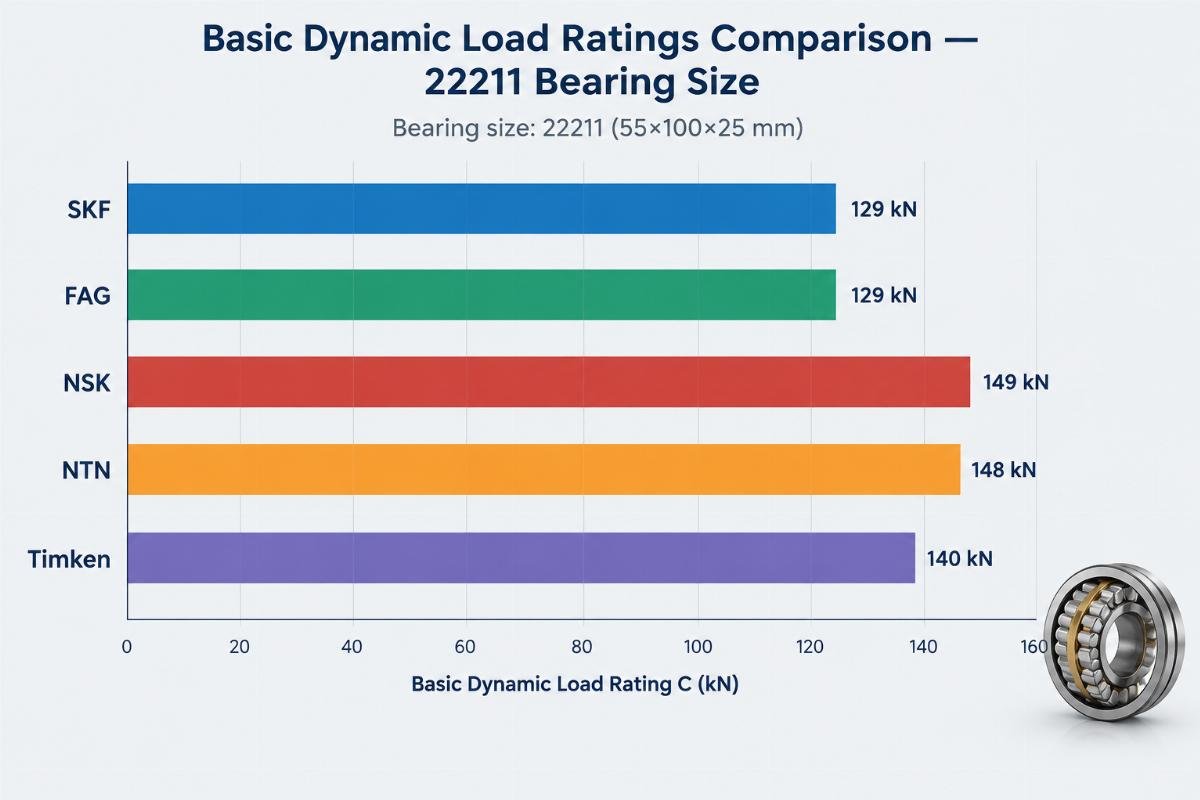
When evaluating a 22211 bearing, it is essential to look beyond the physical size. The internal design, including the profile of the rollers and the curvature of the raceways, plays a crucial role in distributing load and reducing stress concentrations. These design elements are proprietary to each manufacturer and contribute to the overall performance and longevity of the bearing. Therefore, while the external dimensions provide a common language, the internal engineering defines the bearing’s capability.
How Do Global Brand Equivalents Compare?
Cross-referencing 22211 equivalents requires analyzing suffix codes that denote cage material, clearance, and internal design variations.
Global bearing manufacturers use specific suffixes to indicate variations in their standard designs. For a 22211 bearing, these suffixes are critical for identifying the correct equivalent. SKF, FAG, NSK, and other premium brands have their own coding systems, but they generally align with international standards for clearance and cage types. Misinterpreting these suffixes can lead to selecting a bearing that is physically compatible but functionally inadequate for the application.
| Brand | Common Suffix for C3 Clearance | Common Suffix for Brass Cage | Common Suffix for Steel Cage |
|---|---|---|---|
| SKF | C3 | M | J or No Suffix |
| FAG | C3 | M | TVH or No Suffix |
| NSK | C3 | M | Y or No Suffix |
| ZWZ | C3 | M | T or No Suffix |
The table above illustrates the general correspondence of suffixes across major brands. For instance, a “C3” suffix universally indicates a radial internal clearance greater than normal, which is essential for applications involving high temperatures or significant shaft expansion. [NEED_CITE: ISO 5753 internal clearance classes] Similarly, the cage material suffix denotes whether the bearing uses a brass or steel cage, which impacts its performance under vibration and high-speed conditions.
A European wind farm operator once faced repeated failures in their gearbox main shafts. They were replacing bearings based solely on the part number 22211, ignoring the suffixes. The original equipment specified a C3 clearance with a brass cage for better damping properties. The replacements they sourced had standard clearance and steel cages. While the bearings fit, the lack of adequate clearance led to overheating, and the steel cages failed under the cyclic loading. Switching to the correct suffix equivalents resolved the issue, highlighting the importance of detailed cross-referencing.
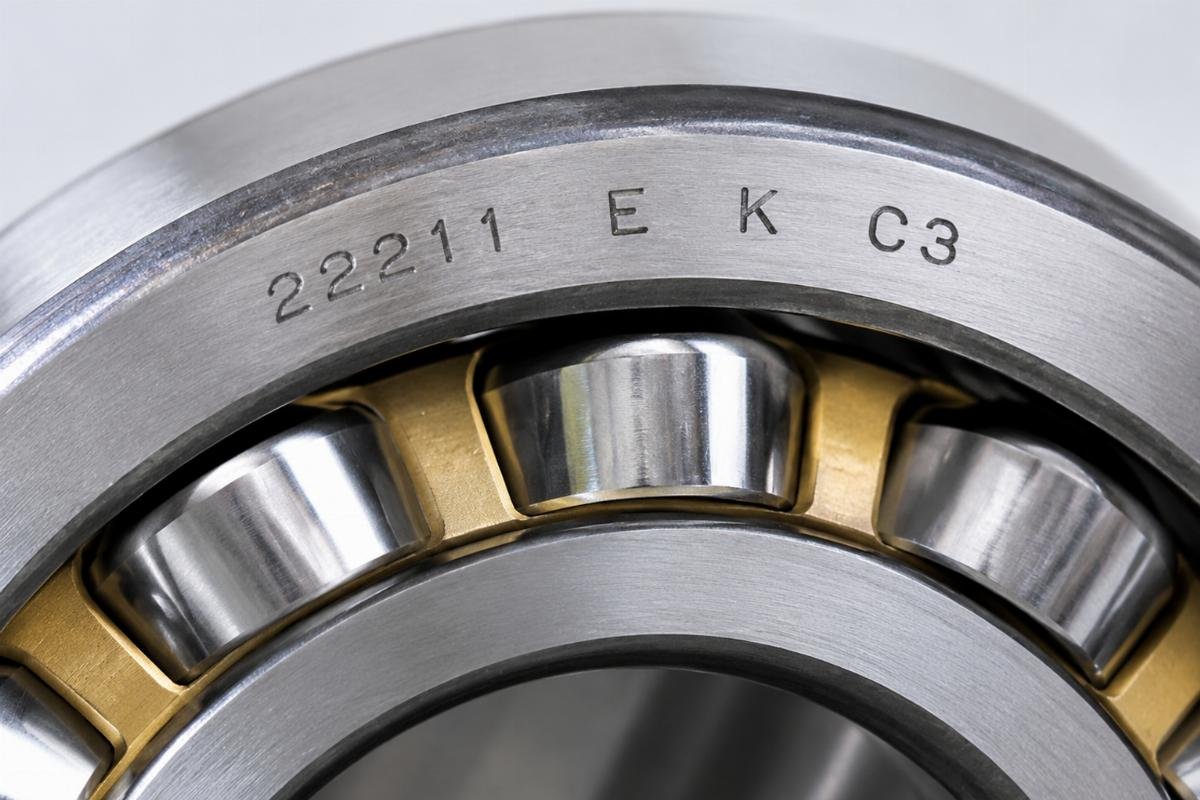
When sourcing a 22211 bearing from different brands, it is crucial to map the suffixes accurately. A direct cross-reference should not only match the dimensions but also ensure that the internal clearance and cage material are equivalent or superior to the original specification. This level of detail ensures that the replacement bearing will perform as intended in the specific operating environment.
Why Internal Clearance and Cage Material Matter in Equivalents?
Internal clearance and cage design are the primary determinants of a 22211 bearing’s lifespan in heavy-duty and high-temperature applications.
The choice between standard (CN) and increased (C3, C4) internal clearance is not arbitrary. In applications where the bearing operates at elevated temperatures, such as in steel mills or mining crushers, the inner ring expands more than the outer ring due to heat transfer from the shaft. If the internal clearance is insufficient, this thermal expansion can eliminate the running clearance, leading to excessive preload, overheating, and eventual seizure. [NEED_CITE: Thermal expansion effects on bearing clearance] Therefore, C3 clearance is often the mandatory baseline for industrial equivalents, providing the necessary space for thermal growth.
Cage material is equally critical. Brass cages offer good damping properties and are resistant to wear, making them suitable for applications with moderate speeds and vibration. Steel cages, on the other hand, are stronger and can handle higher speeds and heavier loads but may be more susceptible to fatigue in high-vibration environments. The choice between brass and steel depends on the specific operational stresses the bearing will encounter.
I recall a case involving a cement plant in Southeast Asia. They were experiencing frequent bearing failures in their kiln drive units. The original bearings had brass cages, but the replacements they sourced had steel cages to cut costs. The high vibration levels in the kiln environment caused the steel cages to fracture prematurely. Switching back to brass cages, or even upgrading to reinforced polymer cages where applicable, extended the service life significantly. This experience underscores that material selection is not just about cost but about matching the component to the operational reality.

When selecting a 22211 equivalent, it is essential to consider the operating temperature and vibration levels. For high-temperature applications, prioritize C3 or C4 clearance. For high-vibration environments, evaluate the cage material carefully, opting for brass or specialized polymer cages if the original design specified them. Ignoring these factors can lead to costly downtime and repeated replacements.
How to Verify and Source Genuine 22211 Equivalents?
Verifying the authenticity and specifications of a 22211 bearing requires rigorous documentation checks and technical validation.
Sourcing genuine bearings from a mixed-brand supplier involves more than just trusting the part number. It requires a systematic approach to verification. Start by requesting full traceability documentation, including material certificates and inspection reports. These documents should confirm the bearing’s origin, manufacturing date, and compliance with relevant standards. [NEED_CITE: Importance of traceability in bearing supply chain]
Next, perform a visual and dimensional inspection. Check the marking on the bearing for clarity and accuracy. Measure the bore, outside diameter, and width to ensure they conform to ISO 15 standards. Inspect the cage for any signs of damage or irregularities. If possible, measure the internal clearance using feeler gauges or dial indicators to verify it matches the specified class (e.g., C3).
A US buyer once procured a large batch of 22211 bearings for a mining project. The supplier provided all the necessary documentation, but upon arrival, the buyer noticed slight inconsistencies in the marking font. A deeper investigation revealed that the bearings were counterfeit, with substandard steel and incorrect internal clearance. This incident highlights the importance of sourcing from reputable suppliers who prioritize authenticity and provide verifiable documentation.

To avoid such pitfalls, work with suppliers who offer technical selection support and have a proven track record in supplying genuine multi-brand bearings. They should be able to provide detailed cross-reference information and assist in verifying the specifications of the bearings you need. This level of support ensures that you receive components that meet your technical requirements and operational demands.
Conclusion
Selecting the right 22211 bearing equivalent demands a focus on internal specifications, not just external dimensions.
Success in heavy-duty applications relies on matching internal clearance, cage material, and load ratings to the specific operational environment. Relying solely on dimensional compatibility invites failure. Prioritize verified documentation and technical alignment to ensure reliability and longevity in your machinery.

Written by
authorEditor covering global sourcing, supplier verification, and industrial product knowledge. Content is compiled from manufacturer specifications, industry standards, and hands-on experience with international B2B buyers. Every article is fact-checked before publishing to help procurement professionals make informed decisions.
View all posts


Leave a Reply