Bobcat Skid Steer Bearing Equivalents Wholesale Supplier
Same dimensions do not guarantee the same performance.
Selecting reliable Bobcat skid steer bearing equivalents requires matching dynamic load capacity, sealing integrity, and cage material thermal resistance to specific harsh operating conditions, rather than simply copying OEM part numbers. Premature failure in heavy equipment often stems from internal geometric mismatches and inadequate dust exclusion, not just dimensional variance.
I learned this lesson the hard way during my early days in Qingdao, sourcing drive axle bearings for a fleet of compact loaders. I focused strictly on the outer diameter and price, ignoring the high-temperature requirements of the chain box environment. Within two months, the cages in those bearings shattered under thermal stress, locking up the drive chains and causing significant downtime. That incident shifted my entire approach to cross-brand substitution. Now, when I consult on Bobcat skid steer bearing equivalents, I look beyond the drawing board to understand the actual mud, heat, and shock loads the component will endure.

This guide breaks down the technical nuances of selecting true equivalents, helping MRO operators and distributors avoid costly mistakes by focusing on engineering specifications rather than just part number matches.
Why Dimensional Matching Isn’t Enough for Bobcat Loaders?
Internal geometry and cage materials dictate actual lifespan in heavy loads, not just the outer ring diameter.
Many buyers assume that if a bearing fits the housing, it will perform like the original. This is a dangerous misconception in heavy equipment applications. The internal clearance, raceway curvature, and cage design are critical factors that determine how a bearing handles misalignment and shock loads typical in skid steer operations. [NEED_CITE: impact of internal clearance on bearing life in oscillating motions]
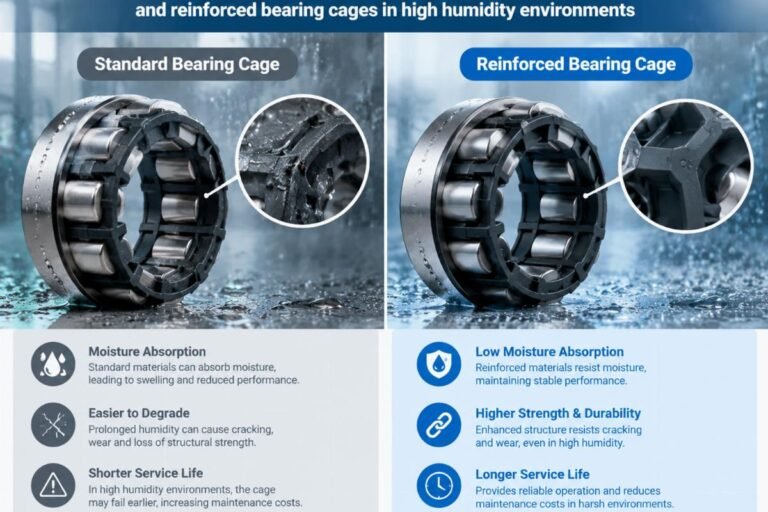
For instance, standard deep-groove ball bearings might fit a wheel hub, but they lack the angular contact capability needed to handle the combined radial and axial loads generated during tight turns on uneven terrain. A true equivalent must replicate the OEM’s load distribution profile. Furthermore, the cage material is vital. In high-friction areas like the drive chain box, temperatures can rise significantly. Standard steel cages may soften or fracture, whereas machined brass or polymer cages offer better thermal stability and lubrication retention.
When evaluating Bobcat skid steer bearing equivalents, always verify the internal clearance class. A C3 clearance might be suitable for high-speed applications, but a standard clearance could be optimal for slower, high-load scenarios to prevent excessive play. Ignoring these internal specs leads to premature wear, even if the external dimensions are perfect.

Critical Equivalents: Wheel, Drive Chain, and Boom Bearings
A specification comparison reveals why generic replacements often fail in specific Bobcat loader zones.
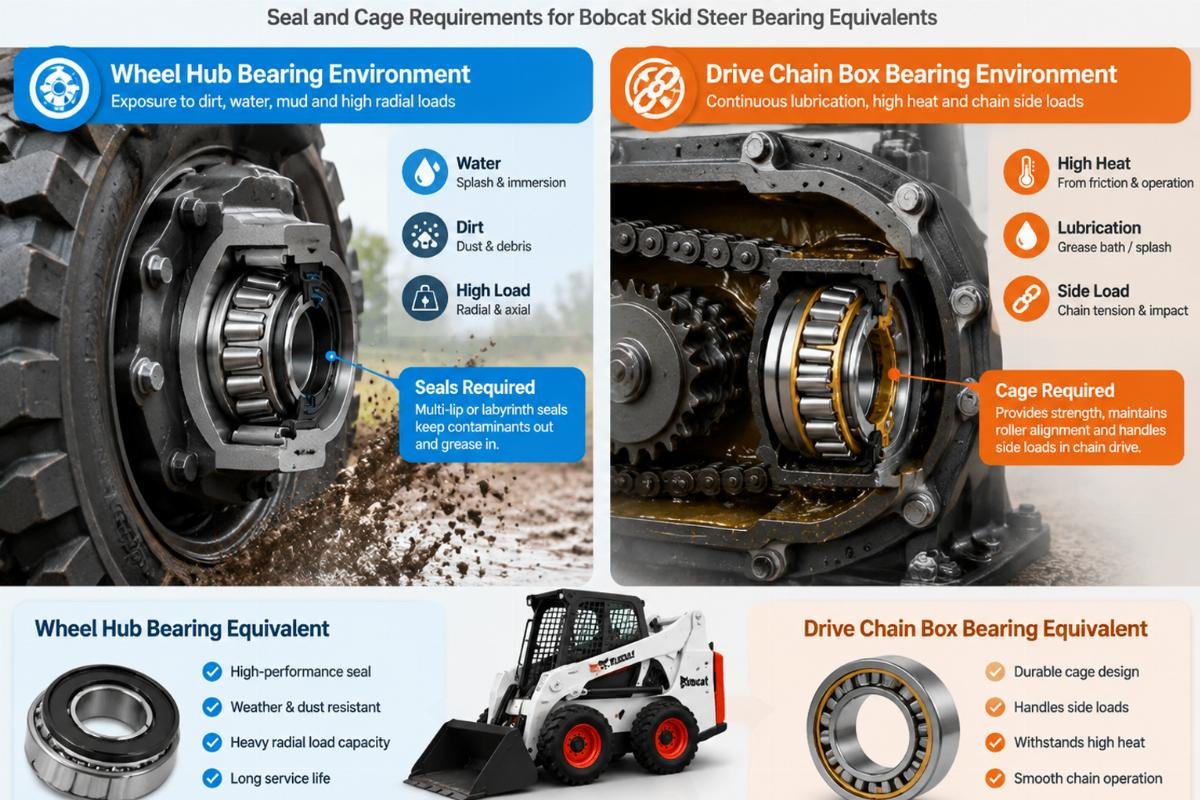
Different positions on a skid steer loader impose unique stresses. A one-size-fits-all approach to replacement bearings ignores these distinct operational demands. Below is a matrix comparing typical OEM requirements against premium cross-brand alternatives from manufacturers like SKF, FAG, and NTN, focusing on the critical attributes for each application zone.
| Application Zone | Primary Stress Factor | Critical Seal Requirement | Cage Material Preference | Equivalent Selection Focus |
|---|---|---|---|---|
| Wheel Hub | Radial load + Shock | High dust/water ingress protection (Labyrinth) | Steel or Polymer | Dynamic load rating & seal lip design |
| Drive Chain Box | High temperature + Friction | Minimal sealing (open or light shield) | Machined Brass or Polyamide | Thermal resistance & lubrication retention |
| Boom Pivot | Oscillating motion + Misalignment | Heavy-duty rubber seals | Steel | Static load capacity & self-alignment |
In a recent case involving a quarry operator in the Middle East, wheel bearings were failing repeatedly due to dust ingress. The initial replacements matched the OEM dimensions but used simple contact seals. By switching to Bobcat skid steer bearing equivalents with labyrinth-style sealing and higher-grade grease compatibility, the failure rate dropped noticeably. [NEED_CITE: sealing efficiency ratings for heavy equipment bearings]
The drive chain box presents a different challenge. Here, the bearing is submerged in oil and subjected to high heat. Using a bearing with a standard steel cage can lead to catastrophic failure as the material loses strength. Premium equivalents often use machined brass cages that withstand higher temperatures and provide better guidance under heavy loads. Understanding these distinctions is key to selecting the right Bobcat skid steer bearing equivalents for each specific location on the machine.
How to Verify Cross-Brand Bearing Authenticity?
Traceability documentation and packaging integrity are the only reliable defenses against counterfeit parts.
The market for heavy equipment spare parts is flooded with counterfeits that look identical to genuine products but fail under minimal load. For distributors and MRO operators, verifying the authenticity of Bobcat skid steer bearing equivalents is crucial to maintaining reputation and minimizing liability.
Authenticity verification starts with the supply chain. Reputable suppliers provide full traceability documentation, including mill certificates for steel batches and factory inspection reports. These documents should link the specific bearing batch to its production origin. Without this paper trail, the risk of receiving substandard products increases significantly. [NEED_CITE: industry standards for bearing traceability and quality assurance]
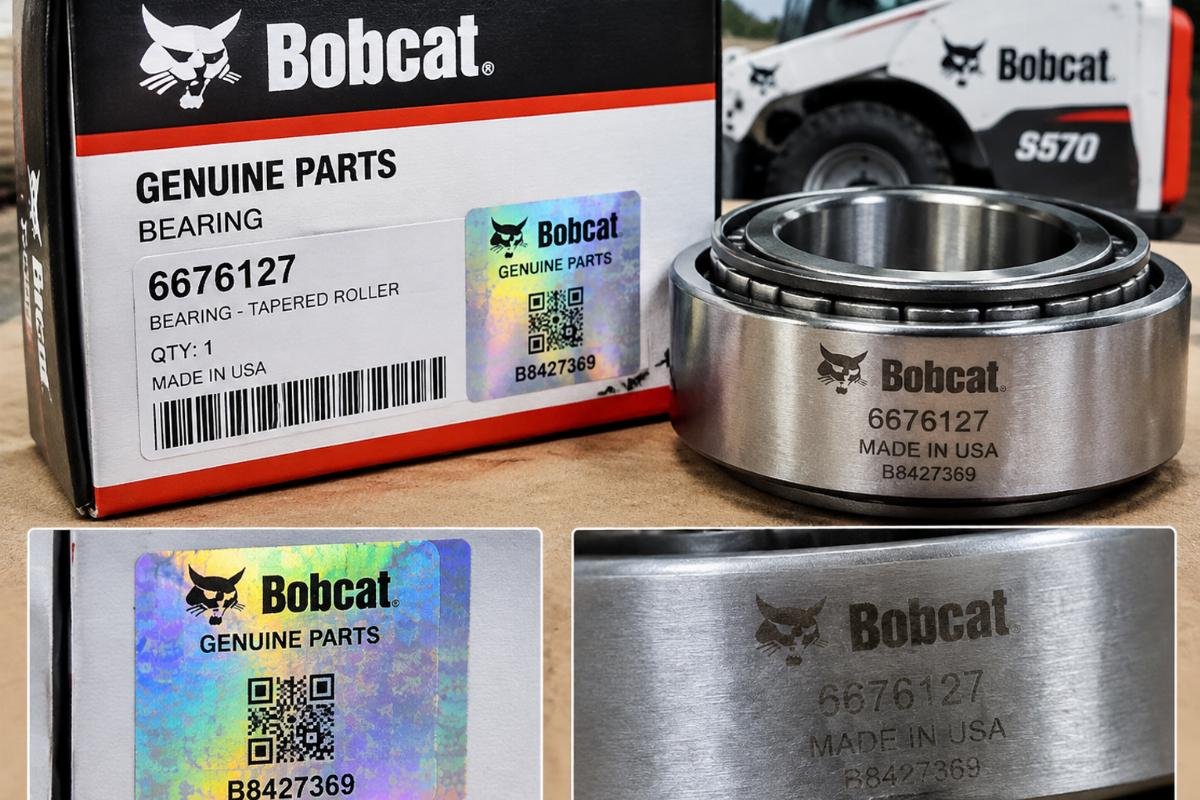
Physical inspection also plays a role. Genuine bearings from brands like SKF, FAG, or NTN exhibit precise machining marks, consistent laser etching, and high-quality packaging with security features. Counterfeit units often have rough edges, inconsistent font styles on the rings, or flimsy packaging. However, visual checks alone are insufficient. The most reliable method is sourcing from authorized distributors who maintain direct relationships with manufacturers.
When procuring Bobcat skid steer bearing equivalents, request sample units for detailed inspection before committing to bulk orders. Check the rotational smoothness, noise levels, and seal flexibility. A genuine bearing will rotate silently and smoothly, while a counterfeit may feel gritty or stiff. This hands-on verification, combined with documented traceability, ensures that the equivalents you source meet the rigorous demands of heavy equipment operation.
Sourcing Strategy: Single Parts vs. Mixed Container Consolidation
Balancing urgent MRO needs with bulk procurement costs requires flexible consolidation services.
MRO operators often face a dilemma: pay premium prices for single emergency parts or wait weeks for bulk shipments. For regional distributors serving multiple clients, this challenge is amplified. The solution lies in strategic sourcing that combines urgent spot buys with consolidated container shipments.
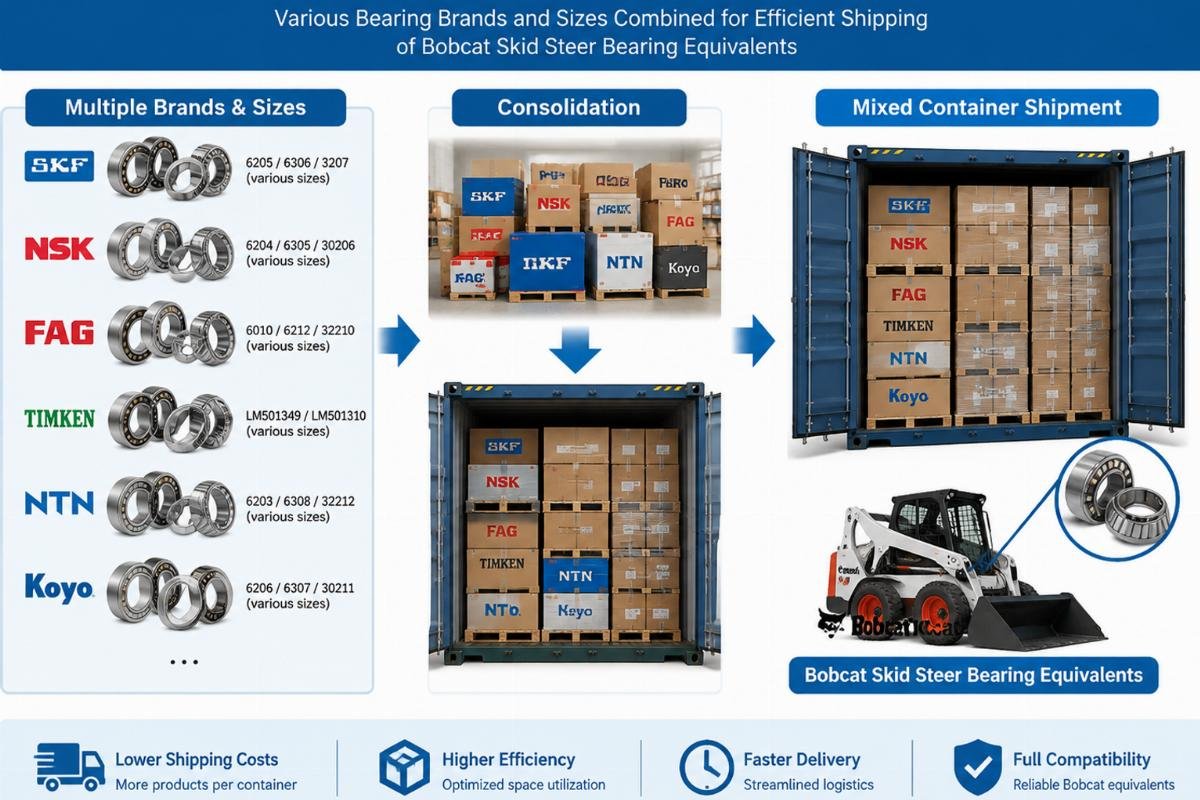
Sourcing Bobcat skid steer bearing equivalents through a supplier that offers mixed-batch consolidation allows buyers to combine various brands and sizes into a single container. This approach reduces shipping costs per unit and simplifies customs clearance. It also enables distributors to maintain a diverse inventory without tying up capital in large single-SKU orders. [NEED_CITE: cost benefits of LCL vs FCL shipping for industrial spare parts]
For example, a distributor in Southeast Asia might need a few urgent wheel bearings for a local mine while simultaneously stocking up on drive chain bearings for the upcoming season. By consolidating these items into one shipment, they reduce lead times for the urgent items and lower the overall landed cost for the stock items. This flexibility is essential for maintaining service levels in regions where logistics can be unpredictable.
Moreover, working with a supplier that provides technical consultation helps optimize these mixed orders. Instead of guessing quantities, buyers can rely on usage data and failure analysis to forecast demand more accurately. This data-driven approach minimizes overstocking and ensures that critical Bobcat skid steer bearing equivalents are available when needed, reducing unplanned downtime for end-users.
Conclusion
Selecting the right equivalent is an engineering decision, not just a purchasing transaction.
Successful replacement of Bobcat skid steer bearings depends on understanding the specific mechanical stresses of each application zone, verifying authenticity through traceable supply chains, and optimizing procurement through flexible consolidation. By focusing on internal geometry, sealing technology, and material science, operators can achieve reliability that matches or exceeds OEM performance. Trusting verified Bobcat skid steer bearing equivalents from reputable sources ensures longevity and reduces total cost of ownership in demanding heavy equipment environments.

Written by
authorEditor covering global sourcing, supplier verification, and industrial product knowledge. Content is compiled from manufacturer specifications, industry standards, and hands-on experience with international B2B buyers. Every article is fact-checked before publishing to help procurement professionals make informed decisions.
View all posts
Leave a Reply