Clearance Suffix Table by Brand: Wholesale Supplier Guide
C3 does not mean the same thing across every manufacturer.
Assuming that a C3 clearance suffix from one brand is mechanically identical to a C3 from another is a critical error that leads to thermal seizure and unplanned downtime. To ensure correct internal clearance selection, buyers must consult a specific Clearance Suffix Table by Brand to map letter codes to actual micrometer tolerance bands rather than relying on universal assumptions.
I learned this lesson the hard way in a humid warehouse in Jakarta. A client in Sumatra needed spherical roller bearings for a coal conveyor system. The original equipment specification called for SKF C3 clearance. Without verifying the cross-reference, I sourced FAG bearings marked with the same C3 suffix, assuming interchangeability. The result was catastrophic. The FAG C3 tolerance band differed slightly but significantly from the SKF standard under high thermal load. The bearings seized within days, halting the entire production line for two days. That incident forced me to stop treating clearance suffixes as generic labels and start treating them as precise engineering data points unique to each manufacturer. [NEED_CITE: ISO 5753 internal clearance measurement standards]
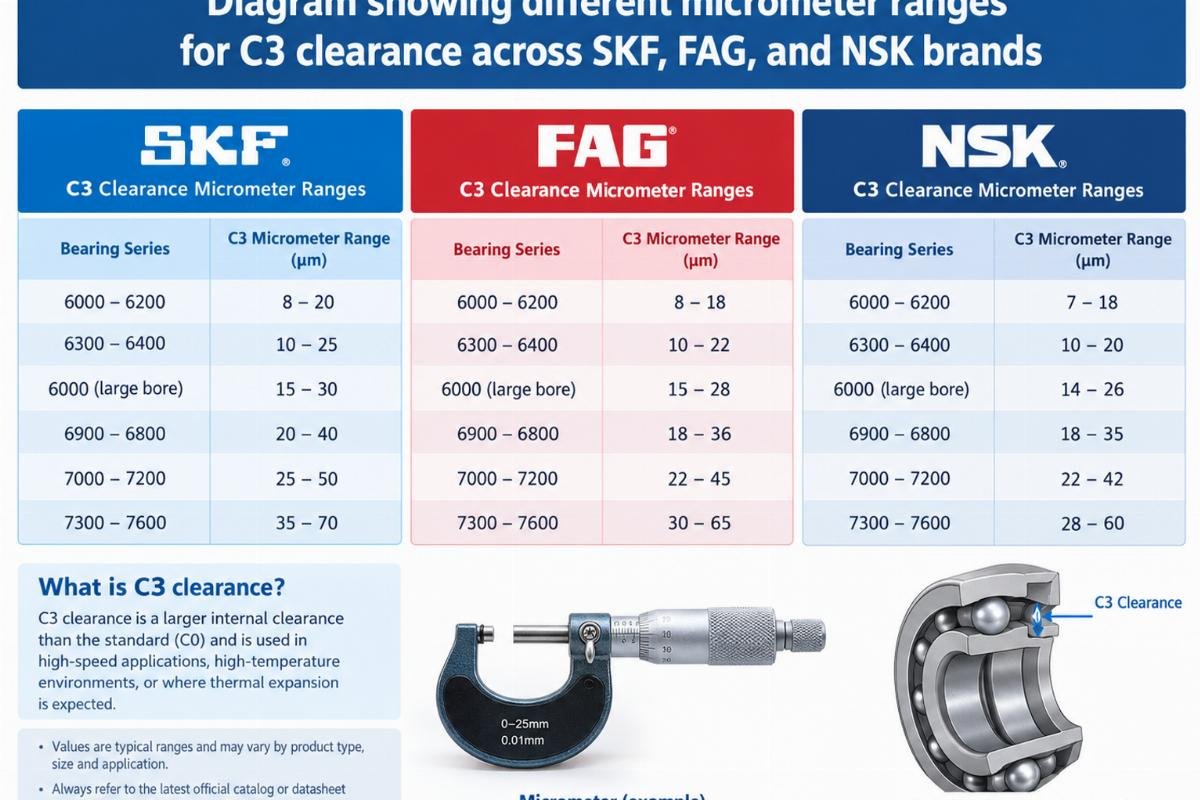
This guide breaks down why these differences exist and how to use a Clearance Suffix Table by Brand to protect your inventory and your clients’ operations.
Why Do Clearance Suffixes Differ Across Brands?
Suffixes represent internal tolerance bands, which vary by manufacturer’s specific manufacturing standards.
The letter codes like C2, C3, C4, and C5 are not defined by a single global law that forces every factory to produce the exact same gap between the rolling elements and the raceways. Instead, they are guided by international standards such as ISO 5753, but each major manufacturer interprets and applies these standards within their own production tolerances. [NEED_CITE: ABMA/AFBMA guidelines on bearing internal clearance]
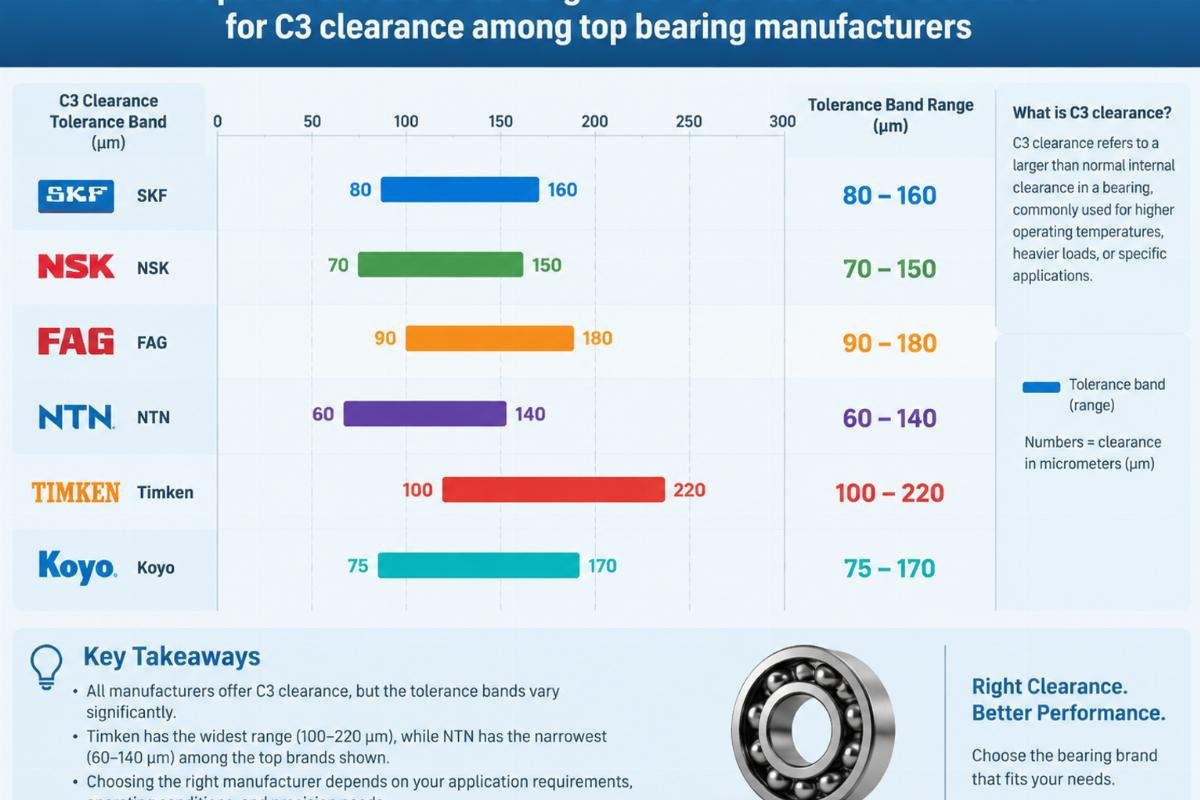
For instance, while all major brands adhere to the general concept that C3 is greater than normal (CN) clearance, the upper and lower limits in micrometers can shift depending on the bearing type, size series, and the brand’s specific quality control protocols. A C3 in a small deep-groove ball bearing has a different absolute value than a C3 in a large spherical roller bearing. Furthermore, Brand A might position its C3 range closer to the lower limit of the ISO standard, while Brand B positions it near the upper limit.
When sourcing mixed-brand bearings for heavy machinery, ignoring these nuances creates risk. If a machine is designed with tight housing fits that rely on the specific expansion characteristics of a Brand A C3 bearing, substituting it with a Brand B C3 that sits at the opposite end of the tolerance spectrum can lead to either excessive play or premature binding. This is why a Clearance Suffix Table by Brand is essential for technical accuracy. It translates the marketing suffix into engineering reality.
How to Read a Cross-Brand Clearance Suffix Table?
Map the suffix to the actual micrometer range rather than relying on the letter alone.
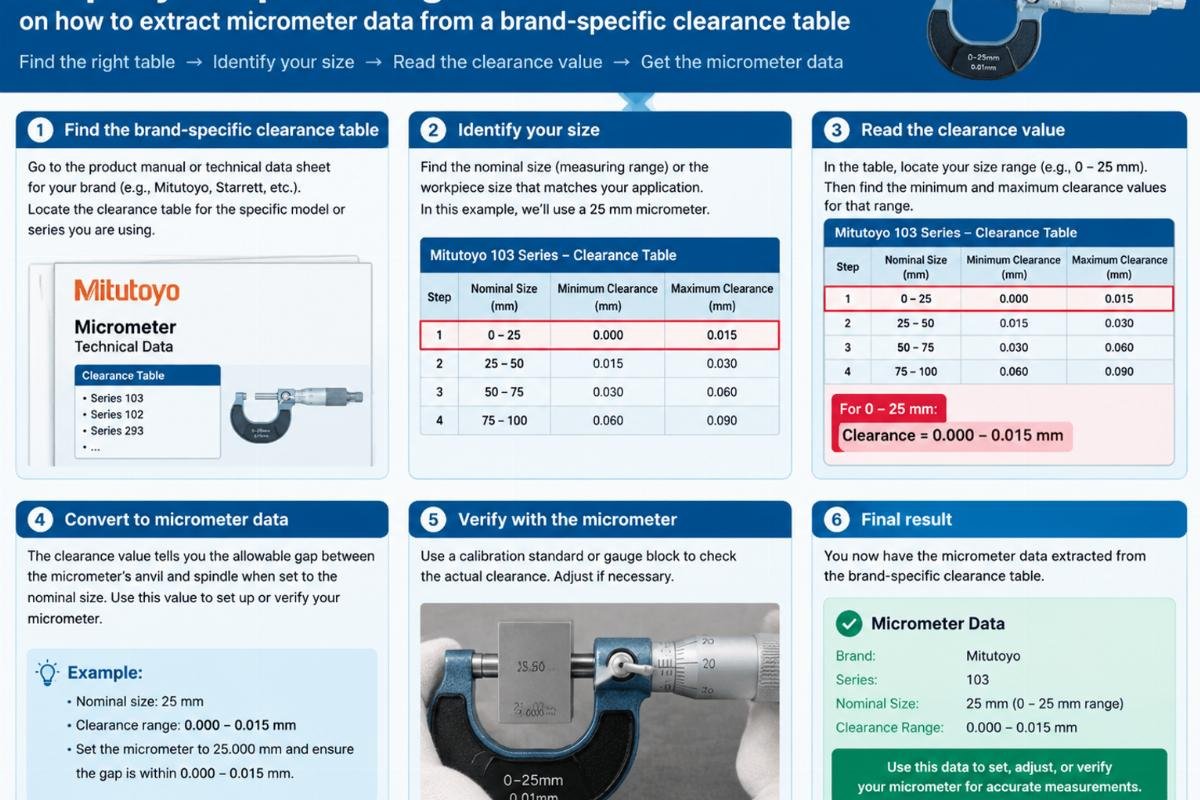
Reading a Clearance Suffix Table by Brand requires shifting focus from the alphanumeric code to the numerical data behind it. The table typically lists bearing bore diameters and outside diameters alongside the corresponding clearance ranges in micrometers for each brand.
To use this tool effectively, follow these steps:
- Identify the exact bearing type and size series. Clearance values change drastically between a 6205 deep-groove ball bearing and a 22210 spherical roller bearing.
- Locate the desired suffix (e.g., C3) in the column for the original specified brand. Note the minimum and maximum micrometer values.
- Compare these values against the column for the alternative brand you intend to source.
- Check if the alternative brand’s range overlaps sufficiently with the original specification. If the alternative brand’s C3 range is entirely higher or lower, it may not be a safe substitute without adjusting the shaft or housing fit.
[NEED_CITE: Manufacturer technical catalogs for specific clearance data]
A common mistake is looking only at the average value. In high-precision applications, the spread of the tolerance band matters more than the midpoint. A wider band might introduce variability in performance across a batch of bearings. By using a Clearance Suffix Table by Brand, procurement teams can verify that the substitute bearing falls within the acceptable engineering envelope of the original design.
What Happens When You Mix Up Clearances in Heavy Machinery?
Incorrect clearances lead to thermal seizure, lubrication failure, and unplanned downtime.
The consequences of ignoring brand-specific clearance differences are most visible in harsh industrial environments. Consider the case of high-temperature mining crushers. These machines generate significant heat during operation, causing the shaft and inner ring to expand. Engineers specify C4 or C5 clearance to accommodate this thermal expansion.
If a buyer substitutes a standard CN clearance bearing because they misinterpreted the suffix or ignored the Clearance Suffix Table by Brand, the bearing will not have enough room to expand. As the temperature rises, the internal clearance disappears completely. The rolling elements press against the raceways with immense force, generating even more heat. This positive feedback loop leads to rapid thermal lock-up. The lubricant breaks down, metal welds together, and the bearing fails catastrophically.
In another scenario involving mixed-batch container consolidation, MRO clients often receive bearings from multiple sources. Without proper verification, a batch labeled C3 might contain units from different brands with varying actual clearances. This inconsistency causes uneven load distribution in multi-bearing arrangements. Some bearings carry too much load while others spin freely, leading to premature fatigue and failure. [NEED_CITE: Root cause analysis of bearing failures in heavy industry]
Using a Clearance Suffix Table by Brand prevents these scenarios by ensuring that every unit installed meets the specific thermal and mechanical requirements of the application. It transforms a guessing game into a verified engineering decision.

How to Verify Clearance During Mixed-Brand Sourcing?
Always request original mill certificates and measure spot batches before final assembly.
Sourcing from multiple brands offers cost and availability advantages, but it introduces complexity. To manage this, buyers must implement strict verification protocols. Relying solely on the box label is insufficient.
First, demand original mill certificates or test reports from the supplier. These documents should specify the actual measured clearance values for the batch, not just the suffix. Reputable suppliers maintain traceability documentation that links each bearing to its production data. [NEED_CITE: ISO 9001 quality assurance requirements for bearing supply chains]
Second, perform spot checks on incoming goods. Use feeler gauges or specialized clearance measurement tools to verify a sample of bearings from each brand. Compare these measurements against the values in your Clearance Suffix Table by Brand. If the measured values fall outside the expected range for that brand’s suffix, quarantine the batch and investigate further.
Third, leverage technical consultation. When switching brands, consult with engineers who understand the specific tolerance profiles of each manufacturer. They can advise on whether a direct suffix swap is safe or if adjustments to the housing or shaft fits are necessary.
By combining documentation review, physical inspection, and expert guidance, buyers can ensure that mixed-brand sourcing does not compromise equipment reliability. The goal is to achieve consistent performance regardless of the brand logo on the box.

Conclusion
Bearing clearance is a precise engineering parameter, not a generic label.
Treating clearance suffixes as universal codes invites failure. Each manufacturer operates within its own tolerance bands, making a Clearance Suffix Table by Brand an indispensable tool for anyone sourcing industrial bearings. By mapping suffixes to actual micrometer values, verifying batch documentation, and understanding the thermal implications of clearance choices, buyers can prevent costly downtime and ensure the longevity of heavy machinery. Accurate cross-referencing is the key to reliable mixed-brand procurement.

Written by
authorEditor covering global sourcing, supplier verification, and industrial product knowledge. Content is compiled from manufacturer specifications, industry standards, and hands-on experience with international B2B buyers. Every article is fact-checked before publishing to help procurement professionals make informed decisions.
View all posts


Leave a Reply