FAG C3 TVH MA E1 Suffix Decoder & Equivalent Bearing Supplier
Identical outer dimensions do not guarantee interchangeability.
To replace an FAG bearing correctly, you must match the suffix codes for internal clearance (C3), cage material (TVH/MA), and internal design (E1) exactly. Ignoring these suffixes leads to thermal seizure or cage fracture, even if the brand changes to SKF, NSK, or NTN. Use this guide to decode FAG suffixes and source verified equivalents that prevent equipment failure.
I still remember the smell of burnt oil in a Qingdao cement plant. A high-temperature fan had seized after only two months of operation. The maintenance team swore they used the “exact same” FAG bearing. They were right about the part number, but wrong about the suffix. They had installed a standard clearance bearing instead of one with C3 radial internal clearance. The heat expansion locked the rolling elements, destroying the shaft. That failure cost the plant far more than the price difference between a standard and a C3 bearing. Since then, I have made it my practice to decode every letter after the basic model number. For industrial buyers, understanding FAG C3 TVH MA E1 suffixes is not just technical trivia; it is the difference between a reliable repair and a catastrophic breakdown. When sourcing from an FAG C3 TVH MA E1 Suffix Decoder & Equivalent Bearing Supplier, precision in these details ensures true interchangeability.
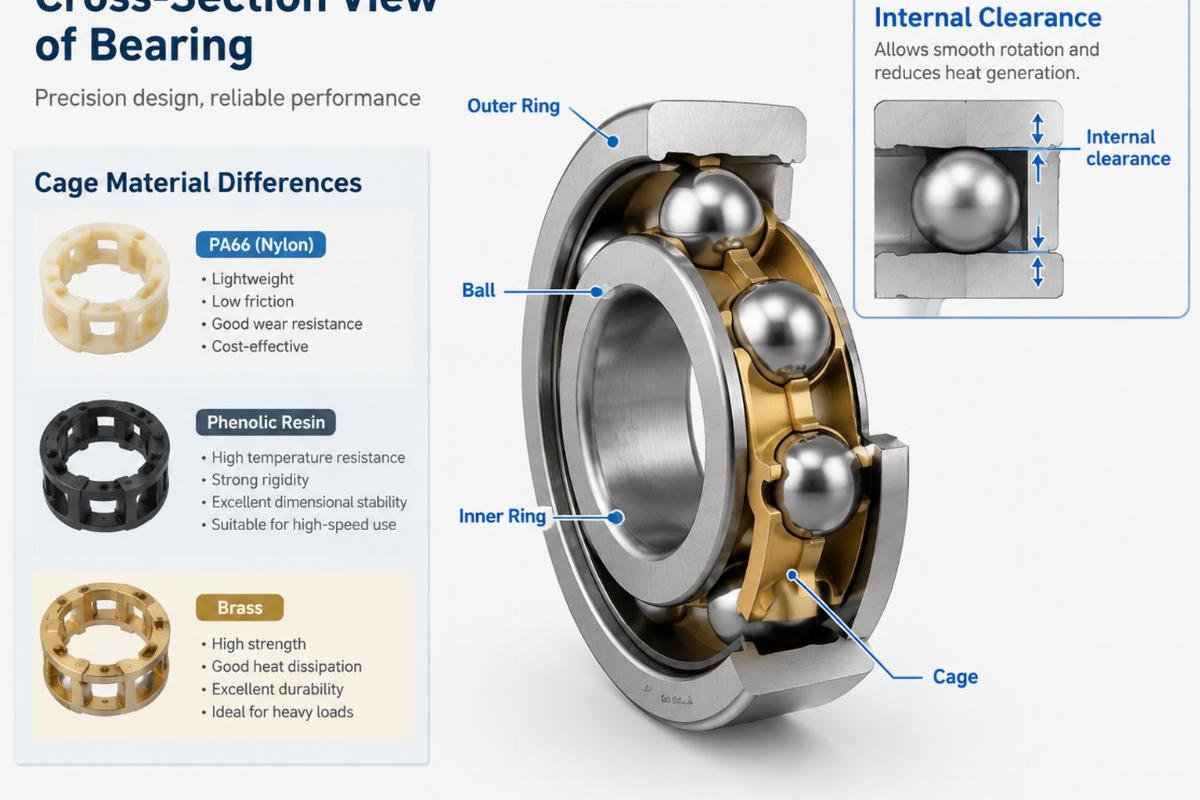
What Do FAG Suffixes C3, TVH, MA, and E1 Actually Mean?
Suffixes define the operational limits of a bearing, not just its physical size.
The basic designation tells you the dimensions, but the suffixes tell you how the bearing behaves under load, heat, and speed. Misinterpreting these codes is the most common cause of premature failure in MRO replacements.
C3: Radial Internal Clearance
C3 indicates a radial internal clearance greater than Normal (CN). This is critical for applications where temperature differences exist between the inner and outer rings, such as in electric motors or fans. Without C3, thermal expansion reduces the clearance to zero, causing pre-load and overheating. [NEED_CITE: ISO 5753 standard for radial internal clearance]
TVH: Polyamide Cage
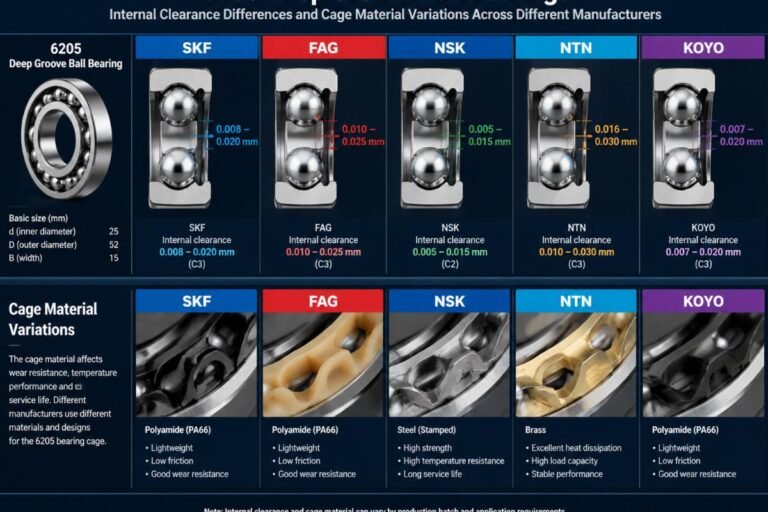
TVH denotes a cage made from glass-fiber reinforced polyamide 66. This material is lightweight and allows for high-speed operation with low friction. However, it has temperature limits. In environments with heavy shock loads or extreme heat, polyamide can become brittle or deform.
MA: Machined Brass Cage
MA signifies a machined brass cage, typically centered on the rolling elements. Brass is heavier than polyamide but offers superior strength and resistance to shock loads. It is the preferred choice for vibrating screens or heavy-duty gearboxes where impact forces are high. Swapping TVH for MA can significantly extend service life in harsh conditions, though it may slightly reduce maximum speed capabilities.
E1: Modified Internal Design
E1 represents a modified internal construction, often involving optimized raceway geometry or rolling element arrangement. This change improves load distribution and fatigue life. Replacing an E1 design with a standard internal design can lead to edge loading and early spalling. [NEED_CITE: Manufacturer technical catalog definitions for internal design modifications]
Understanding these distinctions is vital when consulting an FAG C3 TVH MA E1 Suffix Decoder & Equivalent Bearing Supplier. A supplier who ignores these nuances is merely selling metal rings, not engineering solutions.

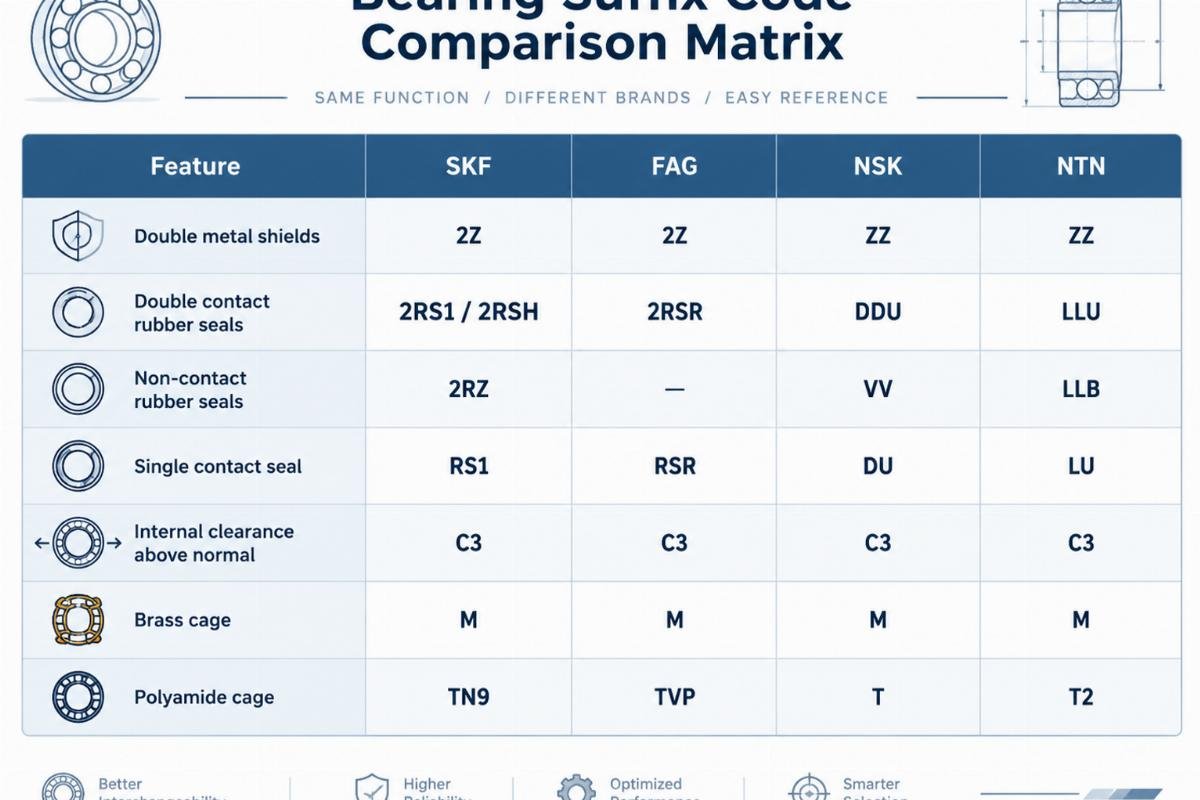
How to Cross-Reference FAG Suffixes to SKF, NSK, and NTN?
Cross-referencing requires matching functional parameters, not just translating part numbers.
Many buyers assume that an FAG bearing with a specific suffix has a direct one-to-one equivalent in other brands. While major manufacturers like SKF, NSK, and NTN follow similar ISO standards, their naming conventions differ. A mismatch in cage material or clearance class can render a “equivalent” bearing useless.
| Parameter | FAG Suffix | SKF Equivalent | NSK Equivalent | NTN Equivalent | Functional Note |
|---|---|---|---|---|---|
| Radial Clearance | C3 | C3 | C3 | C3 | Greater than normal clearance for thermal expansion. [NEED_CITE: ISO 5753 clearance classes] |
| Polyamide Cage | TVH | TN9 / TSH | TY | PA | Glass-fiber reinforced polyamide. High speed, low noise. |
| Brass Cage | MA | M / MB | M | M | Machined brass. High strength, shock resistant. |
| Internal Design | E1 | Varies | Varies | Varies | Check specific series documentation for geometric changes. |
Note that while clearance codes like C3 are standardized globally, cage material codes are proprietary. For instance, FAG uses TVH for certain polyamide cages, while SKF might use TN9. Assuming they are identical without verifying temperature ratings and reinforcement levels is risky. Similarly, the E1 suffix in FAG may correspond to a different internal optimization in NTN or NSK. Always request technical datasheets to confirm that the load rating and fatigue life match the original specification.
A European wind farm operator once replaced FAG main shaft bearings with what they believed were equivalent NSK units. They matched the dimensions and the C3 clearance but overlooked the cage material. The original FAG units used a specialized steel cage for high reliability, while the replacement used a standard polyamide cage. Within a year, several bearings failed due to cage deformation under variable loads. This incident highlights why working with a knowledgeable FAG C3 TVH MA E1 Suffix Decoder & Equivalent Bearing Supplier is essential. They verify these subtle but critical differences before shipment.
Why Do “Dimensionally Identical” Bearings Fail in Replacement?
Failure often stems from invisible mismatches in clearance and material properties.
It is counter-intuitive that a bearing fitting perfectly into the housing can still destroy the machine. The root cause is usually a mismatch in internal dynamics. Two primary failure modes dominate these scenarios: thermal seizure and cage fracture.
Thermal Seizure from Incorrect Clearance
In high-temperature applications, the inner ring expands more than the outer ring. If a standard clearance (CN) bearing is used instead of a C3, the internal space for the rolling elements disappears. The balls or rollers begin to carry load even when the shaft is stationary. As the machine runs, friction generates more heat, further expanding the metal until the bearing locks up. This is not a manufacturing defect; it is a selection error. [NEED_CITE: Thermal expansion effects on bearing internal clearance]
Cage Fracture from Material Mismatch
Polyamide cages (TVH) are excellent for reducing weight and noise. However, they are susceptible to chemical attack and have lower tensile strength than brass (MA). In a vibrating screen application, a buyer replaced FAG MA bearings with TVH equivalents to save cost. The vibration caused micro-cracks in the polyamide, leading to sudden cage disintegration. The resulting debris contaminated the lubricant and scored the raceways.
These failures are preventable. They require a deep understanding of the operating environment. An experienced FAG C3 TVH MA E1 Suffix Decoder & Equivalent Bearing Supplier will ask about temperature ranges, load types, and vibration levels before recommending a cross-brand alternative. They ensure that the equivalent bearing not only fits but also survives the specific stresses of the application.

How to Source Reliable FAG Equivalents Without Compromising Quality?
Verification of traceability and technical support is key to safe substitution.
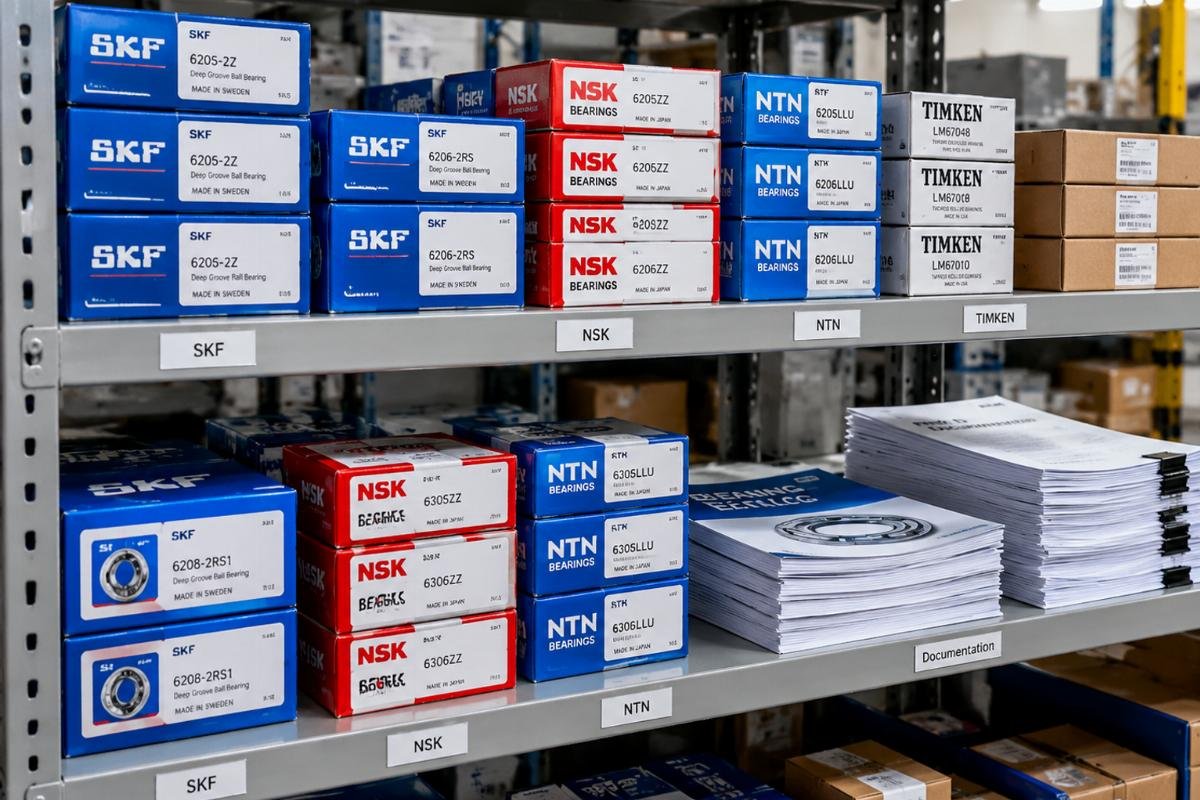
Sourcing alternatives to premium brands like FAG is a common strategy for cost management and supply chain resilience. However, the market is flooded with counterfeit or sub-standard products that mimic the part number but ignore the suffix specifications. To source safely, buyers must prioritize suppliers who offer technical validation alongside logistical efficiency.
First, demand full traceability. Genuine bearings from brands like SKF, NSK, or NTN come with batch-specific documentation. This allows you to verify the origin and quality controls applied during manufacturing. [NEED_CITE: Importance of traceability in bearing supply chains] Second, seek suppliers who provide mixed-brand packages. This flexibility allows you to test equivalents in non-critical applications before full-scale deployment.
Third, leverage technical cross-reference support. A competent supplier does not just look up a part number in a database. They analyze the suffixes. If you need an FAG bearing with C3 clearance and an MA cage, they will confirm that the proposed NTN or NSK alternative has the exact same clearance class and a cage material with comparable mechanical properties. They will also warn you if a direct equivalent does not exist, suggesting a custom solution or a different brand entirely.
For example, a mining company in South America needed urgent replacements for conveyor pulleys. The original FAG bearings with E1 internal design were out of stock. Their supplier identified a domestic Chinese brand that offered a similar internal geometry modification, verified by independent testing. The supplier provided sample units for trial installation. The test was successful, and the mine avoided weeks of downtime. This outcome was possible because the supplier acted as a technical partner, not just a distributor.
When evaluating an FAG C3 TVH MA E1 Suffix Decoder & Equivalent Bearing Supplier, look for those who stock genuine products from multiple premium brands and reliable domestic lines. They should offer flexible MOQs, allowing you to order single units for emergency repairs or container loads for project stock. Their value lies in their ability to navigate the complex web of bearing suffixes and deliver solutions that keep your machinery running.
Conclusion
Suffixes are the DNA of a bearing’s performance.
Ignoring codes like C3, TVH, MA, or E1 turns a precise engineering component into a liability. True interchangeability requires matching these internal specifications, not just external dimensions. By decoding these suffixes and partnering with a technically proficient supplier, you ensure that every replacement bearing meets the rigorous demands of your industrial operations.

Written by
authorEditor covering global sourcing, supplier verification, and industrial product knowledge. Content is compiled from manufacturer specifications, industry standards, and hands-on experience with international B2B buyers. Every article is fact-checked before publishing to help procurement professionals make informed decisions.
View all posts
Leave a Reply