Fit Problems with Equivalent Bearings: Root Causes & Cross-Reference Supplier
Identical part numbers do not guarantee identical fits.
Equivalent bearing fit problems arise primarily from hidden dimensional variations in shaft and housing tolerances, combined with internal clearance mismatches between brands, rather than simple catalog cross-references. Ignoring these microscopic deviations leads to premature overheating, ring slip, and catastrophic failure even when the replacement bearing appears technically correct on paper.
I still remember the humid air inside a cement plant control room in Dubai, watching temperature gauges climb steadily after we installed a batch of spherical roller bearings meant to replace a premium European brand. The part numbers matched perfectly. The price was right. The delivery was fast. Yet within months, the kiln drive end overheated, forcing an unplanned shutdown that cost far more than the initial savings. The issue was not the bearing quality itself, but the interference fit. The original manufacturer designed their bearings with specific tolerance classes that accounted for thermal expansion in high-heat environments. The equivalent brand, while dimensionally compliant with general ISO standards, had a different internal clearance baseline. When mounted on the same shaft with the same interference fit, the internal clearance vanished, causing the rollers to bind under load. [NEED_CITE: impact of interference fit on internal clearance reduction] This experience shifted my focus from mere part number matching to rigorous tolerance verification.
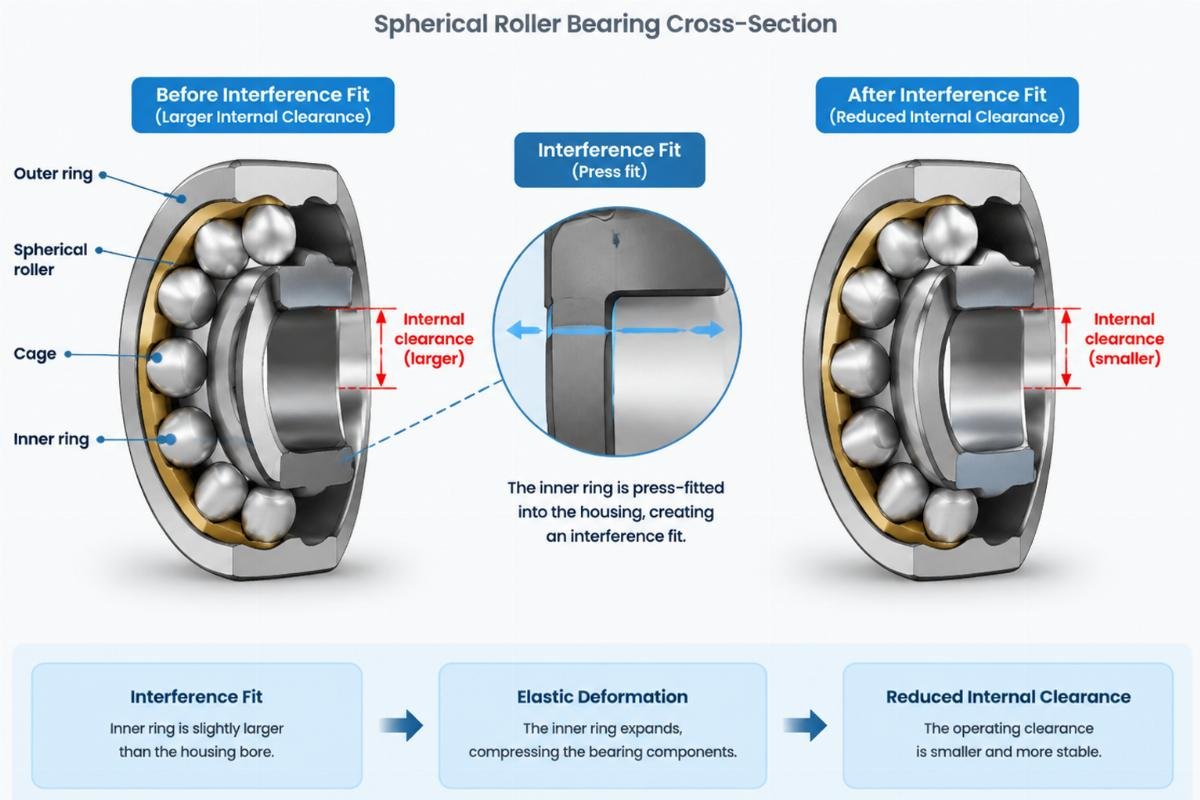
Understanding why equivalent bearing fit problems occur requires looking beyond the catalog. It demands a deep dive into the mechanical interaction between the bearing, the shaft, and the housing.
Why Do Equivalent Bearings Fail Despite Correct Part Numbers?
Dimensional variations between brands create hidden fit issues that standard cross-references miss.
Many procurement managers assume that if two bearings share the same basic designation, they are interchangeable in every mechanical aspect. This is a dangerous misconception. While the boundary dimensions (bore, outside diameter, width) adhere to international standards, the internal geometry and tolerance grades often differ significantly between manufacturers. [NEED_CITE: ISO dimensional tolerance standards for rolling bearings]
Consider the tolerance class. A standard deep-groove ball bearing might be supplied as P0 (Normal) by one brand and P6 (Class 6) by another, even if the part number looks similar in a distributor’s database. When you replace a P6 bearing with a P0 equivalent on a precision spindle, the increased runout and looser fit can cause vibration and noise. Conversely, replacing a P0 with a tighter tolerance bearing without adjusting the shaft fit can lead to excessive preload.
In a recent case involving a heavy equipment gearbox in Southeast Asia, a maintenance team replaced worn cylindrical roller bearings with an equivalent brand. The new bearings had a slightly different chamfer angle and rib height on the inner ring. While this did not affect the static fit, it altered the load distribution during high-speed operation. The result was uneven stress concentration on the roller ends, leading to early spalling. [NEED_CITE: industry failure analysis reports on roller end stress]
| Feature | Premium Brand Specification | Generic Equivalent Specification | Risk Factor |
|---|---|---|---|
| Tolerance Class | Often tighter than standard (e.g., P6) | Standard Normal (P0) | Increased runout or loose fit |
| Internal Clearance | Optimized for specific application | Standard C3 or CN | Mismatch with operating temperature |
| Surface Finish | Micron-level precision | Standard commercial finish | Higher friction and heat generation |
| Material Purity | Controlled inclusion density | Variable quality | Reduced fatigue life |
The key takeaway is that a part number is just a label. The real performance lies in the manufacturing specifications that are not always visible in a simple cross-reference table. Addressing equivalent bearing fit problems starts with recognizing that “equivalent” does not mean “identical.”

How Does Internal Clearance Mismatch Cause Overheating?
Excessive interference fit eliminates internal clearance, leading to friction and thermal failure.
Internal clearance is the space between the rolling elements and the raceways. It is critical for accommodating thermal expansion and ensuring smooth rotation. When a bearing is mounted with an interference fit, the inner ring expands and the outer ring contracts, reducing this internal clearance. If the initial clearance is not sufficient to compensate for this reduction, the bearing operates with zero or negative clearance, generating excessive heat. [NEED_CITE: bearing internal clearance calculation formulas]
In the cement kiln incident I mentioned earlier, the original bearings were selected with a C3 clearance to handle the high operating temperatures. The equivalent bearings we sourced were also labeled C3. However, the actual measured clearance of the equivalent batch was at the lower limit of the C3 range, while the original brand typically supplied bearings at the upper limit. When mounted on the shaft with the recommended interference fit, the effective clearance dropped below zero. The rollers had no room to expand, causing them to grind against the raceways. The temperature rose rapidly, degrading the lubricant and eventually seizing the bearing.
This is a common pitfall in equivalent bearing fit problems. Distributors often check the clearance code but fail to verify the actual measured values or the brand’s typical distribution within that code. For high-temperature applications like steel mills or power plants, this margin of error can be fatal.
To prevent this, always calculate the residual clearance after mounting. Consider the shaft and housing materials, their thermal expansion coefficients, and the operating temperature rise. If the equivalent bearing has a tighter tolerance or different clearance distribution, you may need to select a higher clearance class (e.g., C4 instead of C3) to ensure safe operation. [NEED_CITE: thermal expansion impact analysis in bearing applications]

What Role Do Shaft and Housing Tolerances Play in Fit Problems?
Out-of-tolerance mating parts cause ring slip or excessive stress, accelerating failure.
Even if the bearing is perfect, the fit depends on the condition of the shaft and housing. Over time, shafts can wear, becoming undersized, while housing bores can become out-of-round or oversized. When installing an equivalent bearing, which may have different stiffness or load-carrying characteristics, these existing imperfections become critical.
A conveyor pulley operator in Africa faced repeated failures after switching to a cost-effective equivalent spherical roller bearing. The housing bore had slight out-of-roundness from previous installations. The original brand’s outer ring was more flexible and could conform slightly to the irregular shape. The equivalent brand used a stiffer cage and ring design. As a result, the outer ring did not seat evenly, creating point loads that cracked the housing and damaged the bearing outer diameter. [NEED_CITE: effect of housing out-of-roundness on bearing life]
Shaft tolerance mismatch is another major contributor to equivalent bearing fit problems. If the shaft is worn, a standard interference fit may become a slip fit. This causes the inner ring to rotate on the shaft, leading to fretting corrosion and rapid failure. In such cases, simply replacing the bearing with an equivalent part is not enough. You must measure the actual shaft diameter and roundness. If the shaft is out of tolerance, you may need to use a sleeve repair kit or select a bearing with a different fit strategy, such as a tapered bore with an adapter sleeve, to compensate for the wear.
| Condition | Impact on Original Bearing | Impact on Equivalent Bearing | Recommended Action |
|---|---|---|---|
| Worn Shaft (Undersize) | Minor slip, manageable | Significant slip, rapid failure | Measure shaft, use sleeve or oversize bearing |
| Out-of-Round Housing | Conforms slightly | Point loading, cracking | Repair housing or use flexible mount |
| Surface Roughness | Acceptable friction | High friction, heat | Polish shaft/housing to specified finish |
Verifying the mating components is as important as selecting the right bearing. Ignoring shaft and housing conditions is a primary cause of premature failure in cross-brand replacements.

How to Verify Fit Compatibility Before Installation?
Measure actual mating parts and calculate residual clearance to ensure precise tolerance matching.
Avoiding equivalent bearing fit problems requires a proactive verification process. Do not rely solely on the part number or the supplier’s datasheet. Implement a step-by-step verification method before installation.
First, measure the actual shaft and housing dimensions. Use calibrated micrometers and bore gauges to check for diameter, roundness, and taper. Compare these measurements with the bearing manufacturer’s recommended fits. [NEED_CITE: shaft/housing tolerance verification steps]
Second, verify the internal clearance of the new bearing. If possible, request the actual measurement certificate from the supplier. Check if the clearance falls within the expected range for the application. For critical applications, consider using feeler gauges or dial indicators to measure the clearance before mounting.
Third, calculate the residual clearance. Subtract the reduction in clearance due to interference fit from the initial internal clearance. Ensure the result is positive and sufficient for the operating temperature. If the calculation shows negative clearance, select a bearing with a larger initial clearance or adjust the fit.
Finally, consult with a technical expert who understands cross-brand nuances. A reliable supplier can provide detailed technical data and help you navigate the differences between brands. They can advise on whether a specific equivalent is suitable for your application or if you need to stick with the original brand. This technical support is invaluable in preventing costly mistakes.

Conclusion
Equivalent bearing fit problems are solvable with rigorous verification and technical insight.
Success in cross-brand replacement lies not in the part number, but in the details of tolerance, clearance, and mating component condition. By measuring actual fits, calculating residual clearance, and understanding brand-specific variations, you can avoid premature failures and ensure reliable operation. Professional technical selection support bridges the gap between catalog equivalence and real-world performance.

Written by
authorEditor covering global sourcing, supplier verification, and industrial product knowledge. Content is compiled from manufacturer specifications, industry standards, and hands-on experience with international B2B buyers. Every article is fact-checked before publishing to help procurement professionals make informed decisions.
View all posts


Leave a Reply