Re-Greasing When Switching Bearing Brands: Wholesale Supplier Guide
Adding new grease does not automatically flush out the old.
Switching bearing grease brands requires complete purging of the existing lubricant to prevent thickener incompatibility, which leads to oil separation, hardening, and eventual bearing seizure. The only safe method is to verify chemical compatibility first, then mechanically purge the housing with a volume equal to three times the cavity capacity until only the new grease emerges from the relief vent.
I still remember the humid air in a palm oil mill near Jakarta, thick with the scent of crushed fruit and diesel. A production line had ground to a halt because a newly installed FAG spherical roller bearing seized after just seventy-two hours of operation. The maintenance team insisted they had followed standard procedures, topping up the housing with a premium lithium-complex grease. However, they had skipped one critical step: removing the previous polyurea-based lubricant. The two thickeners reacted chemically, forming a solid, soap-like block that trapped heat and starved the rolling elements of oil. This was not a defect in the bearing itself, but a failure in the re-greasing protocol when switching bearing grease brand. Such incidents are common across industrial sectors, from mining crushers to marine winches, where the assumption that “grease is grease” leads to costly unplanned downtime.

Understanding why this happens requires looking beyond the base oil. The thickener acts as a sponge, holding the oil in place. When two different thickeners mix, their chemical structures can clash, causing the sponge to collapse or harden. This guide details the technical steps required to safely transition between lubricants, ensuring the longevity of high-precision components sourced from global inventories.
Why Does Mixing Grease Brands Destroy Bearings?
Incompatible thickeners cause structural breakdown and oil bleeding, leading to rapid mechanical failure.
The primary risk when changing grease brand on industrial bearings lies in the interaction between thickener types. Common thickeners include lithium, lithium-complex, polyurea, calcium sulfonate, and clay. While the base oil may be similar, the thickener determines the grease’s consistency and stability. When incompatible thickeners mix, they often undergo a process called “syneresis,” where the oil separates from the thickener matrix. This results in two simultaneous problems: the remaining mixture becomes too hard to flow into the contact zones, and the separated oil leaks out, leaving the bearing dry.
[NEED_CITE: chemical compatibility mechanisms of mixed bearing grease thickeners]
In a cement plant conveyor application I observed, maintenance staff added a new calcium-based grease to an existing lithium-complex system without purging. Within weeks, the grease hardened into a blockage that prevented proper circulation. The bearing temperature spiked noticeably, and vibration levels increased until the unit failed. The repair required not just a new bearing, but a complete disassembly and cleaning of the housing, extending the maintenance cycle significantly. This highlights that more frequent re-greasing does not flush out incompatible grease faster; it only accelerates churning and overheating.
The misconception that adding new grease pushes out the old is dangerous. In reality, incompatible thickeners form a solid block that traps heat. This is particularly critical for high-load applications using spherical roller bearings or tapered roller bearings, where thermal management is vital. If the grease cannot circulate, friction increases, leading to surface distress and premature fatigue.

How to Check Grease Compatibility Before Switching?
Verify thickener types and consult compatibility matrices before introducing any new lubricant.
Before opening a new container, you must identify the thickener type of both the old and new greases. This information is typically found in the product data sheet under “Thickener Type” or “Soap Base.” Never assume compatibility based on brand reputation or price point. Even within the same brand, different product lines may use incompatible thickeners.
[NEED_CITE: ASTM D6185 standard practice for evaluating compatibility of lubricating greases]
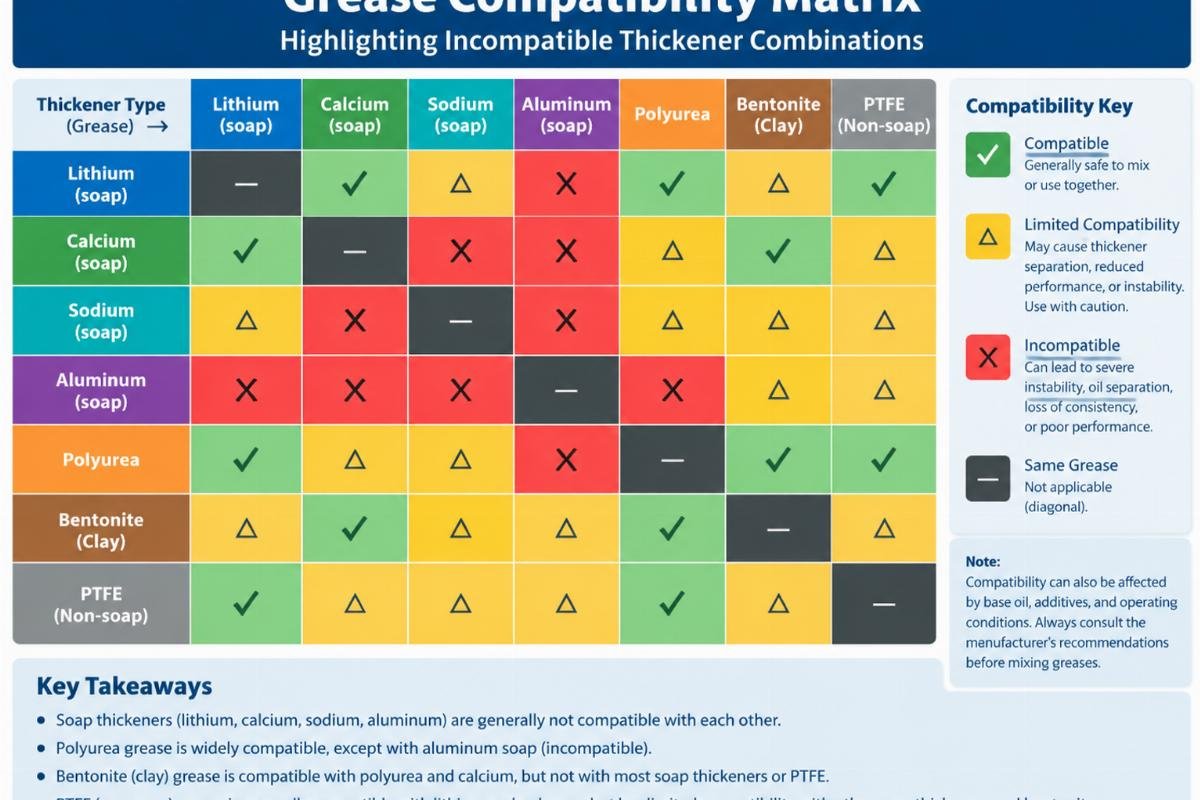
A practical approach involves consulting a grease compatibility chart. These matrices categorize thickeners into compatible, questionable, and incompatible groups. For instance, lithium and lithium-complex greases are generally compatible with each other, but both may be incompatible with polyurea or clay-based greases. If the chart indicates “questionable,” it is safer to treat it as incompatible and proceed with full purging.
| Thickener Type | Lithium | Lithium Complex | Polyurea | Calcium Sulfonate | Clay |
|---|---|---|---|---|---|
| Lithium | Compatible | Compatible | Questionable | Incompatible | Incompatible |
| Lithium Complex | Compatible | Compatible | Questionable | Incompatible | Incompatible |
| Polyurea | Questionable | Questionable | Compatible | Questionable | Incompatible |
| Calcium Sulfonate | Incompatible | Incompatible | Questionable | Compatible | Incompatible |
| Clay | Incompatible | Incompatible | Incompatible | Incompatible | Compatible |
Note: Compatibility can vary by specific formulation. Always verify with the manufacturer.
In my experience sourcing for MRO operators, I often see technicians skip this verification step. They assume that because both greases are “high-temperature,” they will mix well. This is a fatal error. The dropping point, which indicates the temperature at which the grease loses its structure, is irrelevant if the thickeners react chemically at ambient temperatures. Proper verification prevents the need for emergency replacements of genuine SKF, NSK, or TIMKEN bearings, preserving the integrity of the supply chain and reducing waste.
What is the Correct Purging Procedure?
Run equipment, apply three times the cavity volume, and monitor exhaust until pure new grease appears.
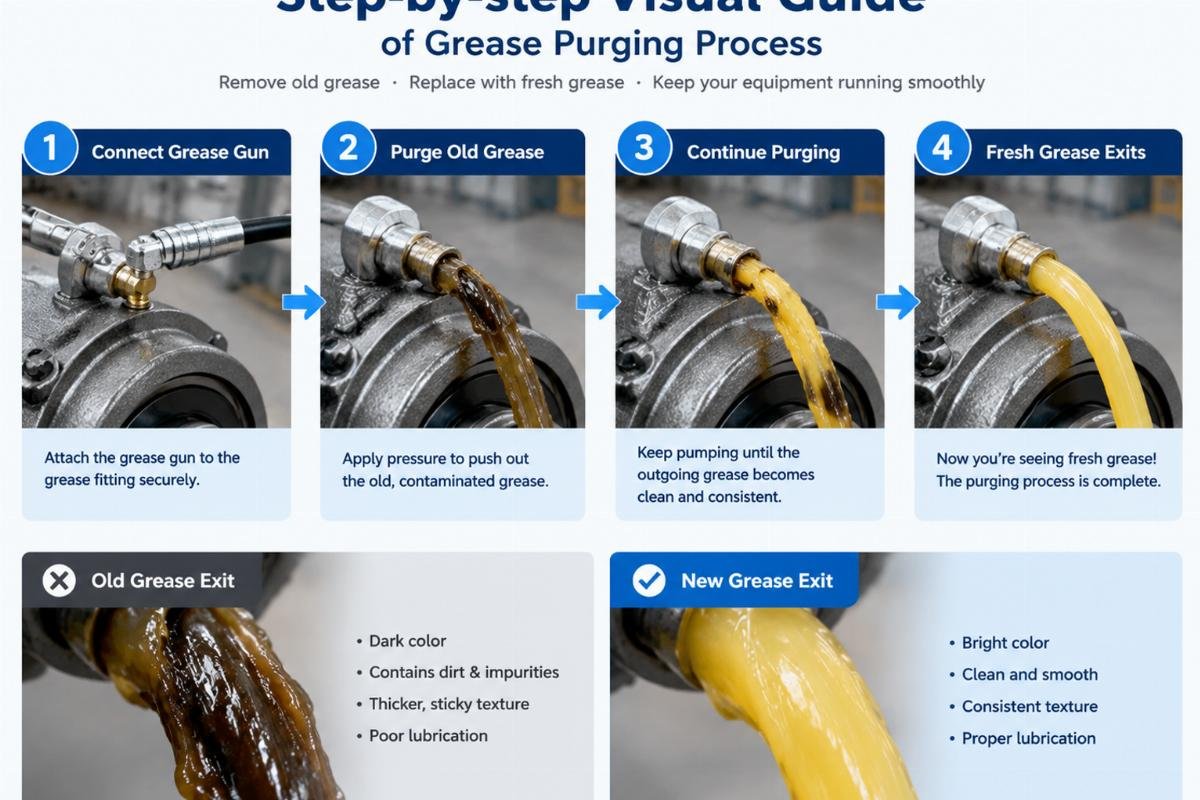
Once incompatibility is confirmed or suspected, the only safe path is mechanical purging. This process removes the old lubricant from the bearing housing and replaces it with the new grease. The volume required is not arbitrary; it is calculated based on the housing cavity size.
[NEED_CITE: calculation method for bearing housing purging volume based on cavity dimensions]
- Preparation: Clean the relief vent and grease nipple. Ensure the equipment is running at low speed to facilitate the expulsion of old grease. If the machine cannot run, manual rotation may be necessary, though it is less effective.
- Initial Injection: Begin injecting the new grease slowly. Observe the relief vent. Initially, the expelled material will be a mix of old and new grease, often discolored or lumpy.
- Volume Calculation: Continue injecting until you have added a volume equal to three times the free space in the housing. This multiplier ensures that the majority of the old grease is displaced. For large housings, this may require several cartridges.
- Monitoring: Watch the exhaust closely. The goal is to see only the new, clean grease emerging from the vent. If the old grease is stubborn, you may need to increase the volume slightly, but avoid over-packing, which can cause churning.
- Cleanup: Wipe away excess grease from the vent and housing exterior. Restart the equipment at normal operating speed and monitor for unusual noise or temperature rise.
In a marine winch scenario, incomplete purging led to grease churning and overheating. The crew had added only half the required volume, leaving a significant amount of old oil-based grease inside. The resulting mixture could not dissipate heat, forcing a reduction in the re-greasing interval and lowering the operating temperature limit. By following the three-times-volume rule, such issues are avoided, ensuring the bearing operates within its designed thermal range.
How to Monitor Bearing Health Post-Switch?
Track temperature trends and vibration levels during the break-in period to detect residual incompatibility.
After purging, the bearing enters a break-in period. During this time, it is crucial to monitor its health closely. Residual old grease may still be present in hard-to-reach areas, or the new grease may need time to settle into the rolling elements.
[NEED_CITE: best practices for post-maintenance bearing monitoring using vibration analysis]
Use infrared thermometers or thermal cameras to check the bearing housing temperature. Compare readings with historical baseline data. A noticeable increase in temperature suggests that the purging was incomplete or that the new grease is not suitable for the operating conditions. Vibration analysis is another powerful tool. Look for changes in the vibration spectrum that might indicate roughness or lack of lubrication.
For distributors stocking multi-brand bearings, providing this technical guidance adds value to the product. It helps end-users maximize the lifespan of genuine components, whether they are using deep-groove ball bearings in electric motors or cylindrical roller bearings in gearboxes. Proper maintenance prevents premature failure, reducing the frequency of urgent spare-part orders and stabilizing inventory planning.
In one instance, a steel mill operator switched to a new synthetic grease without proper monitoring. The temperature remained stable for the first week, but vibration levels began to rise subtly. Early detection allowed them to stop the machine and perform a second purge, saving the bearing from catastrophic failure. This proactive approach is essential for maintaining reliability in harsh environments.

Conclusion
Proper purging is non-negotiable when switching grease brands.
Mixing incompatible greases is a leading cause of preventable bearing failure. By verifying thickener compatibility, executing a thorough purge with three times the cavity volume, and monitoring post-switch health, operators can ensure reliable performance. This disciplined approach protects high-quality bearings from chemical damage, extending service life and minimizing downtime. Whether you are managing a small workshop or a large industrial fleet, adhering to these technical standards is the most effective way to safeguard your assets.

Written by
authorEditor covering global sourcing, supplier verification, and industrial product knowledge. Content is compiled from manufacturer specifications, industry standards, and hands-on experience with international B2B buyers. Every article is fact-checked before publishing to help procurement professionals make informed decisions.
View all posts

Leave a Reply