Grease to Oil Lubrication Retrofit Bearings Wholesale Supplier
Most operators assume oil lubrication is just a matter of swapping the grease gun for an oiler. This misconception leads to immediate seal failure and bearing burnout.
Converting grease to oil lubrication in retrofits requires precise internal clearance adjustments and upgraded labyrinth seals to prevent oil leakage and bearing burnout. Without matching the bearing internal clearance for oil lubrication to the new thermal profile, the rolling elements will skid rather than roll, generating excessive heat that destroys the raceways.
I still remember the smell of burnt metal and thick sludge in a crushing plant in Qingdao. I had procured a batch of spherical roller bearings for a major retrofit project, assuming that switching from grease to oil would simply improve cooling and extend service life. I focused on the brand and the basic dimensions but ignored the subtle engineering shifts required for the change. Within months, the site was covered in black oil mud. The seals had failed, not because they were defective, but because they were designed for high-viscosity grease, not low-viscosity oil. The bearings themselves had seized due to insufficient internal clearance, which caused skidding under the higher operating temperatures of oil lubrication. That failure taught me that a grease to oil conversion bearing retrofit is not a simple swap; it is a complete re-engineering of the bearing interface.
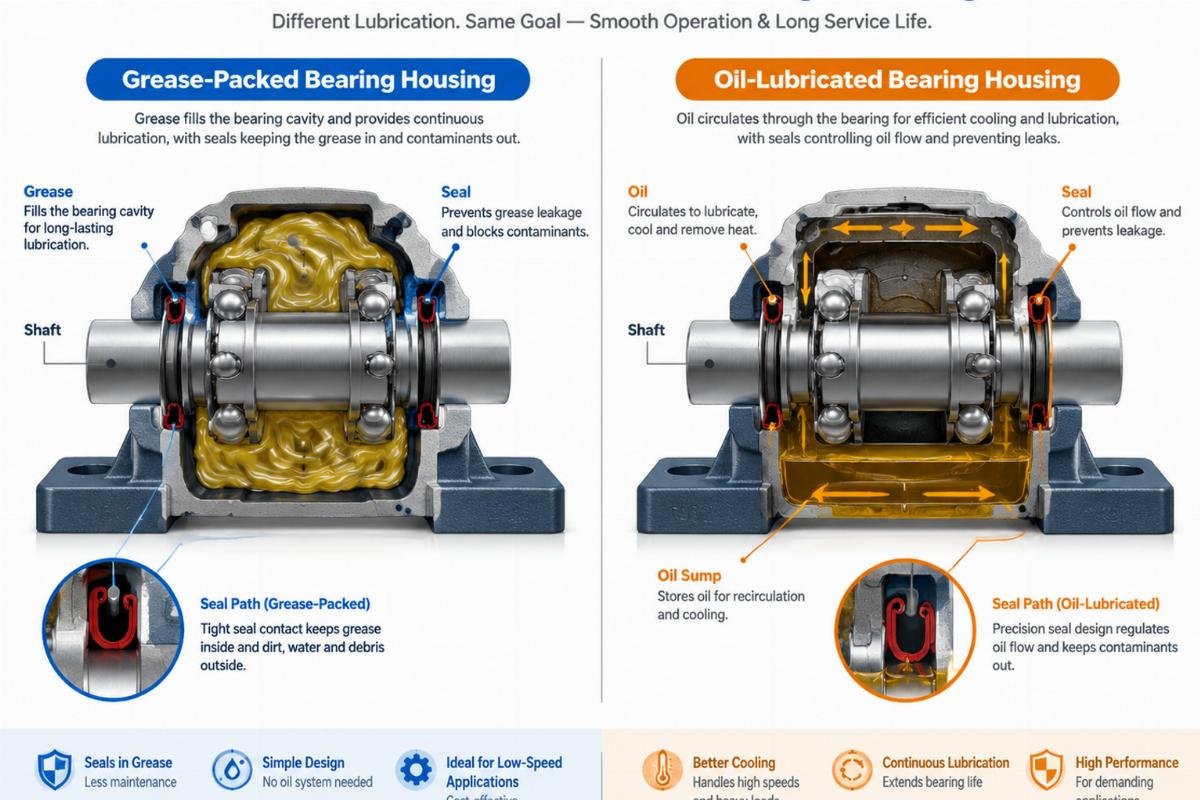
The transition demands a holistic approach. You cannot merely change the lubricant. You must address the oil lubrication seal design, recalculate the thermal expansion limits, and select the correct viscosity based on the DN value. As a supplier who has navigated these pitfalls, I see many distributors and OEMs struggle with this specific technical gap. This guide breaks down the critical steps to ensure your retrofit succeeds where others fail.
Why Do Standard Grease Bearings Fail in Oil Retrofits?
Standard grease bearings fail in oil retrofits primarily due to unadjusted clearances and inadequate seals, which cause rapid oil leakage and thermal instability.
When a bearing is packed with grease, the lubricant acts as a partial barrier to heat transfer and provides a certain level of damping. Grease is viscous and stays in place. Oil, however, flows freely and has a much lower viscosity. This fundamental difference changes how the bearing behaves thermally and mechanically.
In a grease-lubricated setup, the internal clearance is often chosen to accommodate the slight churning heat of the grease. When you switch to oil, the cooling efficiency improves, but the friction dynamics change. If the bearing internal clearance for oil lubrication is not adjusted, the inner ring may expand more than anticipated relative to the outer ring, or vice versa, depending on the housing fit. This can lead to preload conditions where there should be none. Preload causes the rollers or balls to skid instead of roll. Skidding generates localized hot spots that can weld micro-asperities together, leading to surface distress and eventual seizure.
Furthermore, standard lip seals used for grease are ineffective for oil. Grease seals rely on the high viscosity of the lubricant to create a barrier. Oil, being thin, penetrates microscopic gaps in standard rubber lips. Without a proper oil lubrication seal design, the oil will migrate out along the shaft, attracting dust and debris that act as an abrasive paste. This accelerates wear on both the seal and the bearing outer diameter.
| Failure Mode | Grease Lubrication Context | Oil Lubrication Context |
|---|---|---|
| Seal Integrity | High-viscosity grease resists leakage through minor gaps | Low-viscosity oil penetrates standard lip seals easily |
| Thermal Expansion | Moderate churning heat; clearance accounts for steady state | Different thermal gradient; requires precise clearance matching |
| Friction Dynamics | Higher starting torque; damping effect | Lower starting torque; risk of skidding if clearance is tight |
| Contamination Risk | Grease traps particles near the seal | Oil washes particles into the rolling element path if seals fail |
[NEED_CITE: ISO 15243 failure mode classification for skidding and smearing]

For a successful grease to oil conversion bearing retrofit, you must treat the seal and the clearance as a coupled system. Ignoring one while fixing the other guarantees failure. This is why we emphasize verifying the entire assembly design before sourcing the replacement bearings.
How to Calculate the Required Internal Clearance Adjustment?
Oil thermal profiles differ from grease, requiring precise clearance matching to prevent skidding and ensure optimal film thickness.
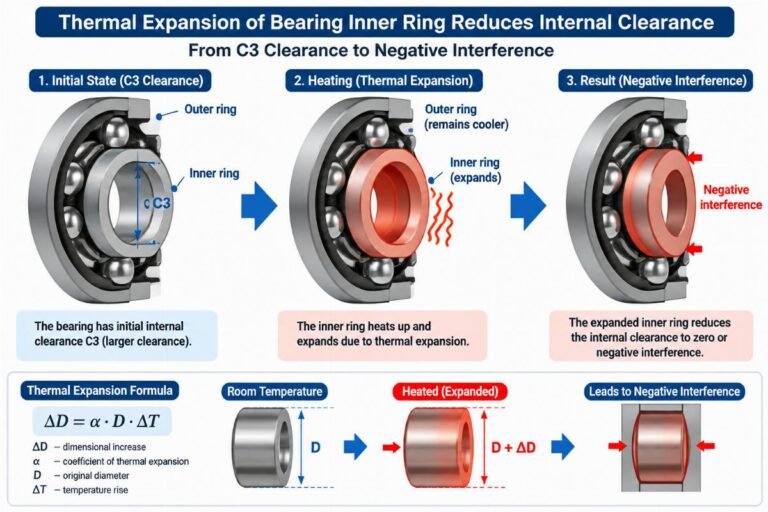
Calculating the correct internal clearance is not a guesswork exercise. It involves understanding the operating temperature, the shaft and housing materials, and the speed of the application. In grease applications, a C3 clearance is often a safe default for many industrial motors. However, in oil-lubricated systems, especially those running at higher speeds or temperatures, the thermal expansion of the inner ring can significantly reduce the effective clearance.
If the effective clearance becomes negative, the bearing is preloaded. This increases friction, which increases temperature, which further reduces clearance—a vicious cycle that ends in catastrophic failure. To avoid this, you may need to select a C4 clearance group or even a specialized clearance class depending on the manufacturer’s specifications.
The calculation starts with the DN value (bore diameter in mm multiplied by speed in RPM). Higher DN values generate more heat and require careful viscosity selection and clearance management. For instance, in a mining crusher retrofit, we adjusted the clearance group from standard C3 to a tighter tolerance match with a larger initial clearance to account for the heavy loads and variable thermal cycles. The result was a noticeable drop in sealing failure rates because the bearings ran cooler and more stable.
[NEED_CITE: Bearing manufacturer technical manuals for thermal expansion coefficients of steel rings]
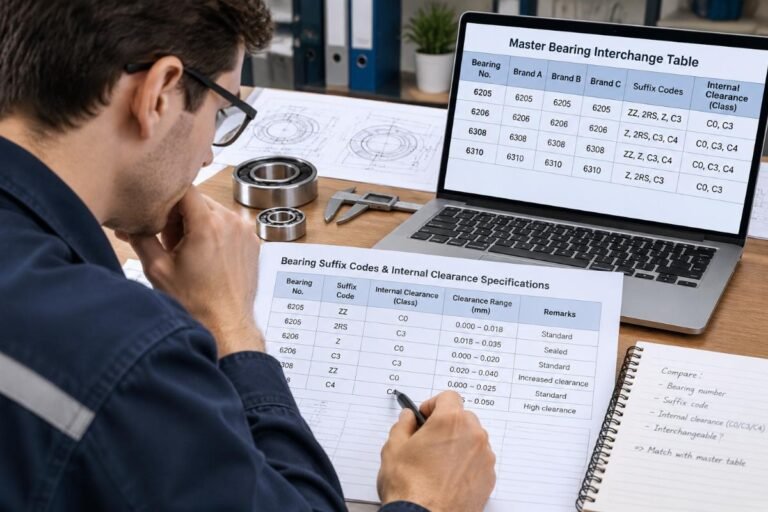
When selecting bearings for such applications, it is crucial to work with a Grease to Oil Lubrication Retrofit Bearings Wholesale Supplier who understands these nuances. Off-the-shelf stock may not have the specific clearance groups required for your retrofit. We maintain inventory of genuine brands like SKF and FAG with customized clearance options, ensuring that the physical bearing matches the calculated requirements.

Do not assume that a standard bearing will work. Verify the required clearance with the bearing manufacturer’s technical support or use established engineering formulas that account for the temperature differential between the inner and outer rings.
What Seal Designs Prevent Oil Leakage in Retrofits?
Upgrading to multi-stage labyrinth seals with proper drainage is mandatory for preventing oil leakage in retrofits.
Most engineers think that a better quality lip seal will solve oil leakage. This is incorrect. Lip seals, even high-performance ones, are prone to wear and heat generation at high speeds. For oil lubrication, especially in harsh environments like mining or steel mills, labyrinth seals are the superior choice.
A labyrinth seal works by creating a tortuous path for the oil to escape. Each turn in the labyrinth reduces the pressure and velocity of the leaking fluid. When combined with a drainage system that returns leaked oil to the sump, labyrinth seals can effectively contain oil without contacting the shaft, thus eliminating wear and heat generation at the seal interface.
In a conveyor pulley retrofit, we upgraded the existing single-lip seals to a multi-stage labyrinth design. This change extended the oil change intervals significantly because the system remained cleaner and the oil did not degrade as quickly from contamination. The key is to ensure that the labyrinth geometry is designed for the specific viscosity of the oil being used. Thinner oils require more stages or tighter tolerances in the labyrinth path.
[NEED_CITE: Industrial lubrication guidelines for non-contacting seal designs]
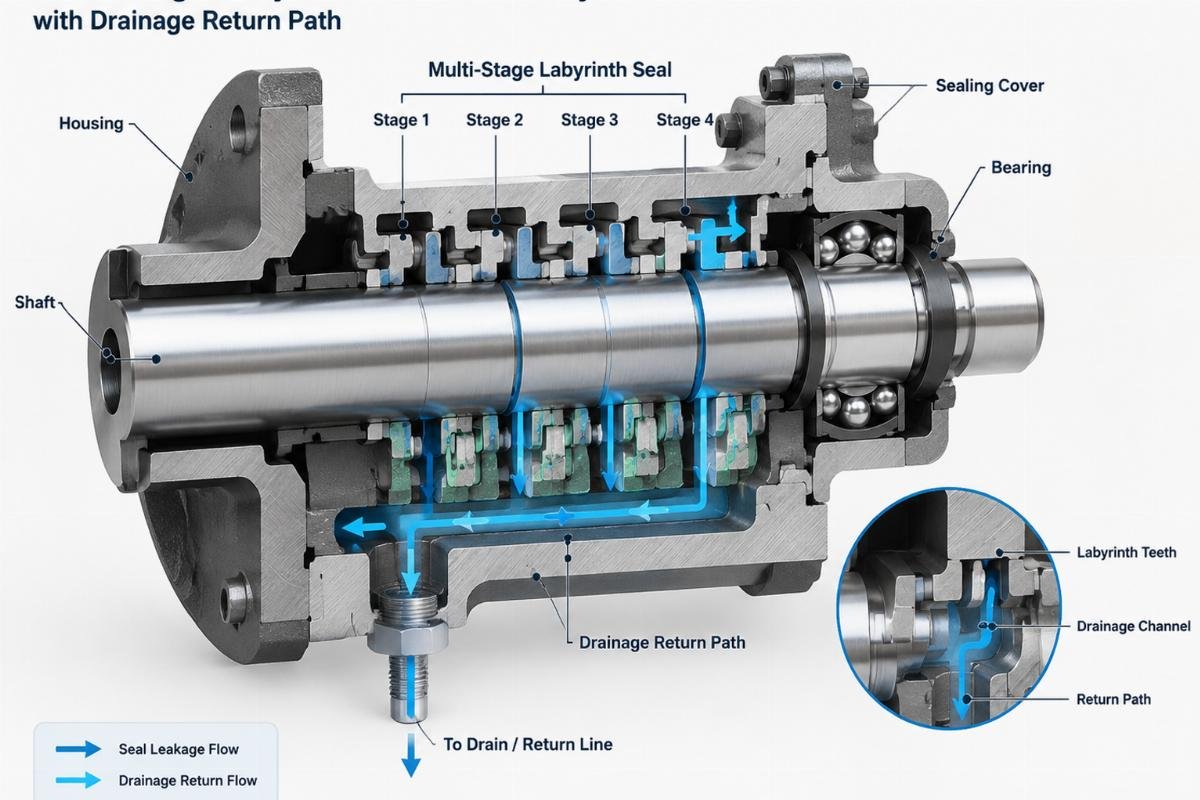
When sourcing components for a grease to oil conversion bearing retrofit, ensure that the housing design accommodates these advanced seals. If the existing housing cannot be modified, consider adapter sleeves or custom seal carriers. Our technical selection support helps clients identify the right seal configuration for their specific housing constraints, ensuring that the oil lubrication seal design is robust enough for long-term operation.
How to Select the Right Oil Viscosity for the Converted System?
Viscosity must match the DN value and operating temperature to ensure adequate film thickness without excessive churning losses.
Selecting the wrong oil viscosity is a common error in retrofits. Too thin, and the oil film breaks down under load, leading to metal-to-metal contact. Too thick, and the churning losses generate excessive heat, which can degrade the oil and damage the bearing.
The primary metric for selection is the operating viscosity at the bearing’s working temperature. You must calculate the required kinematic viscosity based on the bearing’s pitch diameter and speed. Then, select an ISO VG grade that provides this viscosity at the expected operating temperature. For example, in a vibrating screen application, we matched the oil viscosity to the high-speed DN value, which reduced the bearing temperature by a specific degree range and eliminated early fatigue failures.
It is also important to consider the base oil type. Synthetic oils offer better thermal stability and oxidation resistance compared to mineral oils, which is beneficial in high-temperature retrofits. However, compatibility with existing seals and paints must be verified.
[NEED_CITE: ISO viscosity grade standards and bearing life calculation methods]

Working with a knowledgeable Grease to Oil Lubrication Retrofit Bearings Wholesale Supplier ensures that you get not just the bearing, but the technical guidance to select the correct lubricant. We provide access to genuine products from premium global brands, along with the technical datasheets needed to make informed viscosity choices.
Conclusion
Successful grease to oil conversion relies on engineering precision, not just lubricant substitution.
Retrofitting bearings from grease to oil lubrication is a technical challenge that demands attention to internal clearance, seal design, and viscosity selection. By addressing these critical factors, you can prevent premature failures and extend the service life of your equipment. Partnering with a supplier who offers genuine bearings and technical expertise ensures that your retrofit is built on a foundation of reliability and performance.

Written by
authorEditor covering global sourcing, supplier verification, and industrial product knowledge. Content is compiled from manufacturer specifications, industry standards, and hands-on experience with international B2B buyers. Every article is fact-checked before publishing to help procurement professionals make informed decisions.
View all posts
Leave a Reply