SY 1 TF vs UCP 205 Inch Metric Bearings Wholesale Supplier
A 0.4mm gap is not a tolerance issue; it is a mechanical incompatibility that guarantees failure.
SY 1 TF and UCP 205 are not interchangeable. The SY 1 TF is designed for a 1-inch (25.4mm) shaft, while the UCP 205 fits a 25mm shaft. Forcing a metric bearing onto an inch shaft creates excessive interference, leading to inner ring expansion, loss of internal clearance, and rapid fatigue failure within days of operation.
Standing on the dusty floor of a copper mine in Antofagasta, I watched a maintenance team struggle with a seized conveyor pulley. The procurement order had listed “UCP 205” as a generic replacement for a worn SKF unit. The original component was an SY 1 TF. To the untrained eye, 25mm and 1 inch look identical. In reality, that 0.4mm difference meant the metric bearing had to be hammered onto a shaft that was effectively too large for its bore. The result was not just a tight fit; it was a catastrophic distortion of the bearing geometry. The inner ring cracked under the stress of the forced installation, and the bearing seized before the shift ended. This incident reshaped how I approach technical verification. It is not enough to match the outer dimensions or the brand series; the fundamental unit of measurement must align perfectly with the shaft specification. [NEED_CITE: ABMA standard inch vs ISO metric shaft tolerances]

Understanding this distinction is critical for MRO buyers and distributors who manage inventory across mixed-origin equipment. Misidentifying these units leads to costly downtime and returns. As a SY 1 TF vs UCP 205 Inch Metric Bearings Wholesale Supplier, we see this confusion regularly in bulk orders where inch and metric specifications are inadvertently swapped.
What is the exact dimensional difference between SY 1 TF and UCP 205?
The core difference lies in the bore diameter and the corresponding housing standards. The SKF SY 1 TF is part of the inch-series insert bearing lineup, specifically engineered for a 1-inch shaft. The UCP 205 is a metric pillow block bearing, standardized for a 25mm shaft. While 1 inch converts to 25.4mm, bearing manufacturing does not allow for rounding. The bore of the UCP 205 is precisely 25mm, leaving a 0.4mm gap when placed against a 1-inch shaft. Conversely, trying to fit an SY 1 TF onto a 25mm shaft results in a loose fit, causing slippage, fretting corrosion, and eventual shaft damage.
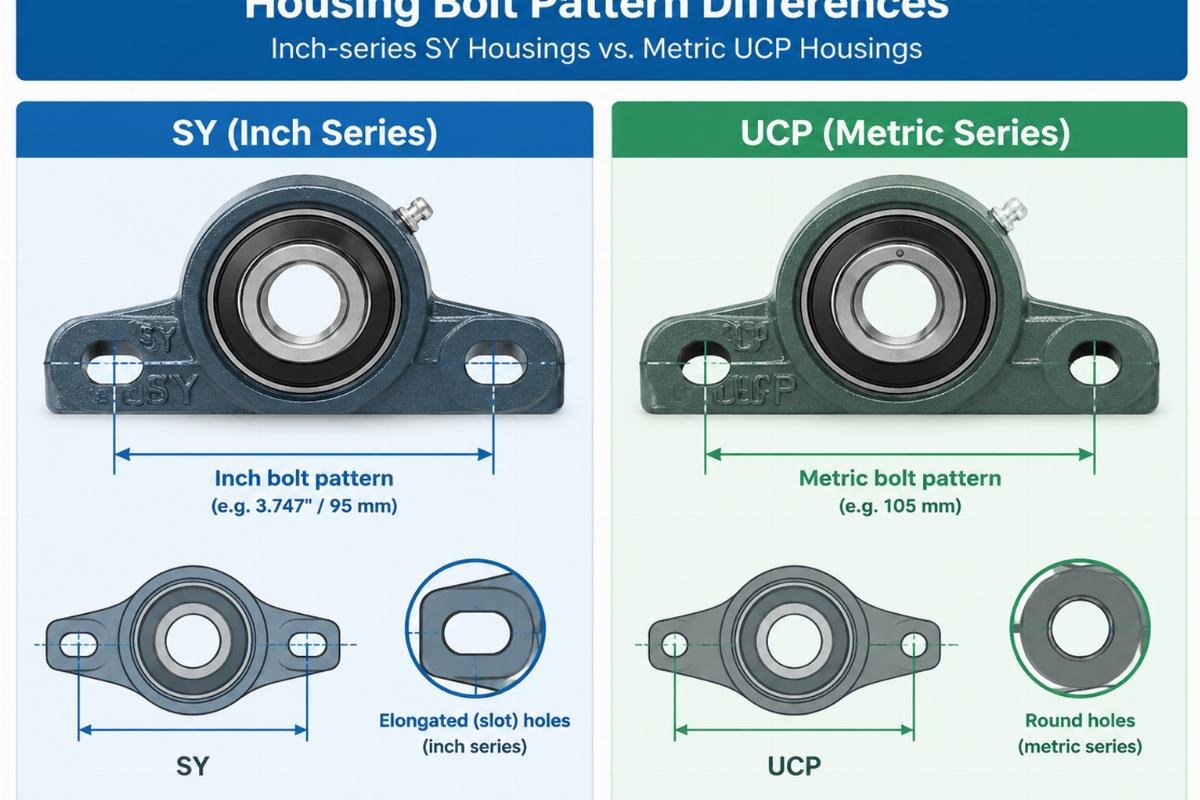
This discrepancy extends beyond the bore. The housing dimensions, bolt hole spacing, and overall footprint often differ between inch and metric series, even if the bearing insert appears similar in width. Inch-series housings like the SYF or SYT types follow ABMA (American Bearing Manufacturers Association) standards, while UCP housings adhere to ISO metric dimensions. Mixing these standards compromises the structural integrity of the mounting assembly.
| Feature | SY 1 TF (Inch Series) | UCP 205 (Metric Series) |
|---|---|---|
| Shaft Diameter | 1 inch (25.4 mm) | 25 mm |
| Bore Tolerance | Designed for inch shaft tolerances | Designed for metric h6/g6 tolerances |
| Housing Standard | ABMA Inch Series | ISO Metric Series |
| Interchangeability | Not interchangeable with metric | Not interchangeable with inch |
| Typical Application | Legacy US/UK machinery, Mining | Global industrial, OEM equipment |
[NEED_CITE: ISO 1132-1 bearing tolerance standards vs ABMA R20]
A distributor in Southeast Asia once received a container load of UCP 205 units intended for a mining project that specified inch-series replacements. The error was caught only during pre-shipment inspection when our team verified the drawing symbols. The client had omitted the “inch” designation in the purchase order, assuming all size 205 bearings were universal. Correcting this before shipping saved the client from a total rejection at the site and avoided the freight costs of returning a full container. This highlights why verifying the unit system is as important as checking the part number.
Why can’t you force a metric UCP 205 onto an inch shaft?
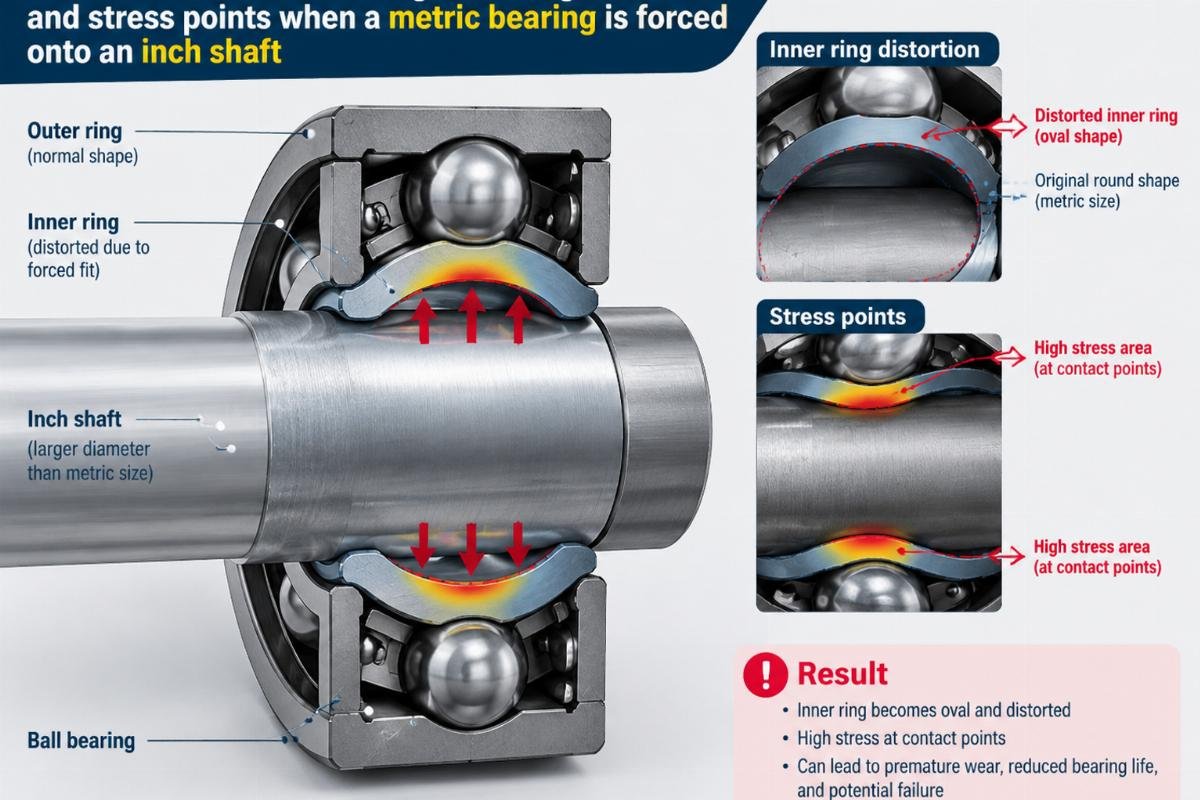
Forcing a metric bearing onto an inch shaft is a common mistake in emergency repairs, but it violates basic mechanical principles. When a UCP 205 with a 25mm bore is pressed onto a 25.4mm shaft, the inner ring undergoes elastic deformation. This expansion reduces the internal clearance of the bearing, which is typically set to C3 or standard clearance for normal operating temperatures. [NEED_CITE: SKF internal clearance guidelines for mounted bearings]
As the inner ring expands, the rolling elements become preload-heavy. This generates*icant film. The increased friction leads to rapid wear of the balls and raceways. More critically, the hoop stress on the inner ring can exceed the material’s yield strength, causing micro-cracks that propagate into full fractures. In the Antofagasta case, the inner ring did not just wear out; it split open because the interference fit was far beyond the design limits of the bearing steel.
Furthermore, the set screws or locking collars used to secure the bearing to the shaft cannot compensate for this dimensional mismatch. In an inch-series bearing like the SY 1 TF, the locking mechanism is designed to grip a 1-inch shaft securely without distorting the bore. On a metric bearing forced onto an inch shaft, the locking mechanism may appear tight, but the underlying bore distortion remains, leading to premature failure regardless of how well the bearing is secured.
How to verify shaft units before placing a bulk order?
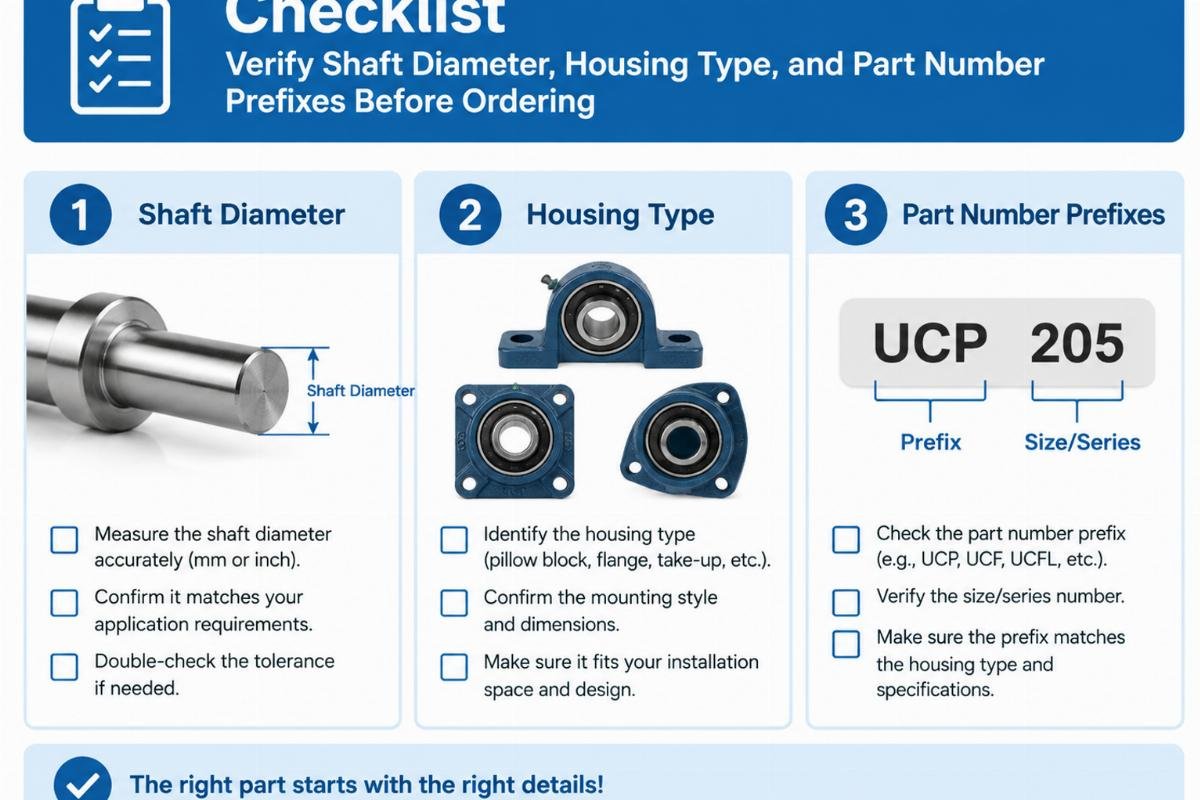
Verification starts with the engineering drawings, not the physical part. Many older machines, especially those manufactured in the US, UK, or Australia, use inch-based designs. Modern global OEMs often use metric standards. When sourcing replacements, relying on visual inspection or old part numbers without context is risky.
First, check the drawing for dimension symbols. Inch dimensions are often denoted with double primes (“) or explicitly labeled as “INCH.” Metric dimensions use “mm.” If the drawing is ambiguous, measure the shaft diameter with a calibrated micrometer. A reading of 25.4mm confirms an inch shaft, requiring an SY 1 TF or equivalent inch-series bearing. A reading of 25.0mm confirms a metric shaft, requiring a UCP 205.
Second, examine the housing bolt holes. Inch-series housings often have bolt hole spacing that does not align with metric standards. If the existing housing is being reused, the new bearing insert must match the housing series. If the housing is also being replaced, ensure the new housing matches the shaft unit system.
Third, consult the manufacturer’s catalog prefix. SKF uses “SY” for inch-series insert bearings and “UCP” for metric pillow blocks. Other brands follow similar conventions, but prefixes vary. Always cross-reference the full part number with the brand’s current catalog to confirm the unit system. [NEED_CITE: Manufacturer catalog prefix definitions for inch vs metric series]
A European wind farm operator recently faced repeated failures in a gearbox auxiliary drive. The maintenance logs showed consistent replacements of UCP 205 units. Upon audit, we found the shaft was originally machined to 1 inch. The metric bearings were slipping slightly, causing fretting that weakened the shaft over time. Switching to the correct inch-series bearing resolved the issue, extending the service life meaningfully. This case underscores the importance of verifying the original design intent rather than just replacing like-for-like based on recent history.
Which brands offer true cross-reference equivalents?
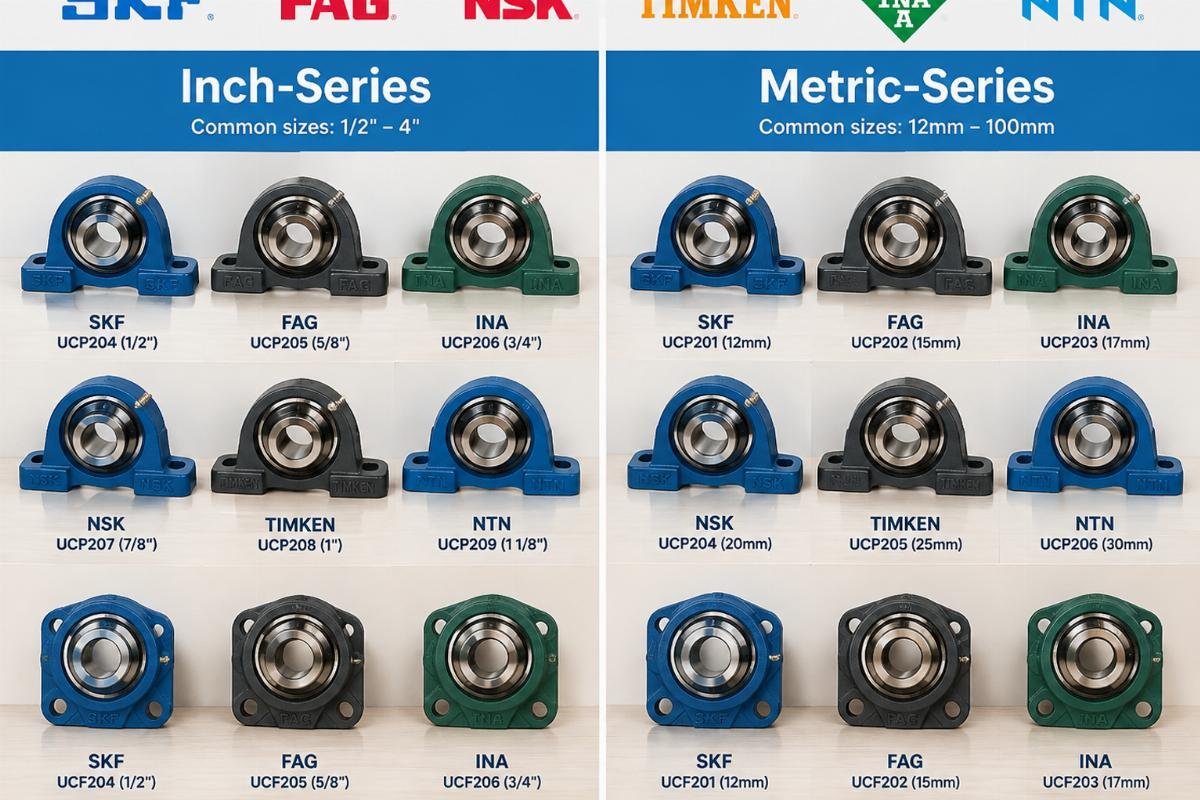
When sourcing alternatives, it is essential to distinguish between true dimensional equivalents and approximate fits. The SY 1 TF is an SKF product, but other major manufacturers produce inch-series insert bearings that are dimensionally compatible. Brands such as NTN, NSK, and FYH offer inch-series insert bearings that can replace the SY 1 TF, provided the housing is also compatible or replaced with an inch-series unit.
However, caution is required when mixing brands. While the bore and outer diameter may match, the locking mechanism design can vary. Some brands use set screws, others use eccentric locking collars, and some use concentric locking rings. Ensuring the locking method matches the application’s vibration and load requirements is crucial. For high-vibration environments like mining conveyors, a robust locking mechanism is vital to prevent loosening.
As a SY 1 TF vs UCP 205 Inch Metric Bearings Wholesale Supplier, we maintain strict segregation between inch and metric inventory. Our technical team verifies each order against the customer’s drawings to prevent mix-ups. We stock genuine products from SKF, FAG, INA, NSK, NTN, TIMKEN, and other premium brands, ensuring that whether you need an inch-series SY 1 TF or a metric UCP 205, you receive the correct specification for your application. This rigorous approach minimizes the risk of receiving incompatible parts, protecting your operations from unplanned downtime.
Conclusion
Precision matters more than proximity. The 0.4mm difference between SY 1 TF and UCP 205 bearings is decisive, not negligible. Verifying shaft units and housing standards before ordering prevents mechanical failure and operational disruption. Always prioritize drawing verification and unit consistency over visual similarity.

Written by
authorEditor covering global sourcing, supplier verification, and industrial product knowledge. Content is compiled from manufacturer specifications, industry standards, and hands-on experience with international B2B buyers. Every article is fact-checked before publishing to help procurement professionals make informed decisions.
View all posts

Leave a Reply