Vibratory Roller Bearing Equivalents: Cross-Reference & Wholesale Supplier
Matching outer and inner diameters is not enough for vibratory roller applications.
Vibratory roller bearing equivalents require precise dimensional matching, internal clearance upgrades (such as shifting from C3 to C4), and cage material verification to withstand high-frequency radial loads. Blind substitution based solely on basic size leads to rapid inner ring fretting, grease leakage, and catastrophic drum failure under thermal expansion.
I still remember the silence in a warehouse near Santos Port, Brazil, where a shipment of “equivalent” spherical roller bearings sat unopened. The paperwork was perfect, the brands were reputable, and the dimensions matched the drawing. Yet, when the maintenance team at a Chilean copper mine tried to install them on a vibratory compactor drum, the fit was too tight. The inner ring would not slide onto the shaft without excessive force, and once installed, the bearing seized within hours of operation. The issue was not the steel quality or the brand reputation. It was the internal clearance. The supplier had provided a standard C3 clearance bearing, assuming it was interchangeable with the original C4 specification required for high-vibration, high-temperature environments. That mistake cost the project weeks of downtime and a mid-six-figure loss in delayed operations. Since then, I have learned that cross-referencing bearings for heavy equipment is not about finding a similar part number. It is about understanding the physics of vibration, thermal expansion, and load distribution. [NEED_CITE: ISO 5753 internal clearance standards for rolling bearings]

This guide breaks down how to correctly identify vibratory roller bearing equivalents, avoiding the hidden traps that cause premature failure in mining, road construction, and cement production.
Why Do Vibratory Roller Bearings Need Strict Equivalency?
High-frequency vibration demands exact load ratings and clearance, making blind substitution fatal.
Vibratory rollers operate under extreme conditions. The drum generates continuous high-frequency impacts while supporting massive static loads. Unlike standard industrial motors or gearboxes, these bearings face a combination of radial shock loads and centrifugal forces that can exceed standard dynamic load ratings. [NEED_CITE: Dynamic load rating calculation methods per ISO 281]
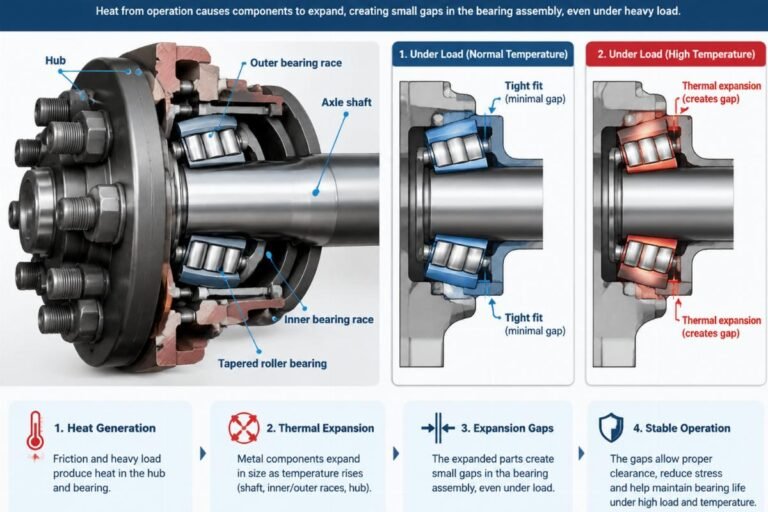
When a bearing rotates under vibration, the rolling elements do not just roll. They micro-slip, generating heat. This heat causes the inner ring to expand. If the internal clearance is insufficient, the expanded inner ring presses against the rolling elements, eliminating the necessary oil film. The result is metal-to-metal contact, rapid temperature rise, and eventual seizure. This is why a bearing that works perfectly in a stationary crusher might fail in days on a vibratory drum.
The cage design is equally critical. Standard stamped steel cages may deform under heavy shock loads, leading to uneven load distribution among the rollers. For vibratory applications, machined brass or reinforced polymer cages are often preferred because they maintain structural integrity under impact. [NEED_CITE: Cage material suitability for high-impact loads in bearing technical catalogs]
Many distributors overlook these details, focusing only on the outer diameter, inner diameter, and width. While these dimensions must match exactly, they are merely the entry ticket. The real performance lies in the internal geometry, which varies significantly between brands even for the same nominal size. A SKF spherical roller bearing and a ZWZ equivalent may share the same boundary dimensions, but their internal curvature, roller profile, and clearance tolerances can differ. Ignoring these differences is the primary cause of premature failure in heavy equipment.

How to Cross-Reference Spherical Roller Bearings for Vibratory Drums?
Match the basic dimensions but upgrade the internal clearance to handle thermal expansion.
Spherical roller bearings are the most common choice for vibratory drum main shafts due to their ability to accommodate misalignment and heavy radial loads. When sourcing equivalents, the first step is to verify the boundary dimensions against ISO 492 standards. [NEED_CITE: ISO 492 dimensional tolerance standards for rolling bearings] However, the critical step is adjusting the internal clearance.
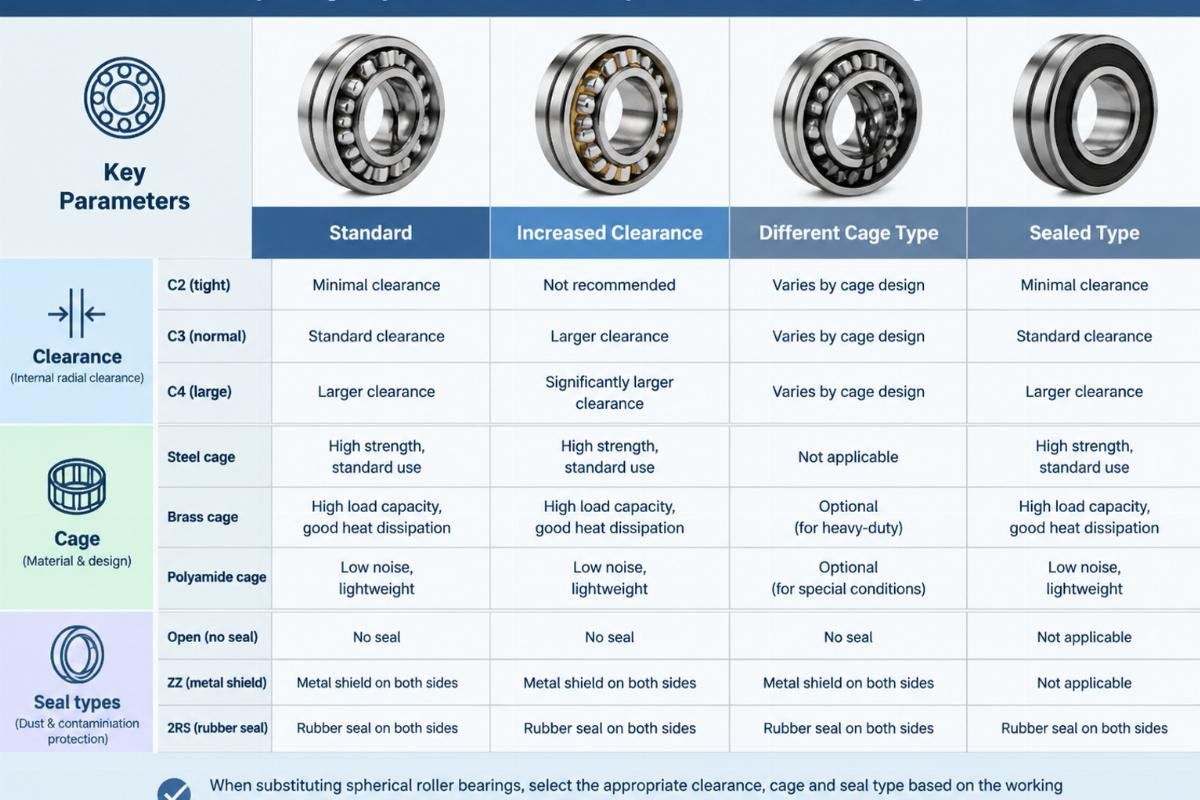
In standard applications, C3 clearance is often sufficient. In vibratory rollers, however, the operating temperature can rise significantly due to friction and ambient heat. To compensate for thermal expansion of the inner ring, a C4 clearance is typically required. Some extreme applications may even need C5. Substituting a C3 bearing for a C4 requirement will almost certainly lead to overheating and failure.
Consider a case from a road construction fleet in Southeast Asia. The operator needed to replace tapered roller bearings in the gearbox of several compactors. The original FAG bearings were unavailable due to supply chain delays. The local distributor offered a domestic alternative with identical dimensions and a lower price. The operator accepted the substitution, saving approximately fifteen percent on costs. However, within six months, three gearboxes failed due to seal leakage and grease contamination. The issue was not the bearing steel, but the seal type and grease compatibility. The equivalent bearing used a standard rubber seal that degraded faster under the specific high-temperature grease used in the region. A proper cross-reference would have verified the seal material and recommended a compatible high-temperature variant.
When cross-referencing, always request the manufacturer’s technical data sheet. Look for the following parameters:
- Internal Clearance: Ensure it matches or exceeds the original specification (e.g., C4 instead of C3).
- Cage Type: Verify if it is stamped steel, machined brass, or polymer. Machined cages are preferred for high-vibration apps.
- Seal Material: Check compatibility with the operating temperature and grease type.
What Are the Hidden Risks of Incorrect Bearing Substitution?
Ignoring cage material and seal types leads to rapid grease leakage and inner ring fretting under heavy shock loads.
The most counter-intuitive risk in bearing substitution is that cheaper equivalents often fail not due to poor steel quality, but due to incorrect clearance selection under thermal expansion. Many buyers assume that if the bearing fits, it will work. This is a dangerous assumption in vibratory applications.
Another hidden risk is fretting corrosion. If the bearing fit on the shaft is too loose, micro-movement occurs between the inner ring and the shaft. This movement breaks down the protective oxide layer, leading to fretting corrosion. Over time, this damages the shaft surface, making future bearing installations difficult and compromising structural integrity. Proper fit tolerances, defined by ISO standards, are essential to prevent this. [NEED_CITE: Shaft and housing fit recommendations per ISO 286]
In an emergency repair scenario at an African cement plant, a steering joint on a heavy-duty roller failed. The maintenance team needed a spherical plain bearing replacement immediately. They sourced a local equivalent that matched the dimensions. However, the material hardness of the sliding surface was lower than the original specification. Under the heavy load of the steering mechanism, the softer material wore down rapidly, causing play in the joint and unsafe operation. The lesson here is that dimension match is not enough. Load ratings and material hardness must also be verified.
To avoid these risks, always verify the dynamic load rating (C) of the equivalent bearing. It should meet or exceed the original specification. Additionally, check the static load rating (C0) for applications with frequent starts and stops or heavy shock loads. [NEED_CITE: Dynamic and static load rating definitions per ISO standards]

How to Verify Equivalent Bearings Before Bulk Procurement?
Request dimensional reports and material certificates to ensure traceability and avoid counterfeit parts.
Before placing a bulk order for vibratory roller bearing equivalents, due diligence is non-negotiable. Counterfeit bearings are a significant problem in the global market, especially for popular brands like SKF, FAG, and TIMKEN. These fakes often look identical to genuine products but lack the precise manufacturing tolerances and material quality required for heavy equipment.
To verify authenticity and quality, request the following documents from your supplier:
- Certificate of Origin: Confirms the manufacturing location and helps with customs clearance.
- Material Certificate: Verifies the steel grade and heat treatment process. Look for certifications that align with international standards.
- Dimensional Inspection Report: A detailed report showing measured values for inner diameter, outer diameter, width, and internal clearance. This proves the bearings meet the specified tolerances.
- Traceability Code: Genuine bearings usually have a unique batch or serial number that can be traced back to the production line.
In my experience working with distributors across Latin America and Africa, suppliers who can provide complete documentation are far more reliable. One client in the Middle East insisted on seeing the inspection reports for a large order of cylindrical roller bearings. The initial batch provided by a new supplier lacked detailed clearance measurements. Upon request, the supplier could not produce them. We switched to a different source that provided full ISO-compliant reports. The bearings performed flawlessly in high-temperature kiln applications, whereas the previous batch had shown inconsistent performance.
Our approach involves maintaining a massive spot inventory of genuine SKF, FAG, ZWZ, and HRB bearings. We perform strict document verification for every shipment to ensure customs clearance goes smoothly and clients receive exactly what they ordered. This level of transparency builds trust and ensures that your equipment stays running.

Conclusion
Precise clearance and cage design matter more than brand names in vibratory applications.
Successful substitution of vibratory roller bearing equivalents depends on matching internal clearance, cage material, and load ratings, not just outer dimensions. By verifying technical specifications and demanding proper documentation, operators can avoid costly downtime and ensure reliable performance in harsh environments. Always prioritize traceability and technical compatibility over initial cost savings.

Written by
authorEditor covering global sourcing, supplier verification, and industrial product knowledge. Content is compiled from manufacturer specifications, industry standards, and hands-on experience with international B2B buyers. Every article is fact-checked before publishing to help procurement professionals make informed decisions.
View all posts

Leave a Reply