Washing Machine Drum Bearing Equivalents: Cross-Reference & Wholesale Supplier
Identical dimensions do not guarantee a functional swap.
Selecting washing machine drum bearing equivalents requires matching internal clearance and seal types, not just bore and outer diameter specifications. A standard 6205 bearing dropped into a high-speed drum assembly will often fail catastrophically during the spin cycle if it lacks the specific C3 or C4 internal clearance and low-friction sealing required for dynamic load management.
I still recall the humid air of a Hanover trade fair years ago, standing in a booth filled with generic deep-groove ball bearings. I had secured a bulk deal for a chain of appliance repair workshops, replacing OEM parts with what appeared to be dimensionally perfect equivalents. The price was right, the steel looked sound, and the measurements matched the calipers. Yet, within weeks, my phone rang incessantly. The bearings were seizing at 1400 RPM. The issue was not the size; it was the thermal expansion. Standard industrial clearances tightened under the heat generated by high-speed dehydration, causing the rollers to bind against the raceways. That mid-six-figure loss taught me that in MRO replacements, the devil is never in the diameter—it is in the microns of play between the balls and the races.
This realization shifted my entire approach to sourcing. It is no longer about finding a part that fits the hole; it is about finding a component that survives the environment. For distributors and repair networks, understanding these nuances is the difference between a reliable supply chain and a warranty nightmare.
Why Do Standard Bearings Fail in Washing Machines?
The primary reason standard industrial bearings fail in washing machines is the mismatch between static design assumptions and dynamic operational realities. A typical washing machine drum undergoes extreme radial loads during the spin cycle, combined with significant thermal fluctuations and exposure to moisture. [NEED_CITE: failure modes in high-speed domestic appliance bearings per ISO 15243]
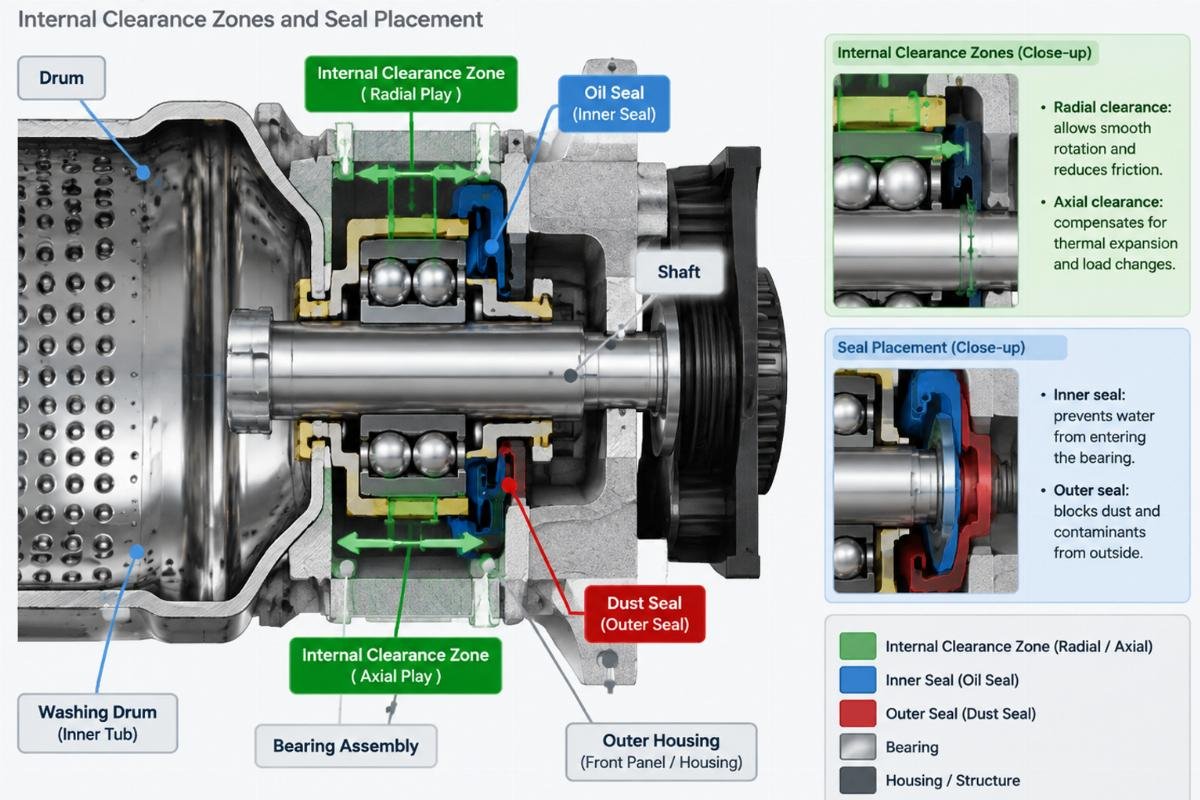
Standard deep-groove ball bearings, often sourced from general industrial stock, are typically manufactured with Normal (CN) internal clearance. This clearance is sufficient for electric motors or conveyor belts operating at moderate speeds and stable temperatures. However, a washing machine drum rotates at high velocities, generating heat that causes the inner ring to expand more than the outer ring due to its direct connection to the heated wash water and friction. Without adequate initial clearance, this thermal expansion eliminates the running gap, leading to pre-loading. The result is excessive friction, rapid temperature rise, and eventual seizure.
Furthermore, the sealing mechanism plays a critical role. Standard rubber seals on industrial bearings may have higher friction torque than the specialized low-torque seals used in appliance applications. In a high-RPM scenario, this additional friction contributes to heat buildup, accelerating grease degradation. I have seen countless batches of “equivalent” bearings returned because they could not handle the centrifugal forces acting on the grease, causing it to migrate away from the contact zone.

To avoid these failures, one must look beyond the basic boundary dimensions. The equivalent must replicate the OEM’s specific balance of clearance and seal friction. This is where a nuanced understanding of washing machine drum bearing equivalents becomes essential for any serious MRO supplier.
How to Read Washing Machine Bearing Cross-Reference Charts?
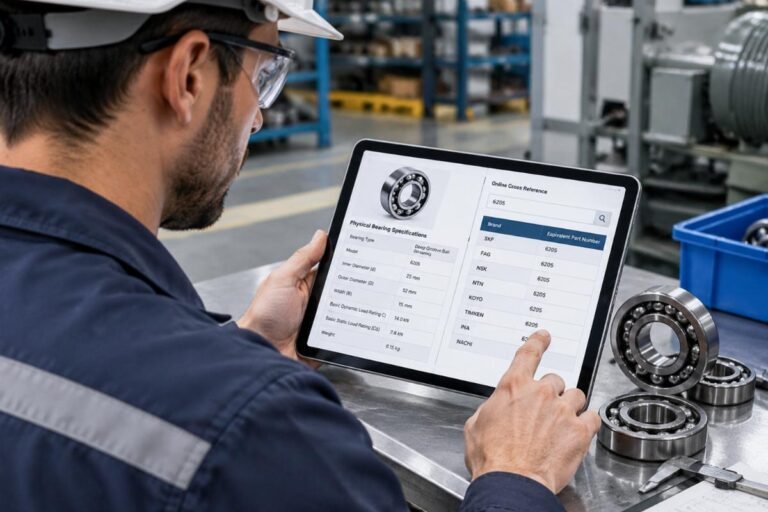
Cross-reference charts are often misleading if interpreted solely as dimension-matching tools. A typical chart might list a manufacturer’s proprietary part number alongside a standard ISO designation like 6205-2RS. While this confirms the bore, outer diameter, and width, it rarely specifies the internal clearance class or the seal material composition. [NEED_CITE: interpretation of bearing designation codes for clearance and sealing]
When evaluating a washing machine bearing cross reference, you must decode the suffixes. The prefix numbers indicate the series, but the suffixes tell the story of performance. For instance, a standard 6205-2RS indicates a double rubber-sealed bearing. However, an OEM equivalent might be designated as 6205-2RS C3. The “C3” denotes a greater internal radial clearance than standard. This extra space allows for thermal expansion without binding. Some heavy-duty applications even require C4 clearance.
Another critical aspect is the seal type. Standard RS seals are common, but some OEMs use specialized low-friction variants, sometimes indicated by specific brand-dependent suffixes or material codes like NBR (Nitrile Butadiene Rubber) with specific hardness ratings. A generic replacement might use a harder rubber compound that creates excessive drag.
| Specification | Standard Industrial Equivalent | OEM-Grade Appliance Equivalent |
|---|---|---|
| Internal Clearance | Normal (CN) | C3 or C4 |
| Seal Type | Standard Rubber (High Friction) | Low-Torque NBR or Specialized Polymer |
| Grease Type | General Purpose Lithium | High-Speed, Water-Resistant Synthetic |
| Cage Material | Stamped Steel | Reinforced Polymer or Steel |
| Dynamic Load Rating | Standard | Optimized for Shock Loads |
This table highlights why a simple dimension match is insufficient. The OEM-grade equivalent is engineered to handle the specific stresses of a washing machine, whereas the standard industrial part is designed for broader, less demanding applications. When sourcing washing machine drum bearing equivalents, verifying these suffixes and specifications is non-negotiable.

A European laundry chain once upgraded their maintenance stock to sealed equivalents with optimized C3 clearance. The result was a noticeable reduction in downtime cycles, as the bearings survived the high-speed spins without the premature failures that plagued their previous standard stock. This shift was not about buying more expensive parts; it was about buying the right specs.
What Are the Key Specs for Equivalent Selection?
Selecting the correct equivalent involves three critical parameters: internal clearance, seal friction torque, and grease life. These factors dictate whether a bearing will survive the harsh environment inside a washing machine drum.
Internal clearance is the most vital spec. As mentioned, C3 clearance is the standard for most modern high-speed washing machines. This clearance class ensures that even when the inner ring expands due to heat, there is still sufficient room for the balls to roll freely. [NEED_CITE: recommended clearance classes for high-speed rotating machinery] Ignoring this leads to the “tight fit” failure mode, where the bearing overheats and seizes.
Seal friction torque is equally important. The seal must keep water and detergent out while allowing the shaft to rotate with minimal resistance. High-friction seals generate heat, which degrades the grease and shortens the bearing’s life. Low-torque seals, often made from specialized NBR compounds, provide the necessary protection without adding significant drag. This is a key differentiator in washing machine drum bearing equivalents.
Grease life is the third pillar. Washing machine bearings are subjected to frequent start-stop cycles and varying loads. The grease must remain stable under these conditions, resisting washout from moisture and maintaining its lubricating properties over time. Standard industrial grease may emulsify or break down faster in the presence of detergent residues, leading to increased wear.

A regional distributor I worked with consolidated mixed-brand bearing packages for local appliance repair shops. By ensuring that all brands in the package met the C3 clearance and low-torque seal requirements, they reduced their warranty claims significantly. The key was not the brand name, but the adherence to these critical specs.
How to Source Reliable Equivalents for MRO?
Sourcing reliable washing machine drum bearing equivalents requires a partner who understands the technical nuances, not just a vendor who ships boxes. For MRO distributors and repair workshops, the goal is to minimize catastrophic spin-cycle bearing seizures while maintaining cost efficiency.
Traceability is paramount. Genuine bearings from reputable manufacturers come with documentation that verifies their origin and specifications. This ensures that the C3 clearance and seal types are as stated. Counterfeit or substandard parts often lack this transparency, leading to inconsistent performance. [NEED_CITE: importance of supply chain traceability in preventing counterfeit industrial components]
Consolidation of mixed-brand orders is another advantage. Repair shops often need various sizes and brands to service different machine models. A supplier who can consolidate these into a single shipment reduces logistics costs and simplifies inventory management. This is particularly useful for distributors serving multiple regions, such as the Middle East, Africa, or Southeast Asia, where shipping efficiency impacts profitability.
Technical support is also crucial. A supplier who offers cross-brand equivalent consultation can help identify the right specs for obscure or discontinued OEM parts. This prevents the trial-and-error approach that leads to wasted time and money.

In my experience, the cheapest standard bearings often cost significantly more in warranty claims than premium equivalents. By focusing on verified specs and reliable sourcing, businesses can avoid the hidden costs of failure. This approach transforms bearing procurement from a commodity purchase into a strategic advantage.
Conclusion
Precision in specification prevents failure in operation.
Selecting washing machine drum bearing equivalents is not a matter of matching dimensions alone. It requires a deep understanding of internal clearance, seal friction, and grease compatibility. By prioritizing these technical details, MRO distributors and repair workshops can ensure reliable performance and reduce costly downtime. Trust in verified specs and traceable sources to keep the spin cycle running smoothly.

Written by
authorEditor covering global sourcing, supplier verification, and industrial product knowledge. Content is compiled from manufacturer specifications, industry standards, and hands-on experience with international B2B buyers. Every article is fact-checked before publishing to help procurement professionals make informed decisions.
View all posts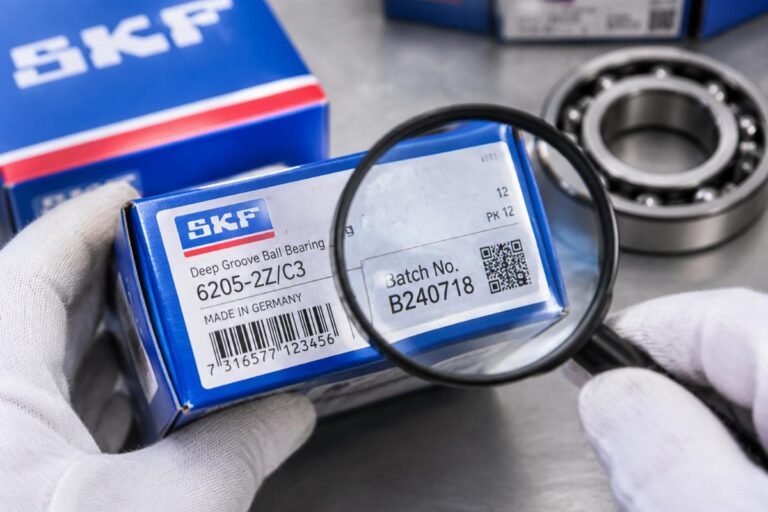

Leave a Reply