Treadmill & Gym Equipment Bearing Equivalents: Wholesale Supplier
Matching dimensions alone guarantees premature failure in high-speed fitness applications.
Selecting the correct Treadmill bearing equivalents requires matching internal clearance, seal type, and noise class to the specific load and speed parameters of the equipment, not just replicating the outer diameter and bore size. Failure to account for thermal expansion in multi-groove pulley systems or ignoring vibration standards in commercial decks leads to immediate operational noise and reduced service life, regardless of brand authenticity.
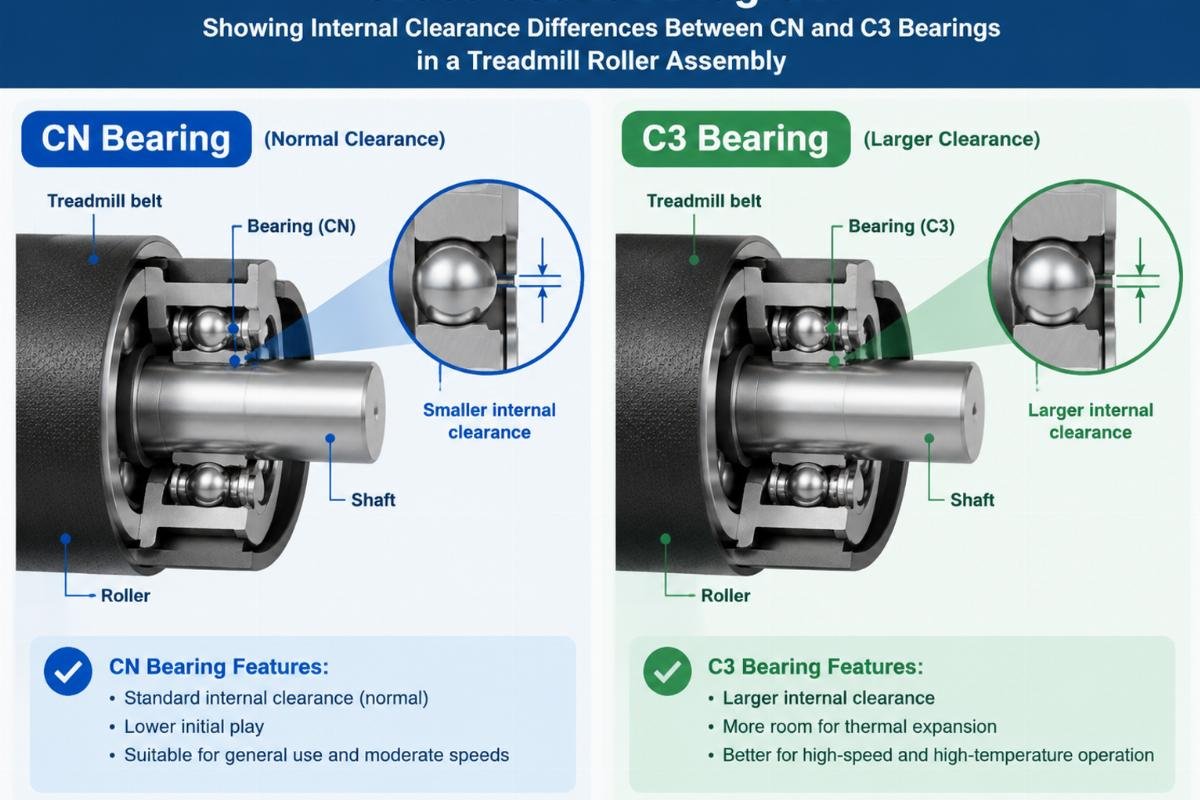
I still remember the silence in the warehouse after that container from North America was rejected. It wasn’t a quality defect in the steel; it was a specification mismatch. I had shipped standard deep groove ball bearings for a high-speed treadmill roller application. On paper, the dimensions were perfect. In reality, the standard internal clearance (CN) tightened under heat generated by friction at 20 km/h, causing the rollers to seize and emit a low-frequency hum that drove gym owners crazy. That batch taught me that in the fitness industry, a bearing is not just a mechanical component; it is an acoustic and thermal management device. [NEED_CITE: ISO 15243 failure mode classification for thermal seizure]
For distributors and MRO buyers, understanding these nuances is the difference between a one-time sale and a long-term contract. The market is flooded with options, but only a few meet the rigorous demands of continuous commercial use. This guide breaks down the technical realities behind Treadmill bearing equivalents, helping you source replacements that maintain OEM performance without the premium price tag.
Why Dimensional Match Isn’t Enough for Treadmill Bearings?
Physical fit is merely the entry ticket; operational stability depends on internal dynamics.
Most buyers assume that if a bearing fits into the housing, it will work. This is a dangerous oversimplification. Treadmills and elliptical machines operate in unique environments characterized by high rotational speeds, variable loads, and strict noise requirements. A bearing that works perfectly in a conveyor belt may fail catastrophically in a fitness machine due to incorrect internal clearance or inadequate sealing.
The primary culprit in treadmill failures is internal clearance. Standard bearings are manufactured with Normal (CN) clearance. However, treadmill rollers generate significant heat during prolonged use. As the inner ring heats up and expands, CN clearance can disappear, leading to preload and eventual seizure. For high-speed applications, such as those found in commercial treadmills running at 15-20 km/h, a C3 clearance is often required to accommodate thermal expansion. [NEED_CITE: SKF general bearing knowledge on internal clearance selection for temperature variations]
Noise class is another critical factor. Gyms are quiet environments where users expect smooth, silent operation. Bearings are graded by vibration and noise levels, typically Z1, Z2, or Z3. Using a standard industrial grade bearing in a premium home treadmill results in audible humming, which customers perceive as a defect. Selecting Treadmill bearing equivalents that meet Z2 or Z3 standards ensures the quiet operation expected by end-users.
Seal type also plays a pivotal role. Fitness equipment is often used in environments with sweat, dust, and cleaning chemicals. Open bearings attract contaminants, leading to rapid wear. Sealed bearings, particularly those with rubber contact seals (2RS), provide better protection against ingress but may generate slightly more friction. The balance between protection and efficiency must be carefully managed based on the specific machine design.

When sourcing replacements, it is essential to look beyond the part number. Verify the clearance code, noise rating, and seal material. This attention to detail prevents the costly returns and reputation damage associated with premature failures.
Cross-Reference Matrix: Top Bearing Equivalents for Gym Equipment
Brand loyalty should not override technical compatibility and cost efficiency.
Navigating the landscape of bearing brands can be daunting. SKF, NSK, FAG, and domestic Chinese manufacturers like ZWZ all produce high-quality products, but their part numbering systems differ. Creating a cross-reference matrix simplifies the sourcing process for Treadmill bearing equivalents, allowing buyers to identify reliable alternatives without compromising on performance.
The following table compares common deep groove ball bearings used in fitness equipment across major brands. Note that while dimensions are standardized per ISO 15, internal features such as cage design and grease type may vary. Always verify these details with the supplier.
| Application | Standard Size (mm) | SKF Equivalent | NSK Equivalent | FAG Equivalent | ZWZ Equivalent | Key Specification Note |
|---|---|---|---|---|---|---|
| Treadmill Roller | 6005 | 6005-2RS/C3 | 6005VVCM | 6005-2RSR-C3 | 6005-2RS | C3 Clearance Recommended |
| Elliptical Crank | 6206 | 6206-2RS | 6206VV | 6206-2RSR | 6206-2RS | Standard CN Clearance |
| Motor Pulley | 6004 | 6004-2RS/Z2 | 6004VVCM | 6004-2RSR-Z2 | 6004-2RS | Z2 Noise Class Critical |
| Incline Actuator | 608 | 608-2RS | 608VV | 608-2RSR | 608-2RS | Compact Sealed Design |
[NEED_CITE: ISO 15 dimensional standards for radial bearings]
In my experience, many distributors hesitate to switch from premium European or Japanese brands to reliable domestic alternatives due to perceived quality gaps. However, for standard gym applications, high-quality Chinese bearings from established manufacturers like ZWZ offer comparable lifespan at a fraction of the cost. The key is consistency. Sourcing from a supplier who maintains strict quality control and provides traceability ensures that every batch meets the same standards.
A case in point involves a large fitness chain in Southeast Asia. They were struggling with the high cost of maintaining their fleet using only imported bearings. By switching to verified Treadmill bearing equivalents from a trusted Chinese supplier for non-critical applications, they reduced their maintenance budget significantly while maintaining uptime. The critical factor was not the brand name, but the rigorous testing of each batch for noise and clearance compliance.

When evaluating equivalents, focus on the manufacturer’s reputation and their adherence to international standards. Request sample batches for testing before committing to large orders. This approach mitigates risk and builds confidence in the alternative supply chain.
How to Diagnose Bearing Failures in Fitness Machines?
Symptoms are the language of the machine; learning to listen saves time and money.
Diagnosing bearing failures in fitness equipment requires a systematic approach. Noise, vibration, and heat are the primary indicators of underlying issues. By correlating these symptoms with specific bearing characteristics, maintenance teams can identify the root cause and select the correct Treadmill bearing equivalents for replacement.
High-pitched whining or humming usually indicates a noise class mismatch or lack of lubrication. If the bearing is sealed, lubrication cannot be added, suggesting that the original specification was incorrect for the application. In such cases, upgrading to a bearing with higher quality grease or a different seal design may be necessary. [NEED_CITE: Vibration and noise class standards ISO 15242]
Grinding or crunching sounds often point to contamination. Dust, sweat, or metal particles have entered the bearing raceway, causing abrasive wear. This is common in open bearings used in dusty gym environments. Switching to sealed bearings with robust rubber lips can prevent recurrence.
Excessive heat is a sign of incorrect internal clearance or misalignment. As mentioned earlier, standard clearance bearings can tighten under heat, leading to increased friction and temperature rise. Checking the clearance specification and ensuring proper installation alignment can resolve this issue. In some cases, switching to C3 clearance bearings provides the necessary thermal allowance.
Vibration felt through the handrails or deck suggests imbalance or raceway damage. This can result from heavy loads or shock impacts during use. For commercial treadmills subjected to intense usage, selecting bearings with higher dynamic load ratings and robust cage designs enhances durability.

Accurate diagnosis prevents unnecessary replacements and ensures that the new bearing addresses the actual problem. Training maintenance staff to recognize these signs improves equipment reliability and user satisfaction.
Sourcing Strategy: Single-Brand vs. Multi-Brand Consolidation
Efficiency in logistics often outweighs the marginal gains of single-brand purity.
For regional distributors and MRO buyers, sourcing strategy is as important as technical selection. Maintaining inventory for multiple brands increases complexity and capital tie-up. Consolidating purchases from a single supplier who offers a multi-brand portfolio simplifies logistics and reduces lead times.
A single-brand strategy ensures consistency but limits flexibility. If a specific brand faces supply chain disruptions, operations can stall. In contrast, a multi-brand consolidation approach allows buyers to switch between equivalents based on availability and cost without changing suppliers. This resilience is crucial in today’s volatile global market.
I have seen buyers save weeks in lead time by consolidating their orders for deep groove and spherical roller bearings from one supplier. Instead of managing separate shipments from SKF, NSK, and local manufacturers, they receive a single mixed container. This not only reduces shipping costs but also simplifies customs clearance and inventory management. [NEED_CITE: Supply chain resilience strategies for MRO sectors]
Moreover, a reputable multi-brand supplier provides technical support across different product lines. They can advise on the best Treadmill bearing equivalents for specific applications, leveraging their broad experience. This value-added service helps buyers make informed decisions and avoid costly mistakes.
When selecting a supplier, look for those with substantial spot inventory and the ability to handle mixed-container shipments. Flexibility in MOQ is also important, allowing buyers to order small batches for emergency repairs alongside larger volumes for stock replenishment. Traceability documentation ensures that all products, regardless of brand, meet genuine quality standards.

By adopting a flexible sourcing strategy, buyers can optimize their inventory, reduce costs, and ensure uninterrupted supply for their customers.
Conclusion
Precision in specification beats prestige in branding for fitness equipment longevity.
Selecting the right Treadmill bearing equivalents is a technical exercise that demands attention to clearance, noise, and sealing details. By moving beyond simple dimensional matching and understanding the operational demands of fitness machines, buyers can secure reliable, cost-effective solutions. Consolidating sourcing through a knowledgeable multi-brand supplier further enhances efficiency and resilience, ensuring that gyms remain quiet, smooth, and operational.

Written by
authorEditor covering global sourcing, supplier verification, and industrial product knowledge. Content is compiled from manufacturer specifications, industry standards, and hands-on experience with international B2B buyers. Every article is fact-checked before publishing to help procurement professionals make informed decisions.
View all posts


Leave a Reply