22215 Bearing Specs & Equivalents: Wholesale Supplier
Identical dimensions do not guarantee identical performance.
Selecting a reliable 22215 bearing specs and equivalents replacement requires matching internal clearance, cage material, and dimensional tolerances to the specific operating environment, not just copying the outer diameter and width. A mismatch in radial internal clearance or cage composition can lead to premature seizure or fatigue failure, even if the part number appears correct on paper.
I still recall the silence in a Middle East steel mill’s control room after a conveyor line halted. The maintenance team had swapped a failed unit with what they believed was a direct equivalent. The outer ring measured 130 mm, the inner 75 mm, and the width 31 mm. On paper, it was a perfect match. In reality, the thermal expansion of the shaft during high-load operation exceeded the limits of the standard clearance installed. The rollers bound against the raceways, generating enough heat to weld the cage to the inner ring. That incident shifted my focus from simple part-number matching to a rigorous verification of technical parameters. Understanding the nuance behind 22215 spherical roller bearing cross reference data is critical for avoiding such costly downtime.

This guide breaks down the essential specifications for the 22215 spherical roller bearing, offering a clear framework for evaluating equivalents across major brands. We will examine how internal clearance classes dictate thermal performance, why cage materials matter in high-vibration environments, and how to verify dimensional tolerances against international standards.
What Are the Core Dimensions of 22215?
The basic boundary dimensions are standardized, but tolerance classes define fit and reliability.
The 22215 designation follows the ISO 15 series for spherical roller bearings. The primary dimensions are consistent across most manufacturers: an inner diameter of 75 mm, an outer diameter of 130 mm, and a width of 31 mm. However, relying solely on these three numbers is insufficient for critical applications. The fit between the bearing and the shaft or housing depends on the tolerance class, which varies by brand and production batch.
According to ISO 492, standard industrial bearings typically adhere to Normal Class (P0) tolerances. For high-precision applications, such as machine tool spindles or high-speed fans, P6 or P5 classes may be required. A common error in sourcing 22215 bearing dimensions and clearance replacements is assuming that all “standard” bearings have identical geometric tolerances. In reality, slight variations in roundness or parallelism can affect load distribution and noise levels.
| Parameter | Standard Value (ISO 15) | Tolerance Class (Typical) | Verification Method |
|---|---|---|---|
| Inner Diameter (d) | 75 mm | Normal (P0) / Precision (P6) | Micrometer measurement at multiple points |
| Outer Diameter (D) | 130 mm | Normal (P0) / Precision (P6) | Caliper or bore gauge check |
| Width (B) | 31 mm | Normal (P0) | Depth gauge or caliper |
| Chamfer Dimension | Varies by manufacturer | Standard | Visual inspection and gauge |
[NEED_CITE: ISO 492 tolerance limits for radial bearings]
When evaluating a 22215 spherical roller bearing cross reference, always request the inspection certificate that specifies the actual measured tolerances. A reputable supplier will provide traceability documentation showing that the batch meets the declared ISO class. This is particularly important when mixing brands in a single assembly, as inconsistent tolerances can lead to uneven preload or misalignment.

How Do Internal Clearances Affect 22215 Performance?
Clearance selection dictates the bearing’s ability to handle thermal expansion and misalignment.
Radial internal clearance is the gap between the rollers and the raceways when the bearing is unloaded. It is not a fixed value but a range defined by standards such as ISO 5753. The most common clearance groups are CN (Normal), C3 (Greater than Normal), and C4 (Even Greater). Choosing the wrong group is a frequent cause of premature failure.
In high-temperature environments, such as near kilns or in heavy-duty crushers, the inner ring expands more than the outer ring due to heat transfer from the shaft. If a CN clearance bearing is used where a C3 is required, the expansion eliminates the internal gap, causing the rollers to bind. This generates excessive friction, leading to rapid temperature rise and eventual seizure. Conversely, using a C4 clearance in a low-load, low-temperature application can result in excessive vibration and noise due to too much play.
| Clearance Group | Typical Application Scenario | Thermal Expansion Handling | Vibration Resistance |
|---|---|---|---|
| CN (Normal) | General industrial motors, pumps | Low | Moderate |
| C3 | Heavy machinery, conveyors, fans | Moderate | Good |
| C4 | High-temperature ovens, severe misalignment | High | Lower (due to play) |
[NEED_CITE: ISO 5753 radial internal clearance values for spherical roller bearings]
A Latin American distributor once consolidated a container order with mixed brands for a mining client. The specification called for C3 clearance, but a portion of the shipment contained CN units due to a labeling error at the source. The client installed them in a high-heat crusher application. Within weeks, multiple bearings failed due to thermal locking. This highlights why verifying the clearance marking on the bearing side face is non-negotiable. When sourcing 22215 bearing specs and equivalents, ensure the supplier confirms the clearance group matches the operational thermal profile.

What Are the Best Cross-Brand Equivalents for 22215?
Equivalency requires matching more than just the part number; it demands alignment of design philosophy.
Major global brands like SKF, FAG, NTN, and domestic leaders like ZWZ and HRB produce 22215 bearings that are dimensionally interchangeable. However, subtle differences in manufacturing processes, material purity, and quality control can affect service life. A 22215 spherical roller bearing cross reference matrix helps buyers compare these options based on key performance indicators rather than just price.
SKF and FAG are often preferred for high-reliability applications due to their stringent quality controls and advanced steel cleanliness. NTN and NSK offer strong alternatives with excellent balance in performance and cost. Domestic Chinese brands like ZWZ and HRB have improved significantly and provide viable options for less critical applications or where budget constraints are tight. The key is to ensure that the alternative brand meets the same ISO standards for dimensional accuracy and load capacity.
| Brand Origin | Typical Strengths | Recommended Use Case | Traceability Level |
|---|---|---|---|
| European (SKF, FAG) | High precision, superior steel cleanliness | Critical OEM, high-speed, heavy-load | Full batch-level |
| Japanese (NTN, NSK) | Balanced performance, reliable quality | General industrial, automotive, MRO | Full batch-level |
| Chinese (ZWZ, HRB) | Cost-effective, wide availability | Non-critical MRO, agricultural, construction | Sample-level to Batch-level |
[NEED_CITE: Comparative analysis of bearing steel cleanliness standards]
When consolidating orders for container shipments, mixing premium and domestic brands can optimize costs without compromising critical safety margins. For instance, use premium brands for main drive shafts and reliable domestic equivalents for auxiliary rollers. Ensure that the supplier provides distinct packaging and clear labeling to prevent mix-ups during installation. Our consultation service helps clients map out these mixed-batch strategies, ensuring that each 22215 bearing specs and equivalents choice aligns with the specific risk profile of the application.

Why Do Cage Materials Matter in 22215 Equivalents?
The cage holds the rollers in place and must withstand the specific stresses of the application.
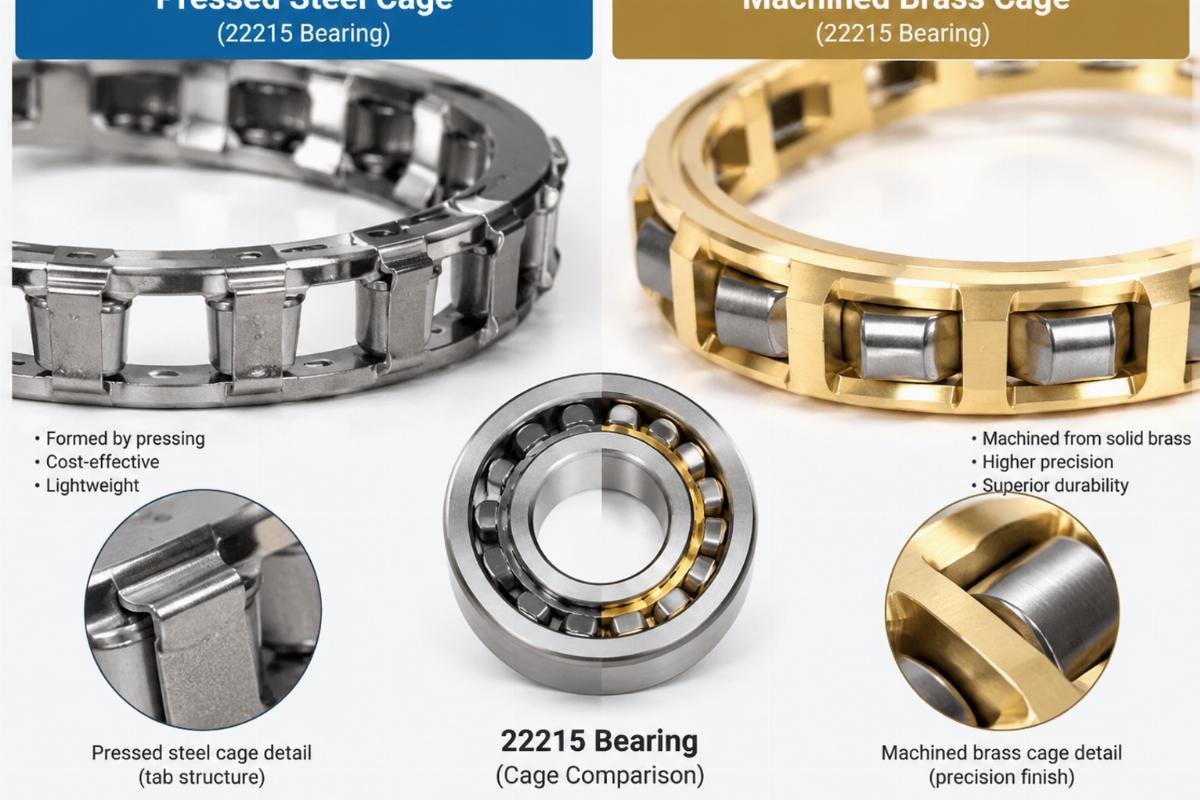
Spherical roller bearings typically come with either pressed steel cages or machined brass cages. The choice between them is not arbitrary. Pressed steel cages are lightweight and suitable for moderate speeds and loads. They are cost-effective and widely available. However, in applications with high shock loads, severe vibration, or high temperatures, steel cages may be prone to fatigue or deformation.
Machined brass cages offer greater strength and better resistance to shock and vibration. They also perform better at higher temperatures due to brass’s thermal properties. In mining crushers or vibrating screens, a steel cage might crack under repeated impact, leading to roller misalignment and catastrophic failure. A brass cage, while more expensive, provides the durability needed for such harsh conditions.
| Cage Material | Shock Load Resistance | Temperature Limit | Typical Application |
|---|---|---|---|
| Pressed Steel | Moderate | Up to 120°C | General machinery, fans, pumps |
| Machined Brass | High | Up to 150°C | Crushers, vibrating screens, heavy-duty gearboxes |
[NEED_CITE: Cage material performance guidelines for spherical roller bearings]
A European wind farm operator reported extended service life after switching from steel to brass cages in their main gearbox bearings. The high vibration levels in the nacelle were causing micro-fractures in the steel cages. The switch to brass eliminated this failure mode. When reviewing 22215 bearing specs and equivalents, always check the cage type suffix in the part number (e.g., M for brass, J or no suffix for steel). Ignoring this detail can lead to selecting a cheaper equivalent that fails prematurely under operational stress.
Conclusion
Correct specification prevents premature failure.
Selecting the right 22215 bearing specs and equivalents involves a holistic review of dimensions, internal clearance, and cage material. Relying solely on part numbers ignores the technical nuances that determine real-world performance. By verifying tolerance classes, matching clearance to thermal conditions, and choosing appropriate cage materials, buyers can ensure reliability and cost-efficiency. Always demand traceability and technical documentation to confirm that the equivalent meets the required ISO standards for your specific application.

Written by
authorEditor covering global sourcing, supplier verification, and industrial product knowledge. Content is compiled from manufacturer specifications, industry standards, and hands-on experience with international B2B buyers. Every article is fact-checked before publishing to help procurement professionals make informed decisions.
View all posts

Leave a Reply