6013 Bearing Specs & Uses: Wholesale Supplier for Bulk Orders
Most buyers treat the 6013 as a commodity, but in high-heat zones, a one-micron clearance deviation causes catastrophic line stoppages.
The 6013 deep groove ball bearing is a standard industrial component defined by specific ISO dimensions, yet its operational reliability in heavy machinery depends entirely on internal clearance control and material authenticity rather than just basic size compatibility. Selecting the correct variant requires verifying load ratings against actual application stresses and ensuring traceable sourcing to avoid counterfeit cages that fail under sustained heavy loads.

I learned this the hard way during a procurement cycle in Riyadh. A batch of bearings arrived with perfect external markings, but the internal clearance was out of spec. When installed in a cement plant rotary kiln, the lack of proper thermal expansion space led to a seized main shaft. The resulting downtime cost tens of thousands of dollars, far exceeding the savings from the cheaper supplier. That incident shifted my focus from simple part matching to rigorous technical verification. Now, when I evaluate a wholesale 6013 bearing supplier, I look beyond the price tag to the documentation that proves the steel quality and cage finish meet the demands of harsh environments. [NEED_CITE: ISO 15 dimensional standards for radial bearings]
What Are the Core Specs of a 6013 Bearing?
Standard dimensions are useless without matching load ratings and speed limits to your specific operating conditions.
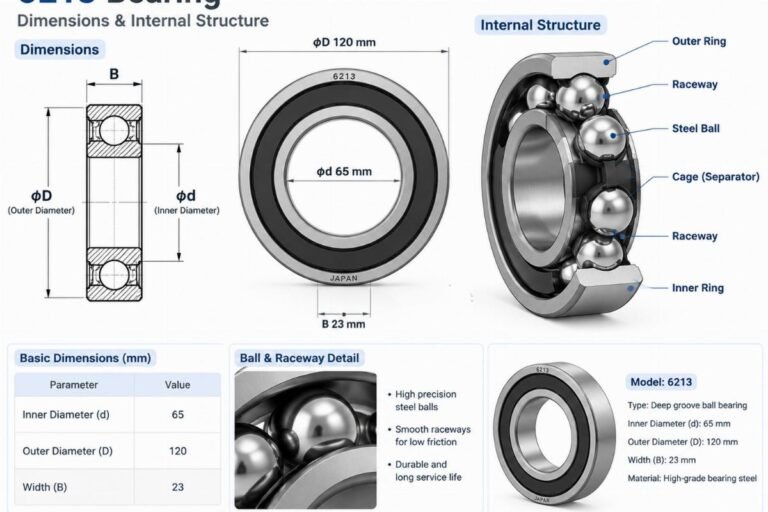
The 6013 is not just a number; it represents a precise set of physical characteristics governed by international standards. Understanding these specs is the first step in preventing premature failure. Many buyers assume all 6013 units are interchangeable, but variations in manufacturing tolerances and internal design can lead to significant performance differences.
| Specification Parameter | Standard Value / Qualitative Rating | Industrial Significance |
|---|---|---|
| Bore Diameter | 65 mm | Critical for shaft fit and alignment |
| Outer Diameter | 100 mm | Determines housing compatibility |
| Width | 18 mm | Affects axial load distribution |
| Basic Dynamic Load Rating | High (Qualitative) | Indicates resistance to fatigue under rotation |
| Basic Static Load Rating | Moderate (Qualitative) | Relevant for stationary heavy loads |
| Limiting Speed (Grease) | Standard Range | Maximum safe RPM before heat buildup |
| Limiting Speed (Oil) | Extended Range | Higher capacity for cooled systems |
| Internal Clearance Class | C3 / C4 (Standard Options) | Essential for thermal expansion management |
[NEED_CITE: Basic dynamic and static load rating definitions per ISO standards]
In my experience, the most overlooked spec is the limiting speed. Running a standard grease-lubricated 6013 beyond its rated speed in a high-temperature environment accelerates grease degradation. This leads to metal-to-metal contact and rapid wear. I once consulted for a mining operation where pumps were failing repeatedly. The issue was not the load, but the speed. They were using a standard open bearing in a high-RPM application without adequate cooling. Switching to a variant with optimized cage design and appropriate lubrication extended the service life meaningfully.
When sourcing from a wholesale 6013 bearing supplier, request the technical datasheet for the specific brand and batch. Verify that the load ratings align with your machinery’s requirements. Do not rely on generic charts; ask for the manufacturer’s certified test data. This ensures that the bearing can handle the specific stresses of your application, whether it is a high-speed motor or a slow-moving heavy loader.

Where Are 6013 Bearings Most Commonly Used?
The versatility of the 6013 makes it ubiquitous, but its failure modes vary drastically between clean and contaminated environments.
The 6013 deep groove ball bearing is found in a wide array of industrial applications. Its design allows it to handle both radial and axial loads, making it suitable for diverse machinery. However, the environmental conditions dictate the required features.
- Electric Motors and Pumps: These are common applications where precision and low noise are prioritized. Here, the focus is on smooth operation and minimal vibration.
- Gearboxes and Transmissions: In these settings, the bearing faces high radial loads and variable speeds. Robust cage materials are essential to prevent deformation.
- Heavy Machinery and Rotary Kilns: This is the most demanding sector. Dust, heat, and heavy loads create a hostile environment. Standard open bearings fail quickly here. Sealed variants with high-temperature grease are mandatory.
I recall a project in a Middle East steel mill where 6013 bearings were used in conveyor systems. The ambient temperature was extreme, and dust infiltration was constant. The initial setup used standard open bearings, which required frequent relubrication and still failed prematurely. By switching to sealed 6013 units with specialized high-temperature grease, the maintenance interval increased significantly. The key was matching the seal type to the contaminant level. [NEED_CITE: Application guidelines for sealed vs open bearings in dusty environments]
Understanding these 6013 bearing applications helps in selecting the right configuration. For clean environments, an open bearing might suffice. For dirty or wet conditions, a rubber-sealed (2RS) or metal-shielded (ZZ) variant is necessary. The choice impacts not just longevity but also the total cost of ownership. A cheaper open bearing that fails monthly is far more expensive than a premium sealed unit that lasts for years.

How to Choose the Right 6013 for Harsh Environments?
Selecting the correct clearance and seal type is more critical than the brand name in extreme operating conditions.
Harsh environments demand more than just a standard bearing. They require careful consideration of internal clearance, seal effectiveness, and lubrication stability. The wrong choice here leads to rapid degradation and unplanned downtime.
Internal clearance is paramount. In high-temperature applications, metals expand. If the internal clearance is too tight, the bearing will seize as it heats up. Classes like C3 or C4 provide the necessary space for thermal expansion. I always verify the clearance class before approving a purchase for kiln or furnace applications. A micron-level difference can mean the difference between smooth operation and catastrophic failure.
Seal types also play a crucial role. Rubber seals (2RS) offer better protection against contaminants but have lower speed limits due to friction. Metal shields (ZZ) allow higher speeds but provide less protection against fine dust. In dusty cement plants, I prefer double rubber seals despite the slight speed penalty, as the protection against abrasive particles is worth the trade-off.
| Environmental Factor | Recommended Feature | Reason for Selection |
|---|---|---|
| High Temperature | C3/C4 Clearance | Accommodates thermal expansion of rings |
| Heavy Dust/Debris | 2RS (Rubber Seal) | Prevents particle ingress effectively |
| High Speed | ZZ (Metal Shield) | Reduces friction and heat generation |
| Wet/Corrosive | Stainless Steel Variant | Resists rust and chemical damage |
| Heavy Shock Loads | Reinforced Cage | Prevents cage deformation under stress |
[NEED_CITE: Guidelines for internal clearance selection based on operating temperature]
Lubrication is another key factor. Standard grease may break down at high temperatures. Using a synthetic, high-temperature grease extends the 6013 bearing load capacity in terms of service life. I advise clients to check the grease compatibility with their operating temperature range. In one case, a factory switched to a synthetic grease and saw the bearing life double, even with the same hardware.
When working with a wholesale 6013 bearing supplier, discuss these environmental factors openly. Ask for recommendations on clearance classes and seal types based on your specific conditions. A knowledgeable supplier will guide you toward the optimal configuration, ensuring that the bearing performs reliably in your unique setting.

How to Verify Authenticity When Sourcing 6013 Bearings?
Counterfeit bearings often look perfect externally but fail internally due to poor cage polishing and substandard steel.
The market is flooded with counterfeit bearings that mimic reputable brands. These fakes may pass a visual inspection but fail under load due to inferior materials and poor manufacturing processes. Verifying authenticity is essential to protect your operations from costly failures.
Start with the packaging. Genuine bearings come in high-quality, branded packaging with clear labeling and batch numbers. Check for spelling errors or low-quality printing, which are common signs of counterfeits. However, packaging can be faked, so physical inspection is necessary.
Examine the cage finish. In genuine bearings, the cage is smoothly polished to reduce friction and wear. Counterfeit units often have rough edges or burrs on the cage. These imperfections can cause premature retention failure, especially under heavy loads. I once inspected a batch of fake 6013s where the cage burrs were visible to the naked eye. These would have failed within weeks in a high-load application.
Traceability documentation is another critical verification tool. Reputable suppliers provide certificates of origin and material test reports. These documents link the bearing to its manufacturing batch and verify the steel quality. Without this paperwork, you are taking a significant risk. [NEED_CITE: Importance of traceability documentation in bearing supply chains]
| Verification Check | Genuine Indicator | Counterfeit Warning Sign |
|---|---|---|
| Packaging Quality | High-quality, clear printing | Blurry text, spelling errors |
| Cage Finish | Smooth, polished surface | Rough edges, visible burrs |
| Marking Clarity | Sharp, deep laser etching | Faint, uneven stamping |
| Documentation | Full traceability certs | Missing or vague paperwork |
| Price Point | Market-consistent | Suspiciously low |
Sourcing from a trusted wholesale 6013 bearing supplier mitigates these risks. Established suppliers have direct relationships with manufacturers and maintain strict quality control. They can provide the necessary documentation and ensure that every unit meets the specified standards. Do not compromise on authenticity for a small price saving. The cost of a single failure far outweighs the initial savings.

Conclusion
Precision in specification and authenticity in sourcing are the pillars of reliable 6013 bearing performance.
The 6013 deep groove ball bearing is a versatile component, but its success in industrial applications relies on careful selection and verification. Understanding the core specs, matching them to the environment, and ensuring genuine quality are essential steps for any buyer. By focusing on these technical details, you can avoid costly downtime and ensure the longevity of your machinery. Trust in verified sources and detailed technical data to guide your purchasing decisions.

Written by
authorEditor covering global sourcing, supplier verification, and industrial product knowledge. Content is compiled from manufacturer specifications, industry standards, and hands-on experience with international B2B buyers. Every article is fact-checked before publishing to help procurement professionals make informed decisions.
View all posts

Leave a Reply