6213 Bearing Specs & Brand Equivalents: Wholesale Supplier
Identical outer dimensions do not guarantee identical performance.
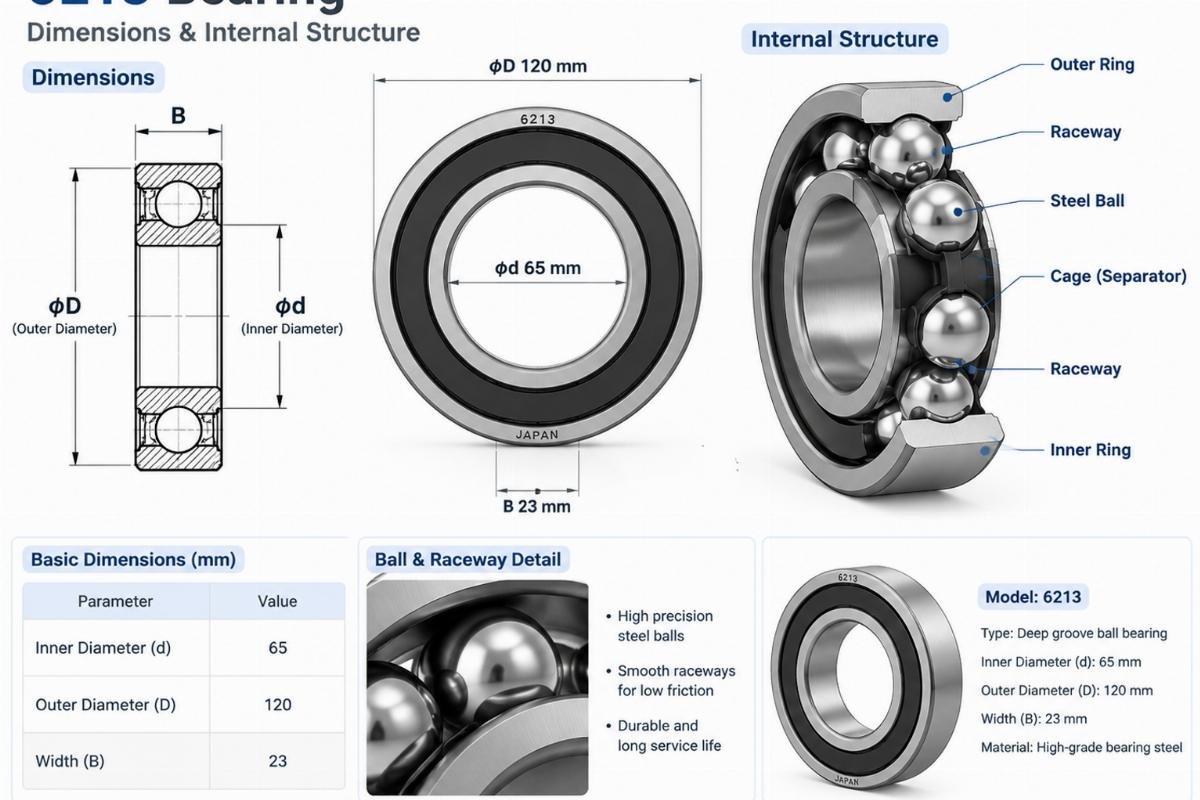
A 6213 bearing is a deep groove ball bearing with standard dimensions of 65 mm bore, 120 mm outer diameter, and 23 mm width. However, its real-world viability depends entirely on internal clearance classes such as C3 or C4, seal types like 2Z or 2RS, and precise adherence to ISO tolerance standards rather than mere physical fit.
I learned this the hard way in a dusty industrial zone near Riyadh. A water treatment plant manager called me in a panic because their motor had seized just weeks after installation. I had supplied open 6213 units based solely on the dimensional drawing, assuming standard stock would suffice. The desert environment was unforgiving. Fine silica dust penetrated the open raceways within days, acting as an abrasive paste that destroyed the rolling elements. The motor locked up, production halted, and I nearly lost the entire contract over a component that cost less than a tank of fuel. That failure shifted my focus from simple part matching to rigorous technical verification of suffixes and environmental protections. Today, when clients ask for a 6213 bearing specs sheet, I first ask about the operating temperature, contamination risk, and load direction before quoting a single brand.
Understanding these nuances separates a reliable supply chain from a costly liability. Let us break down exactly what makes this specific bearing tick and how to source it correctly across major global brands.
What Are the Core Specs of a 6213 Bearing?
The 6213 designation defines a specific geometric footprint, but operational limits are dictated by material grade and manufacturing precision.
At its most basic level, the 6213 is a medium-duty deep groove ball bearing. The numbers are not arbitrary; they follow the ISO dimension series. The ‘6’ indicates the deep groove ball bearing type, ‘2’ represents the width series, and ’13’ multiplied by five gives the bore diameter in millimeters. This results in the universal 65x120x23 mm profile. However, knowing the size is only the entry ticket. The critical data lies in the load ratings and speed limits, which vary significantly depending on the manufacturer’s internal design and cage material.
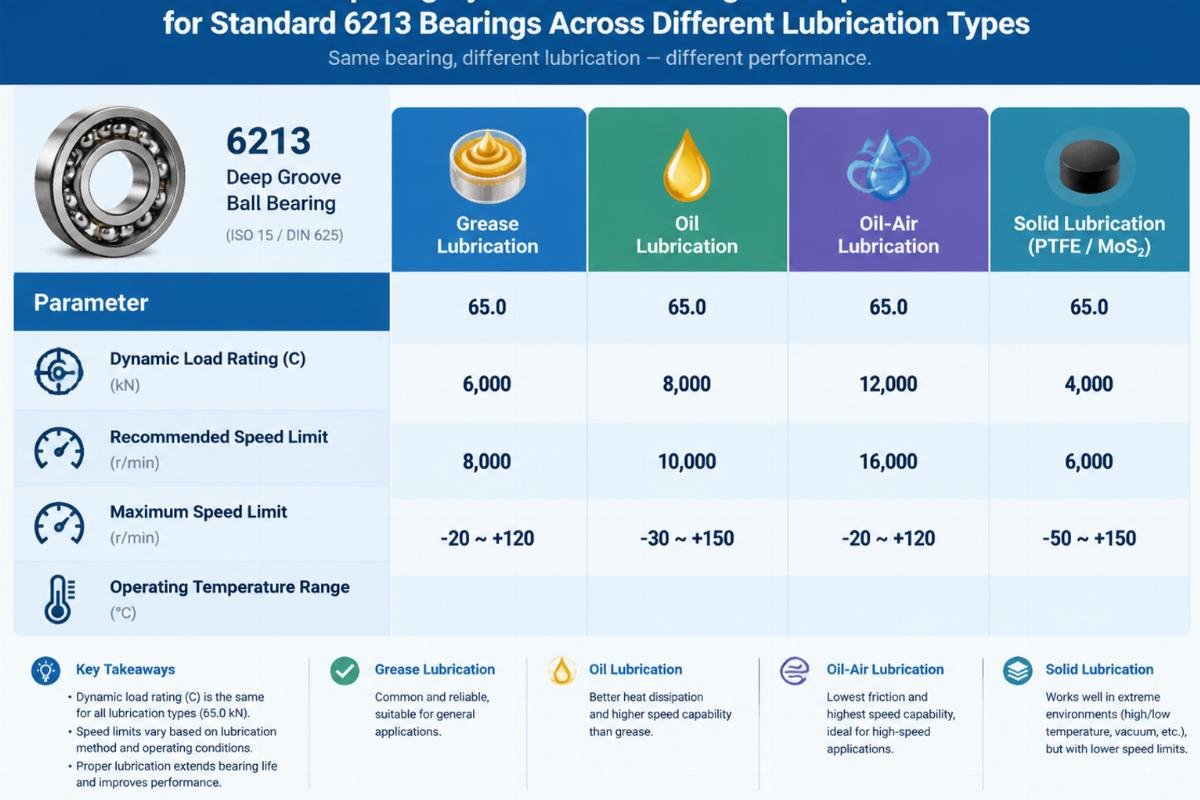
For procurement professionals, the static and dynamic load ratings are vital for calculating service life. While exact values differ slightly between premium European brands and high-quality Asian manufacturers, the general capacity remains consistent for standard applications. The limiting speed is another crucial factor. Grease-lubricated versions typically have lower speed limits compared to oil-lubricated ones due to heat generation within the grease matrix. Ignoring these thermal limits can lead to premature grease breakdown and subsequent bearing failure, even if the load is within acceptable ranges.
| Parameter | Standard Value / Description | Notes |
|---|---|---|
| Bore Diameter | 65 mm | Fixed by ISO standard |
| Outer Diameter | 120 mm | Fixed by ISO standard |
| Width | 23 mm | Fixed by ISO standard |
| Bearing Type | Deep Groove Ball | Single row, non-separable |
| Cage Material | Steel or Polyamide | Varies by brand and suffix |
| Precision Class | P0 (Normal) | Higher grades like P6 available on request |
When reviewing a datasheet, always verify the precision class. Most general industrial applications use Normal class (P0), which aligns with ISO 492 standards for general tolerances [NEED_CITE: ISO 492 tolerance classes for radial bearings]. For high-speed spindles or precision machinery, you may need P6 or P5 classes, which require tighter control over radial runout and bore deviation. Sourcing a 6213 bearing specs document that omits these precision details is a red flag. It suggests the supplier may be offering commercial-grade products where dimensional consistency is loosely controlled, leading to vibration issues in sensitive equipment.
How Do Brand Equivalents Compare Across SKF, FAG, and NSK?
Cross-referencing part numbers requires more than matching digits; it demands an understanding of minor design variations that affect interchangeability.
In the global bearing market, SKF, FAG, NSK, and other premium brands produce 6213 units that are physically interchangeable but internally distinct. A buyer might assume that an SKF 6213 is identical to an FAG 6213-2RSR, but the suffixes tell a different story. These suffixes denote seal types, cage designs, and internal clearances that are not always uniform across brands. For instance, one brand’s standard shield might offer better dust exclusion than another’s, while their grease formulations may have different temperature thresholds.
When building a mixed-brand inventory for MRO purposes, it is essential to map these equivalents accurately. A direct swap without checking the suffix can lead to compatibility issues, particularly regarding housing fit and shaft tolerance. Below is a comparative overview of how major brands structure their 6213 offerings. Note that while the core dimensions remain constant, the optional features vary.
| Brand | Standard Open Model | Shielded Variant | Sealed Variant | Common Cage Material |
|---|---|---|---|---|
| SKF | 6213 | 6213-2Z | 6213-2RS1 | Steel or Polymer |
| FAG | 6213 | 6213-2SR | 6213-2RSR | Steel or Polyamide |
| NSK | 6213 | 6213-ZZ | 6213-DDU | Steel or Resin |
| NTN | 6213 | 6213-ZZ | 6213-LUU | Steel or Plastic |
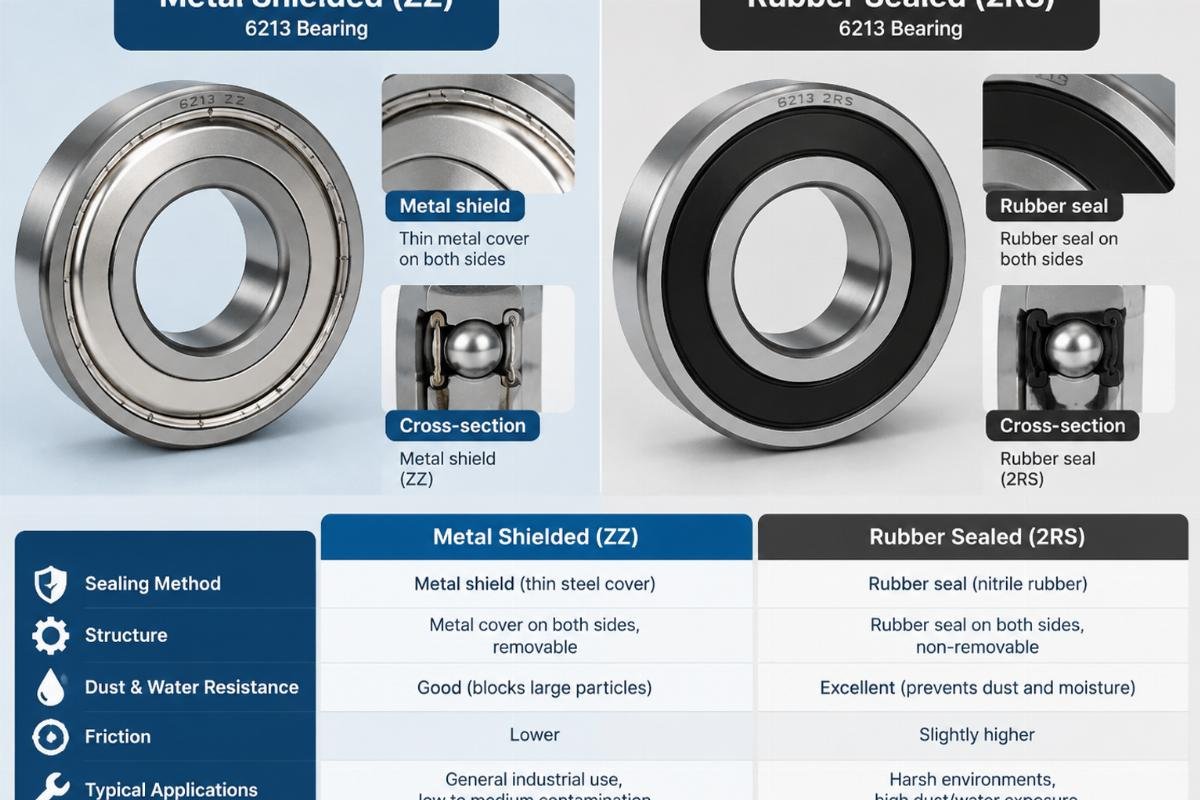
The table above illustrates the naming conventions. Notice how ‘2Z’ in SKF corresponds to ‘ZZ’ in NSK and ‘2SR’ in FAG for metal shields. Similarly, rubber seals are denoted by ‘2RS1’, ‘DDU’, or ‘2RSR’. These are not just cosmetic differences. Metal shields offer low friction and high-speed capability but provide limited protection against fine contaminants. Rubber seals create a tighter barrier against dust and moisture but generate more heat due to contact friction. Choosing the wrong equivalent for a high-speed application can cause overheating, while choosing an open bearing for a dirty environment leads to rapid contamination.
I once assisted a distributor in Southeast Asia who was trying to substitute NSK units with FAG equivalents for a textile machine application. The machines ran at high speeds, and the original NSK bearings used low-friction shields. The FAG equivalents they sourced had contact seals, which increased running temperature significantly. The motors began tripping on thermal overload sensors within weeks. By switching to the correct shielded equivalent, the issue was resolved. This highlights why understanding the 6213 brand equivalents goes beyond simple part number matching. It requires a functional understanding of the application environment.
Why Do Suffixes and Clearances Dictate Real-World Performance?
Internal clearance and seal selection are often more critical than the brand name itself in determining bearing lifespan.
The suffixes attached to a 6213 part number are not mere administrative codes; they are engineering instructions. The most commonly overlooked aspect is internal radial clearance. Standard bearings come with Normal clearance (C0). However, in applications involving significant thermal expansion, such as electric motors or gearboxes, Normal clearance can become insufficient. As the shaft heats up, it expands, reducing the internal space between the balls and raceways. If the initial clearance is too tight, this expansion can lead to preload, causing excessive heat generation and eventual seizure.
This is where C3 clearance becomes essential. A 6213-2RS1-C3 bearing has greater internal space than a standard unit, accommodating thermal growth without inducing harmful preload. In my experience supplying parts to heavy industry in the Middle East, ambient temperatures alone can raise operating baselines significantly. Using a standard clearance bearing in a hot environment is a recipe for failure. Conversely, using C3 clearance in a cold, precision application might result in excessive vibration and noise due to loose internal fit.
| Suffix Code | Meaning | Application Impact |
|---|---|---|
| Z / ZZ / 2Z | Metal Shield | Low friction, moderate dust protection, high speed |
| RS / 2RS / DDU | Rubber Seal | High contamination protection, higher friction, lower speed |
| C3 | Increased Clearance | Compensates for thermal expansion, prevents preload |
| C4 | Greater Clearance | For extreme temperature differentials or heavy misalignment |
| JEM | Steel Cage, Centring | Standard for larger sizes, robust for heavy loads |
Another critical suffix element is the cage material. Steel cages are robust and suitable for heavy loads and high temperatures. Polymer cages, often denoted by specific brand codes, offer lighter weight and better lubrication retention but may have lower temperature limits. Mixing these up in high-heat environments can lead to cage deformation and catastrophic failure.
Consider a case involving a mining crusher in Africa. The operator kept experiencing premature failures with standard 6213 units. Upon inspection, we found that the bearings were seizing due to thermal expansion from continuous heavy loading. The solution was not a more expensive brand, but a switch to C3 clearance variants. The change allowed the bearing to accommodate the heat-induced expansion, extending the service life noticeably. This demonstrates that mastering the 6213 bearing suffix meaning is crucial for optimizing performance in harsh conditions. It is not enough to know the size; you must know the internal geometry.

How to Select the Right 6213 Equivalent for Your Application?
Matching the bearing to the application requires a systematic evaluation of load, speed, and environmental factors rather than relying on brand loyalty alone.
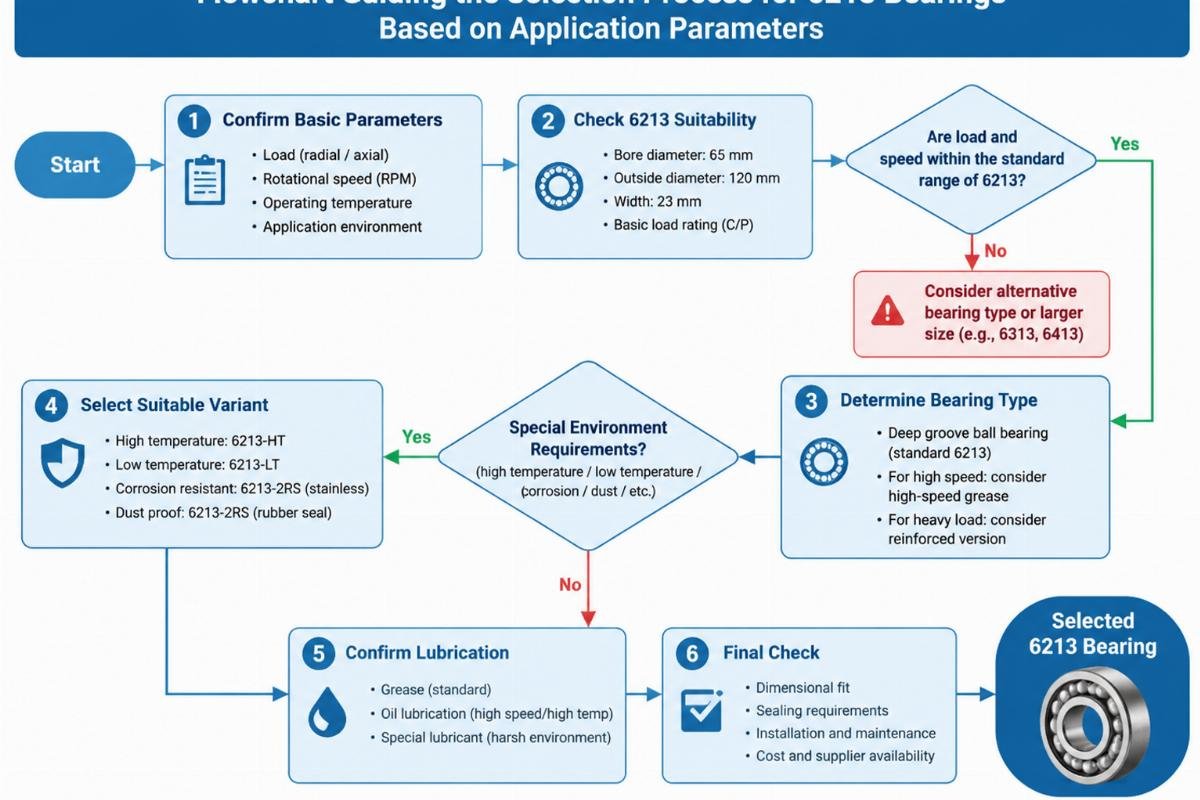
Selecting the correct 6213 equivalent involves a step-by-step analysis of the operating conditions. First, determine the load type. Is it radial, axial, or combined? Deep groove ball bearings handle both, but their capacity varies. Second, assess the speed. High-speed applications require low-friction shields and possibly polymer cages to reduce heat. Third, evaluate the environment. Dusty, wet, or chemically aggressive environments demand robust sealing solutions like double rubber seals. Finally, consider the temperature range. High temperatures necessitate special greases and increased internal clearance.
For MRO buyers managing diverse equipment portfolios, creating a standardized substitution matrix is invaluable. This matrix should list the OEM part number alongside verified equivalents from multiple brands, including their specific suffixes. This ensures that when a preferred brand is out of stock, a suitable alternative can be deployed without technical risk. It also facilitates bulk purchasing negotiations by allowing buyers to source from multiple suppliers without compromising quality.
- Identify Operating Conditions: Document max speed, load direction, and ambient temperature.
- Determine Sealing Needs: Choose shields for speed, seals for contamination protection.
- Select Clearance Class: Use C3 for high-temp or heavy-load applications, C0 for standard precision.
- Verify Cage Material: Ensure compatibility with operating temperature and load profile.
- Cross-Reference Brands: Map OEM specs to available equivalents from SKF, FAG, NSK, etc.
A common mistake is assuming that all “premium” brands are equal in every aspect. While they meet high-quality standards, their specific design philosophies differ. Some brands excel in steel purity, others in cage design or grease formulation. Understanding these nuances allows for smarter sourcing decisions. For instance, if cost is a primary concern for non-critical applications, high-quality domestic brands that adhere to ISO standards can offer significant savings without sacrificing reliability. The key is verifying their traceability and quality control processes.
When sourcing from a global supplier, request detailed technical datasheets for each equivalent. Do not settle for generic brochures. Specific data on load ratings, speed limits, and clearance values ensures that the replacement bearing will perform as expected. This diligence prevents the costly downtime associated with incorrect substitutions. By focusing on technical compatibility rather than just brand names, buyers can optimize their procurement strategies and maintain operational efficiency.
Conclusion
Precision in specification prevents failure in operation.
Mastering the 6213 bearing specs and understanding the nuances of brand equivalents empowers buyers to make informed decisions that balance cost and reliability. By focusing on internal clearance, seal types, and environmental suitability, you ensure that every bearing installed contributes to sustained equipment performance rather than becoming a point of failure.

Written by
authorEditor covering global sourcing, supplier verification, and industrial product knowledge. Content is compiled from manufacturer specifications, industry standards, and hands-on experience with international B2B buyers. Every article is fact-checked before publishing to help procurement professionals make informed decisions.
View all posts

Leave a Reply