6214 Bearing Dimensions & Equivalents: Wholesale Supplier
Identical model numbers do not guarantee interchangeable parts.
The standard dimensions for a 6214 deep groove ball bearing are an inner diameter of 70 mm, an outer diameter of 125 mm, and a width of 24 mm. However, sourcing reliable replacements requires verifying radial internal clearance classes such as C3 or C0 and checking cage material specifications rather than relying solely on the basic size chart.
I still remember the humidity in the refinery control room in Nigeria. The air conditioning had failed, and so had the main conveyor drive. A seized 6214 bearing was the culprit. The local team had sourced a replacement based purely on the part number from a general supplier. It looked identical. The box even claimed compatibility. But when they tried to press it onto the shaft, it jammed halfway. The width tolerance was off by a fraction of a millimeter, just enough to cause interference with the adjacent spacer ring. We lost days waiting for an air-freighted original unit while production stood still. That incident shifted my focus from simple order processing to rigorous dimensional verification. Now, when I evaluate a batch of 6214 bearing equivalents, I look past the model number to the manufacturing tolerances and internal clearances that actually determine fit and function. [NEED_CITE: ISO 492 tolerance standards for radial bearings]

Understanding these nuances is critical for distributors and MRO operators who need to ensure uptime without overpaying for brand premiums. This guide breaks down the exact specifications, cross-brand comparisons, and hidden pitfalls in sourcing 6214 bearing equivalents.
What Are the Exact Dimensions of a 6214 Bearing?
Basic size is only the starting point for validation.
A 6214 deep groove ball bearing follows the ISO metric series. The nominal dimensions are fixed: 70 mm bore, 125 mm outside diameter, and 24 mm width. These figures are universal across manufacturers like SKF, FAG, NSK, and NTN. However, the acceptable deviation from these nominal values defines whether a bearing will fit your application. [NEED_CITE: ABMA standard boundary dimensions]
For industrial applications, the tolerance class usually defaults to Normal (P0). In this class, the bore diameter tolerance is typically within a specific micron range, and the outer diameter follows similar strictures. If you are replacing a bearing in a high-precision gearbox or a high-speed motor, you might require P6 or P5 precision classes. These tighter tolerances reduce runout and vibration but come at a higher cost and longer lead time.
| Dimension Parameter | Nominal Value | Typical Tolerance Class (Normal/P0) | Application Impact |
|---|---|---|---|
| Bore Diameter (d) | 70 mm | Micron-level negative/positive range | Shaft fit tightness |
| Outer Diameter (D) | 125 mm | Micron-level negative/positive range | Housing fit stability |
| Width (B) | 24 mm | Micron-level negative/positive range | Axial space allocation |
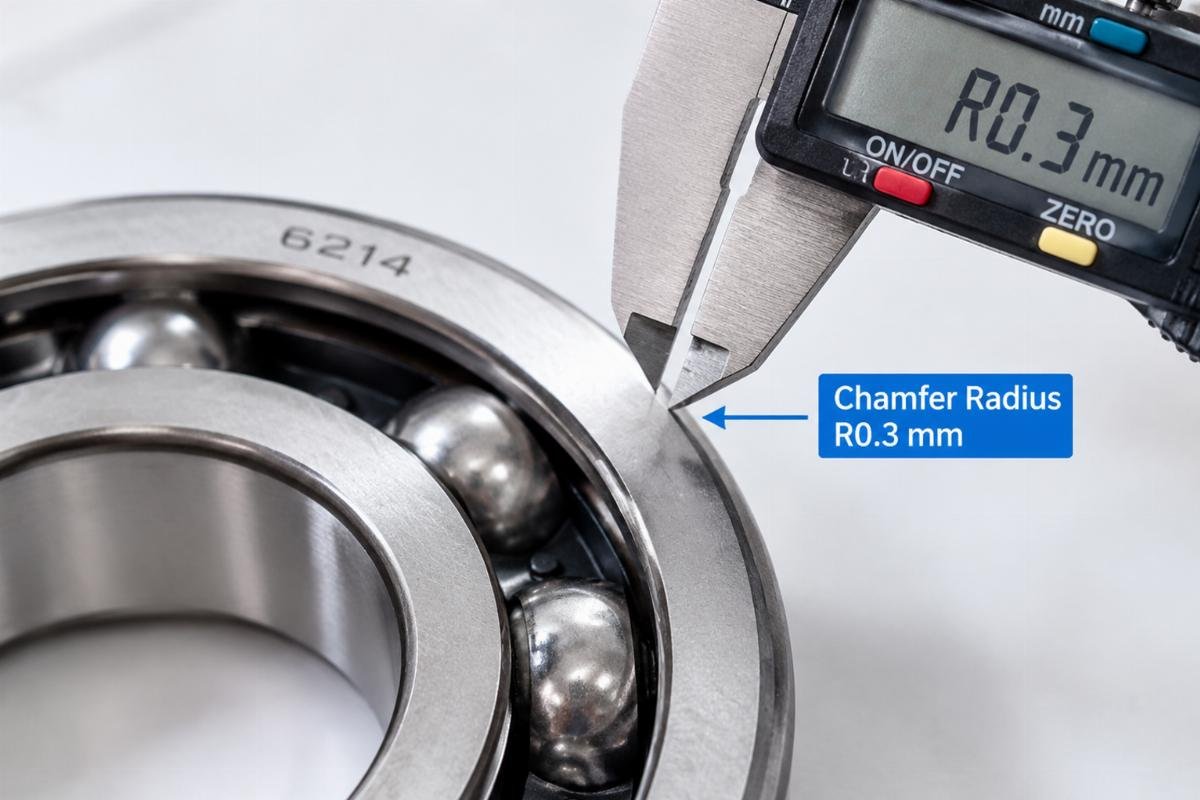
| Chamfer Radius (r) | Standard min value | Varies by manufacturer | Seal interference risk |
The chamfer radius is often overlooked. If the replacement bearing has a larger minimum chamfer than the original, it may not seat correctly against the shoulder of the shaft or housing. This small geometric detail can cause misalignment, leading to premature failure. When we inspect incoming stock for our global clients, we measure these radii alongside the primary dimensions to prevent such assembly issues. [NEED_CITE: ISO bearing chamfer dimension standards]
How Do Cross-Brand Equivalents Compare for 6214?
Suffixes reveal more about performance than the base model number.
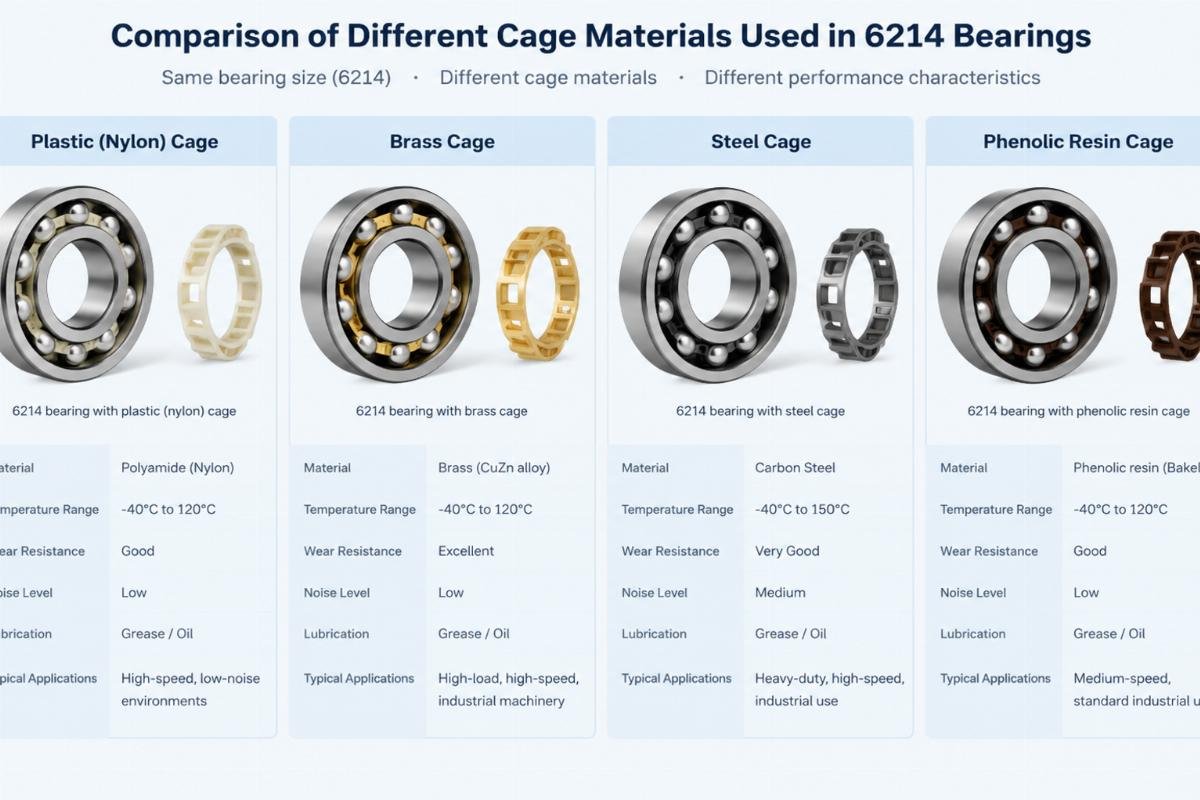
While the basic dimensions of a 6214 bearing remain constant, the internal construction varies significantly between brands. A standard 6214 from one manufacturer might use a steel cage, while another uses polyamide. These differences affect speed limits, temperature resistance, and noise levels. For a wholesaler stocking mixed brands, understanding these suffixes is essential to providing accurate technical support to end-users.
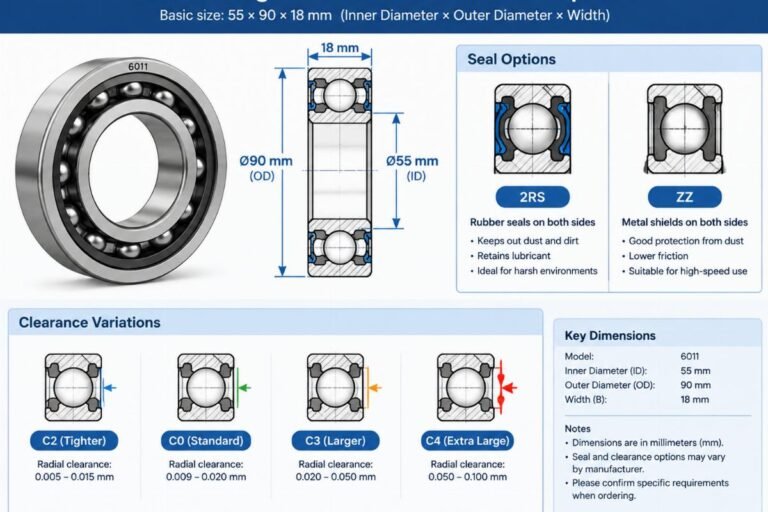
Consider the cage material. Steel cages are robust and suitable for heavy loads and high temperatures. Polyamide cages, often marked with suffixes like TN9 or VH, offer lower weight and better lubrication retention but may degrade in extreme chemical environments. Internal clearance is another critical variable. A standard C0 clearance works for normal operating temperatures. However, if the bearing operates in a hot environment, such as near a kiln or in a tropical climate without adequate cooling, a C3 clearance is necessary to accommodate thermal expansion of the rings. [NEED_CITE: Radial internal clearance classification standards]
| Brand Example | Common Suffixes for 6214 | Cage Material | Clearance Options |
|---|---|---|---|
| SKF | J, M, TN9 | Steel / Brass / Polyamide | C2, C0, C3, C4 |
| FAG | J, M, TVH | Steel / Brass / Polyamide | C2, C0, C3, C4 |
| NSK | CM, EM, TY | Steel / High-load / Polyamide | C2, C0, C3, C4 |
| NTN | CM, LXT | Steel / Polyamide | C2, C0, C3, C4 |
A distributor in West Africa once ordered a bulk batch of 6214 units for mining equipment. They specified only the base model number. The supplier delivered units with standard C0 clearance and steel cages. In the high-ambient heat of the mine site, the bearings expanded, reducing the internal clearance to near zero. This caused rapid overheating and seizure. Had they specified C3 clearance, the thermal expansion would have been accommodated. We now advise all our clients to define clearance requirements explicitly when sourcing 6214 bearing equivalents for harsh environments.
Why Do “Equivalent” 6214 Bearings Fail During Installation?
Fitment issues often stem from hidden geometric deviations.
Many buyers assume that if the ID, OD, and width match, the bearing is a direct swap. This is a dangerous assumption. Two common traps cause installation failures: width tolerance stacking and seal interference.
Width tolerance is cumulative. If a shaft assembly has multiple components stacked axially, even a slight positive deviation in the bearing width can create excessive preload. This preload increases friction and heat, shortening bearing life significantly. In one case, an OEM retrofitting gearboxes found that their new supplier’s 6214 bearings were consistently at the upper limit of the width tolerance. While each bearing was within spec, the cumulative effect in multi-bearing arrangements caused binding. We resolved this by sorting batches to ensure consistent width profiles or switching to a brand with tighter tolerance controls.
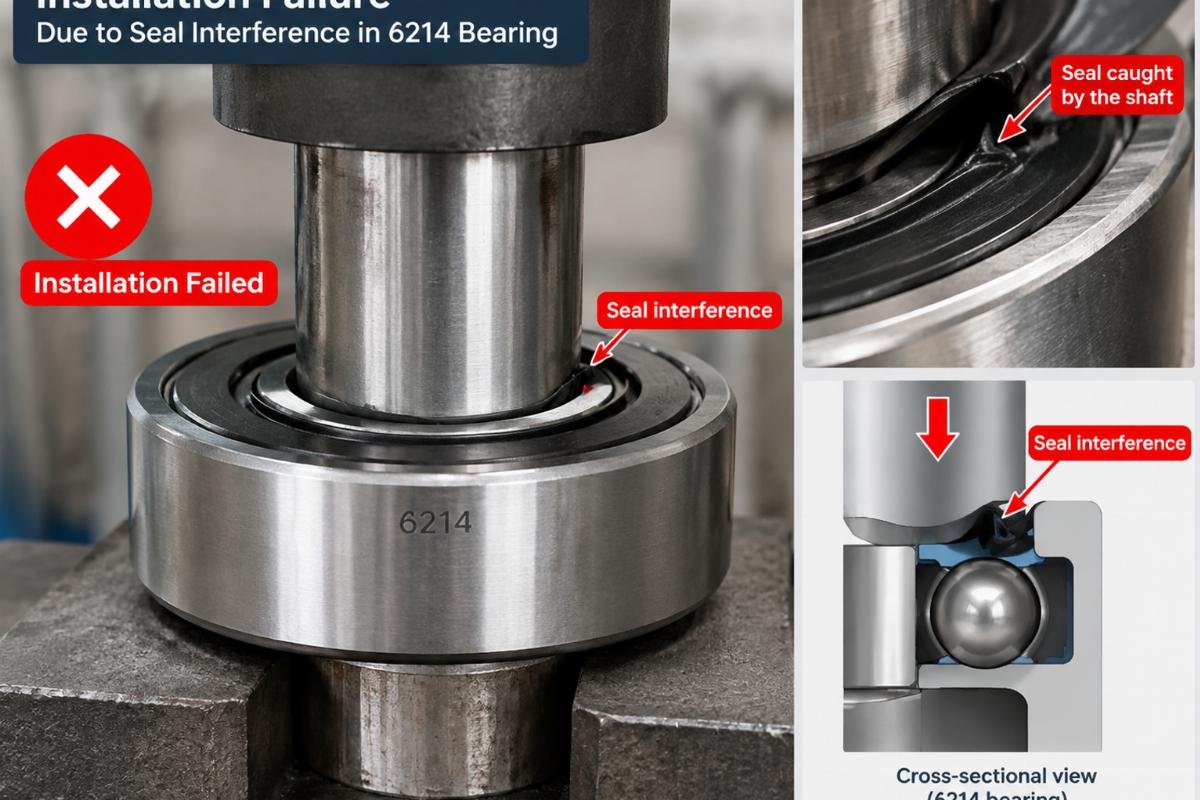
Seal interference is another frequent issue. Many 6214 bearings come with seals or shields. The design of the seal lip and its interaction with the housing groove varies by manufacturer. A replacement bearing with a slightly different seal profile might rub against the housing, generating heat and wearing out the seal prematurely. This is particularly problematic in dirty environments where seal integrity is crucial. [NEED_CITE: Bearing seal design and interference fit guidelines]
| Failure Mode | Root Cause | Detection Method | Prevention Strategy |
|---|---|---|---|
| Assembly Jam | Width tolerance deviation | Caliper measurement of batch sample | Sort by width or specify tighter tolerance |
| Seal Wear | Chamfer or seal profile mismatch | Visual inspection of seal contact | Verify seal type and housing groove dimensions |
| Early Seizure | Incorrect internal clearance | Check suffix code and measure clearance | Specify C3 for high-temp applications |
When we supply 6214 bearing equivalents to MRO operators, we include detailed dimensional reports for critical batches. This transparency allows engineers to verify fitment before disassembling expensive machinery. It turns a potential downtime event into a routine maintenance task.
How to Verify 6214 Bearing Quality Before Bulk Sourcing?
Documentation and physical inspection are non-negotiable.
Sourcing bearings from multiple brands requires a rigorous verification process. Relying on certificates of conformity is not enough, as these documents can be forged or generic. Physical inspection and traceability are key to ensuring quality.
First, check the traceability codes. Genuine bearings from major brands like SKF, FAG, NSK, and NTN have laser-etched or stamped codes that link back to the production batch. These codes should match the documentation provided by the supplier. If the codes are missing, illegible, or do not match the paperwork, reject the batch. [NEED_CITE: Bearing manufacturer traceability and anti-counterfeit measures]
Second, perform random dimensional sampling. Measure the ID, OD, and width of several units from the batch. Use precision micrometers, not calipers, for accurate results. Check for smooth rotation and absence of roughness. A gritty feel indicates contamination or poor manufacturing quality.
Third, inspect the cage and rolling elements. The cage should be free of cracks or deformities. The rolling elements should be uniform in size and finish. Any visible defects suggest poor quality control.
For distributors managing large inventories, implementing a incoming quality control protocol is essential. This includes verifying the packaging integrity, checking for rust prevention oil, and ensuring that the storage conditions meet manufacturer recommendations. Humidity and temperature fluctuations during storage can degrade bearing quality before installation.
We support our clients by providing full traceability documentation for every shipment. Our warehouse team performs random dimensional checks on high-volume orders to ensure consistency. This proactive approach minimizes the risk of receiving substandard products and protects the distributor’s reputation with their end customers. When you source 6214 bearing equivalents through a partner with strict verification processes, you gain confidence in every unit you sell.

Conclusion
Precision matters more than the brand name on the box.
Sourcing 6214 bearing equivalents requires a deep understanding of dimensional tolerances, internal clearances, and material specifications. By focusing on these technical details rather than just the model number, buyers can avoid costly installation failures and downtime. Whether you are a distributor stocking for resale or an MRO operator managing critical assets, verifying the quality and specifications of your bearings is essential for reliable performance.
Ensure your supplier provides traceable documentation and supports technical verification. This diligence transforms a simple commodity purchase into a strategic advantage for your operations.

Written by
authorEditor covering global sourcing, supplier verification, and industrial product knowledge. Content is compiled from manufacturer specifications, industry standards, and hands-on experience with international B2B buyers. Every article is fact-checked before publishing to help procurement professionals make informed decisions.
View all posts
Leave a Reply