Bulk Cross-Reference Requests: Sending Your BOM
Exact OEM codes are not always the fastest path through customs.
Submitting a clear bearing BOM with verified cross-reference requests ensures accurate part matching, prevents customs clearance delays, and secures genuine replacements for bulk orders.
I still remember the silence on the other end of the line when a client in Santos called me. His container of bearings had been detained at the port for days. The issue was not counterfeit goods or missing payments. It was a mismatch between the invoice descriptions and the physical nameplates on the boxes. He had sent a list of hundreds of items, expecting a literal translation of his local supplier’s part numbers into our shipping documents. We had complied, typing exactly what he gave us. But the customs officers saw SKF codes on the invoice and FAG markings on the boxes. To them, it looked like fraud. We spent weeks compiling technical equivalence sheets and substitution letters to prove that the parts were functionally identical and legally imported. That experience changed how I view every spreadsheet that lands in my inbox. Now, the first step in processing any large order is not checking stock levels, but validating the bulk cross-reference requests within the bill of materials.
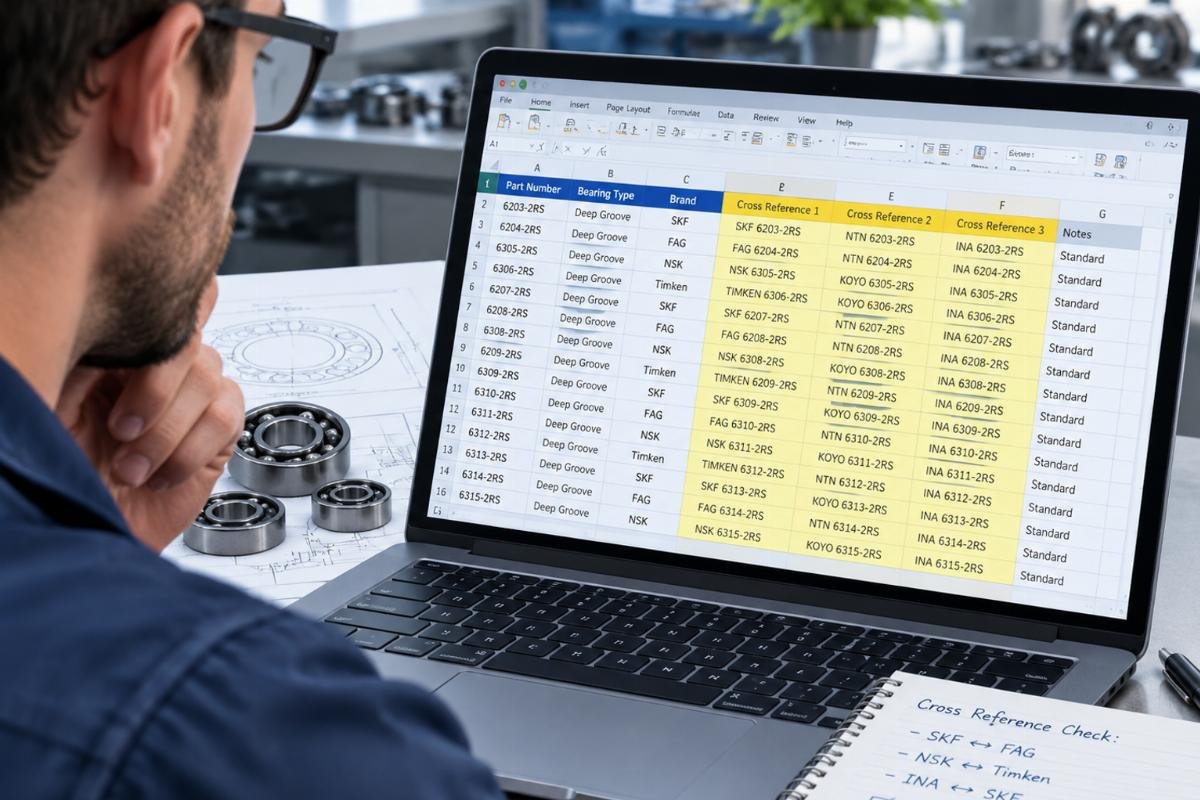
This process is not just about avoiding headaches. It is about ensuring that the machinery you maintain keeps running. When you send a BOM for bearing quote, you are asking for more than a price. You are asking for a technical validation that bridges the gap between different manufacturing standards and global trade regulations.
Why is cross-referencing critical for bulk BOMs?
Mismatched invoices trigger port seizures and costly inspections.
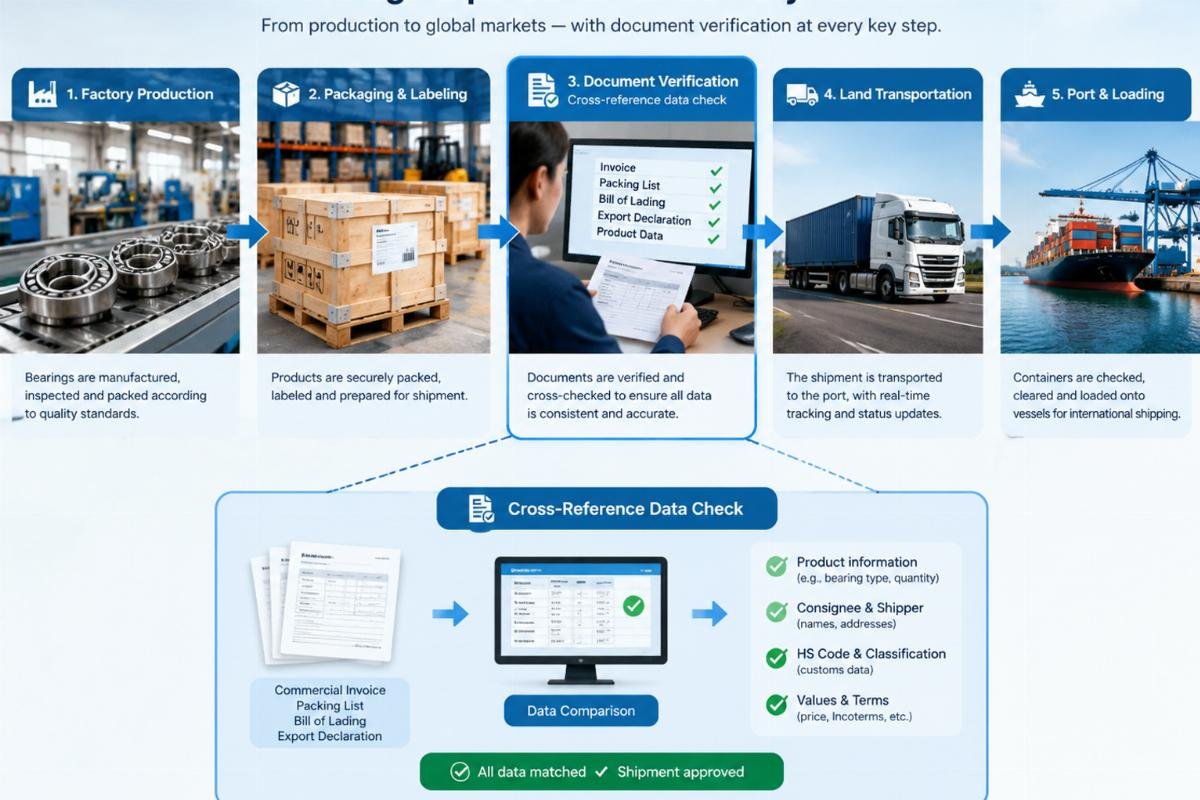
Customs authorities worldwide rely on harmonized system codes and precise product descriptions. When a shipment contains mixed brands, such as NSK, TIMKEN, and ZWZ bearings in the same container, the documentation must reflect this reality accurately. If your BOM lists only one brand but the shipment contains equivalents from another due to stock availability or cost optimization, the discrepancy raises red flags. [NEED_CITE: common causes of customs detention for industrial parts]
Consider a scenario where a distributor in Southeast Asia ordered a full container of deep-groove ball bearings. The original request specified premium European brands. However, due to lead time constraints, we proposed reliable domestic Chinese alternatives for non-critical applications, maintaining the same dimensional tolerances and load ratings. Without a proper cross-reference map in the commercial invoice, the local customs broker could not verify that the imported goods matched the declared value and origin. The shipment sat in bond, accruing demurrage charges that nearly wiped out the margin saved by switching brands.
By integrating bulk cross-reference requests into your initial inquiry, you allow us to pre-validate these substitutions. We map the OEM code to the proposed alternative, documenting the technical equivalence. This creates a paper trail that satisfies customs officials who need to see why a box labeled with one manufacturer’s logo is declared under a different part number. It transforms a potential legal ambiguity into a transparent technical decision.
How should you format and send your BOM?
Include OEM codes, target brands, and quantities in a structured table.
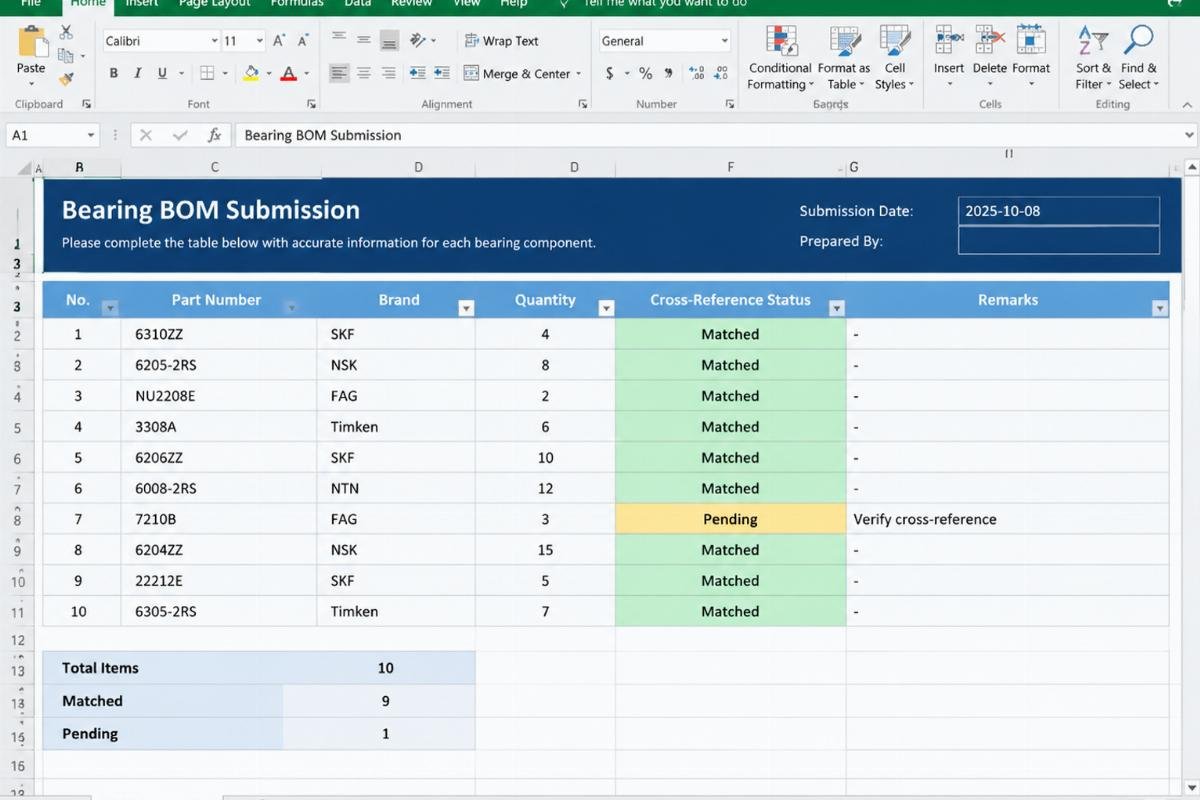
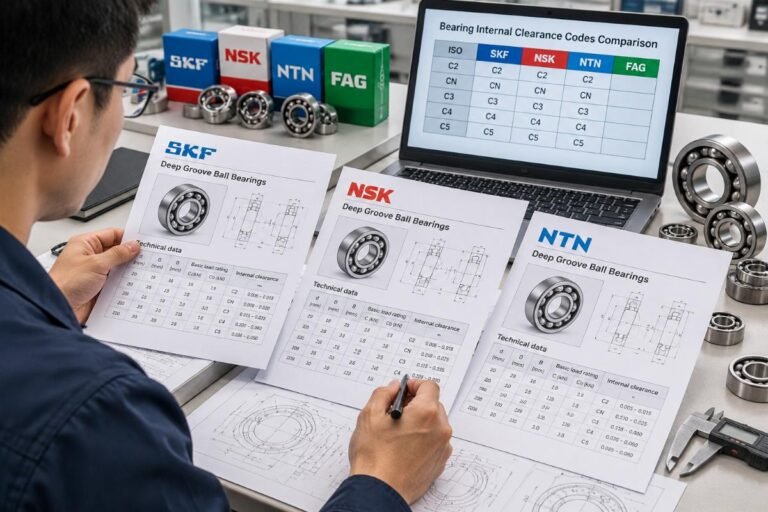
The quality of the quote you receive depends entirely on the clarity of the data you provide. A simple list of part numbers is often insufficient because bearing nomenclature varies by manufacturer. An SKF 6205-2RS1 is not identical in naming convention to an NSK 6205DDU, even if they share the same dimensions. When you send BOM for bearing quote, structure matters.
We recommend a spreadsheet format with specific columns:
- Item Number: Your internal reference.
- OEM/Original Part Number: The exact code from the machine manual or existing part.
- Brand Preference: Specify if you require the original brand or are open to equivalents.
- Quantity: Exact units needed.
- Application Notes: Optional but helpful details like speed, load, or environment.
This structure allows our technical team to perform accurate cross-reference bearing part numbers checks. For instance, if you list a tapered roller bearing from a discontinued line, we can immediately identify the current production equivalent from TIMKEN or NTN. Without the brand preference column, we might guess wrong, offering a high-precision aerospace grade when a standard industrial grade would suffice, or vice versa.
A US buyer once sent a PDF scan of a handwritten maintenance log. It took our team three days to decipher the handwriting and confirm the suffixes. By the time we issued the quote, the spot inventory had shifted, and lead times had extended. Switching to a digital Excel template reduced the turnaround time from days to hours. [NEED_CITE: best practices for procurement data formatting]
What documents support cross-referenced replacements?
Traceability certificates and technical equivalence sheets validate substitutions.
Cheaper direct quotes often lack the documentation required for international trade. When you accept a lower price without verifying the source, you risk receiving goods without proper traceability. This is dangerous for industries like mining or wind power, where failure analysis is mandatory after any incident.
When we process bulk cross-reference requests, we do not just swap part numbers. We generate supporting documents that travel with the cargo. These include:
- Certificate of Origin: Proving where the bearings were manufactured.
- Material Test Reports: Verifying the steel quality and heat treatment processes.
- Technical Equivalence Sheet: A detailed comparison showing that the proposed alternative meets or exceeds the original specifications in terms of bore diameter, outer diameter, width, and dynamic load rating.
For a European wind farm operator, replacing a main shaft bearing is a major logistical challenge. They required proof that the substitute bearing from a reputable Asian manufacturer met the same ISO precision classes as the original German brand. We provided a side-by-side technical datasheet comparing the P5 precision ratings and cage materials. This document satisfied their engineering team’s validation protocol and their insurer’s requirements. Without it, the replacement would have been rejected regardless of its performance capability. [NEED_CITE: ISO standards for bearing precision and documentation]

How do we handle mixed-brand consolidation?
One-stop sourcing with unified customs declarations simplifies logistics.
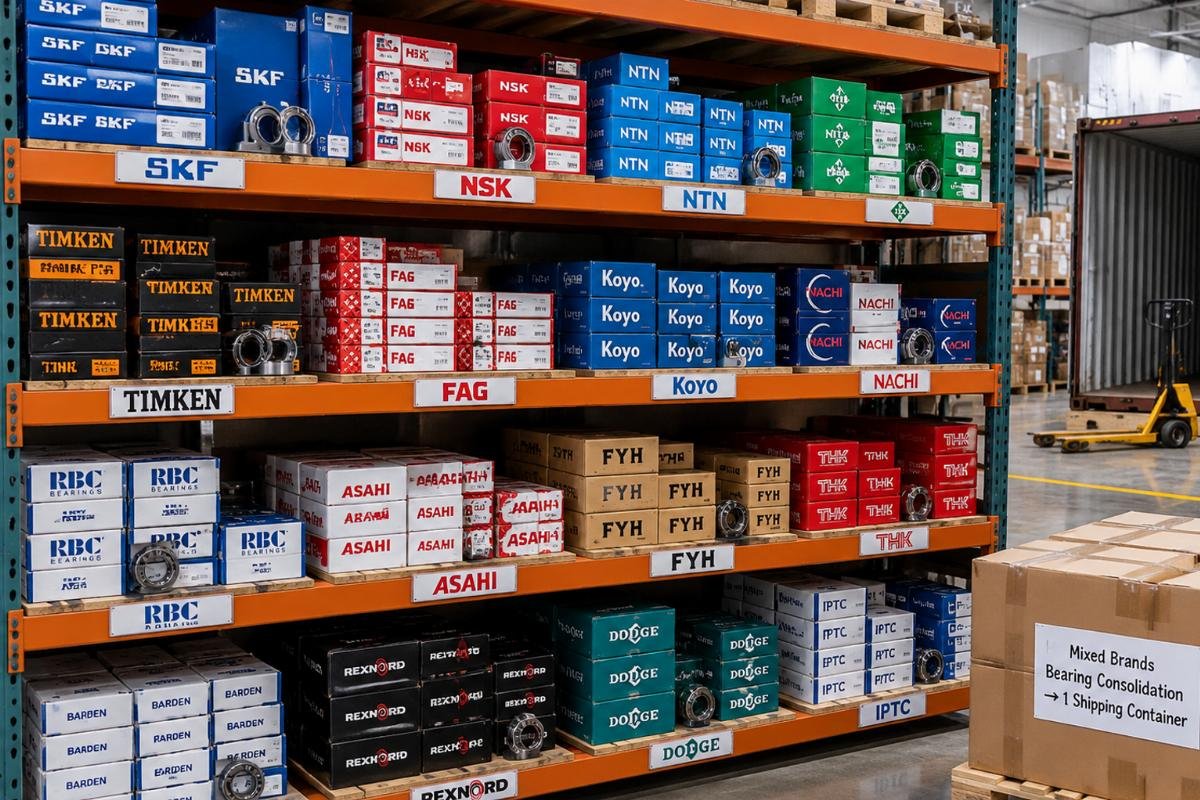
Sourcing from multiple official brand channels means dealing with multiple invoices, multiple shipments, and multiple customs entries. This fragmentation increases administrative overhead and the risk of errors. By consolidating your bulk cross-reference requests with a single supplier who stocks multiple brands, you streamline the entire supply chain.
We stock genuine products from SKF, FAG, INA, NSK, NTN, TIMKEN, KOYO, NACHI, IKO, and reliable domestic lines like ZWZ, HRB, and LYC. This allows us to build mixed-brand packages that optimize both cost and availability. For a regional distributor in the Middle East, we consolidated an order containing heavy-duty spherical roller bearings for crushers and high-speed angular contact ball bearings for spindles. The shipment included brands from Europe, Japan, and China, all packed in a single container.
The key to success here is the unified commercial invoice. Instead of ten separate documents, the client received one comprehensive invoice that clearly listed each item with its corresponding brand and cross-referenced part number. This single document matched the physical packing list perfectly, allowing for smooth clearance at the destination port. The client saved significantly on freight forwarding fees and customs brokerage charges, while also reducing the time their purchasing team spent reconciling payments. [NEED_CITE: benefits of consolidated shipping for industrial components]
Conclusion
Accurate data prevents costly delays.
Submitting a well-structured BOM with clear bulk cross-reference requests is the most effective way to ensure your bearing orders arrive on time and clear customs without issue. It transforms a simple purchase into a technically validated supply chain solution. By focusing on documentation and equivalence from the start, you protect your operations from unnecessary risks and keep your machinery running smoothly.

Written by
authorEditor covering global sourcing, supplier verification, and industrial product knowledge. Content is compiled from manufacturer specifications, industry standards, and hands-on experience with international B2B buyers. Every article is fact-checked before publishing to help procurement professionals make informed decisions.
View all posts

Leave a Reply