OEM Spare Parts Lists to Standard Bearings: Wholesale Supplier
Most OEM part numbers are just proprietary labels wrapped around standard ISO dimensions.
Converting an OEM spare parts list to standard bearings requires ignoring the manufacturer’s prefix, decoding the internal design code, and strictly matching the clearance suffix to ensure direct replacement and significant cost savings. This process transforms expensive, single-source procurement into a flexible, multi-brand sourcing strategy without compromising equipment reliability.
I still remember the heat rising in my face, not from the machine, but from embarrassment. I was standing in a European steel plant, watching a newly installed cylindrical roller bearing seize up within hours of startup. The production line had halted. The cause wasn’t poor quality; it was a mismatched clearance suffix. I had converted the OEM part number based on dimensions alone, ignoring that the original specification called for a C4 clearance due to high thermal expansion, while I had supplied a standard C3. That downtime cost far more than the bearing itself. Since then, I have dedicated my career to helping buyers navigate the complex translation between OEM lists and standard global brands. Understanding this conversion is not just about saving money; it is about ensuring operational continuity. [NEED_CITE: common causes of premature bearing failure related to clearance mismatch]
Why do OEM codes look so different from standard models?
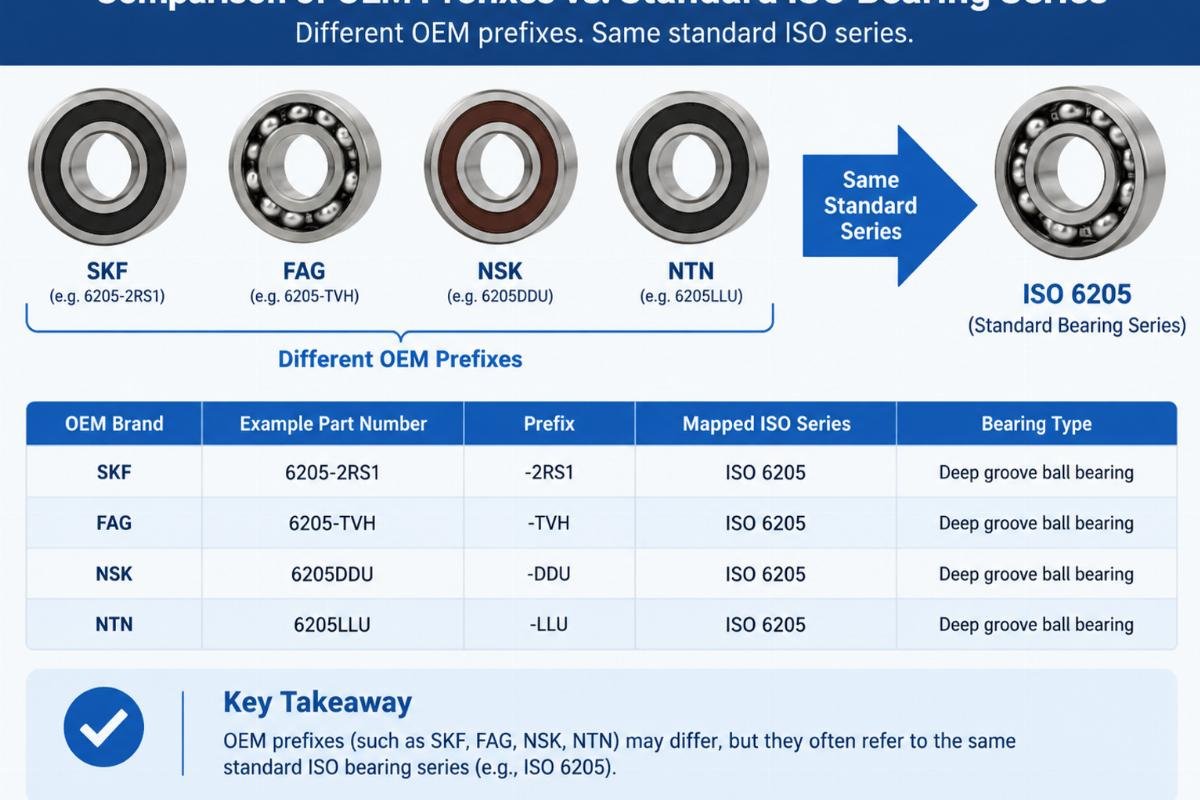
OEM codes often include proprietary prefixes and suffixes that mask the underlying ISO standard dimensions.
When you receive a spare parts list from an original equipment manufacturer, the part numbers can look like random strings of characters. These codes are designed to lock you into their supply chain, but mechanically, they rarely deviate from international standards. The core boundary dimensions—bore, outside diameter, and width—almost always adhere to ISO 15 or ISO 355 standards. [NEED_CITE: ISO standards for rolling bearing boundary dimensions]
The difference lies in the coding logic. An OEM might add a prefix indicating the supplier they contracted at the time of machine design, or a suffix denoting a specific packaging requirement. For example, a code starting with “X-” might simply mean it was sourced from a specific vendor decades ago, while the numeric core “22310” refers to a standard spherical roller bearing. By stripping away these proprietary layers, you reveal the standard model that is available from multiple global manufacturers like SKF, FAG, or NSK.
This realization changes how you approach OEM spare parts list conversion. Instead of searching for a unique, hard-to-find part, you search for the standard dimensional series. This opens up the market to competitive bidding and faster availability. However, one must be cautious. While dimensions are standard, internal designs can vary. Some OEMs specify non-standard cage materials or sealing types that are not immediately obvious from the basic number. Always cross-reference the detailed specification sheet, not just the part number.
What are the hidden traps in clearance suffixes?
Ignoring suffix differences like C3 or C4 leads to thermal expansion issues and premature failure.
The most critical error in converting OEM lists is treating the base number as the complete specification. The base number defines the size, but the suffix defines the fit. In heavy industry, machines operate under varying thermal loads. A bearing that fits perfectly at room temperature may seize when the housing expands due to heat if the internal clearance is insufficient.
Clearance suffixes indicate the radial internal clearance. Standard clearance is often unmarked or designated as CN. For applications with higher temperatures or interference fits, C3 clearance is common. In extreme conditions, such as vibrating screens or high-speed paper machines, C4 or even C5 clearances are required. [NEED_CITE: bearing clearance selection guidelines based on operating temperature and fit]
My earlier mistake in the steel plant was assuming that “close enough” was acceptable. It is not. If an OEM specifies a C4 clearance, substituting a C3 bearing will result in reduced internal space for thermal expansion. As the bearing heats up, the rollers expand against the races, generating excessive friction, heat, and eventually, catastrophic failure. Conversely, using too much clearance can lead to vibration and noise.
When performing OEM spare parts list conversion, you must verify the operating environment. If the original equipment manual is unavailable, inspect the failed bearing. Look for signs of overheating or smearing on the raceways, which indicate insufficient clearance. Consult with technical experts who can analyze the application parameters. Do not guess. The cost of a wrong clearance choice is measured in days of lost production, not just the price of the component.

How to verify cross-reference accuracy before ordering?
Always double-check boundary dimensions, internal design, and load ratings against official datasheets.
Blindly trusting a cross-reference table is risky. Different manufacturers may have slight variations in internal geometry, such as cage design, roller profile, or seal type, even if the boundary dimensions are identical. To ensure a safe replacement, you must validate three key areas: dimensions, internal construction, and load capacity.
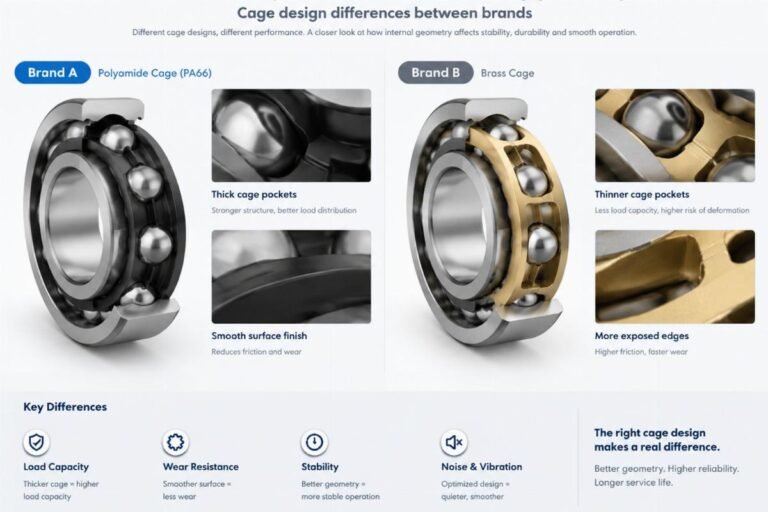
First, confirm the boundary dimensions. Use a caliper or micrometer to measure the old bearing if it is available. Compare these measurements with the standard ISO tables. Second, examine the internal design. Does the OEM part use a brass cage, steel cage, or polymer cage? Is it sealed or open? A change in cage material can affect speed limits and chemical resistance. Third, check the dynamic and static load ratings. While rare, some OEM-specific bearings may have enhanced load capacities due to specialized heat treatment or material purity. [NEED_CITE: methods for verifying bearing load ratings and internal design features]
For buyers managing OEM spare parts list conversion, creating a verification checklist is essential.
- Measure: Verify bore, OD, and width.
- Inspect: Identify cage type, seal material, and any special coatings.
- Decode: Determine the correct clearance and precision class.
- Compare: Match these specs against the datasheet of the proposed standard replacement.
If any parameter does not match, do not proceed without engineering approval. For example, replacing a sealed bearing with an open one in a contaminated environment will lead to rapid failure. Similarly, substituting a standard precision class with a lower grade in a high-speed spindle application will cause vibration and poor surface finish.

Can standard bearings truly match OEM performance?
Yes, provided the technical parameters align perfectly and genuine quality is guaranteed.
There is a persistent myth that OEM-branded bearings are inherently superior to standard global brands. In reality, most OEMs do not manufacture their own bearings. They source them from major bearing producers and rebrand them. Therefore, a standard bearing from a reputable manufacturer like SKF, FAG, or Timken is often the exact same product, just without the OEM markup.
The key to achieving equivalent performance lies in sourcing genuine products. The market is flooded with counterfeits that mimic the appearance of premium brands but lack the material integrity and precision manufacturing. When you engage in OEM spare parts list conversion, you must ensure your supplier provides traceability. Certificates of origin and material test reports are not just paperwork; they are proof of authenticity.
Standard bearings offer additional advantages. They are widely available, reducing lead times from weeks to days. They allow for consolidation of suppliers, simplifying logistics and inventory management. Furthermore, because they are produced in massive volumes, their quality consistency is often higher than low-volume OEM-specific runs.
However, this only works if the conversion is done correctly. A standard bearing that matches the dimensions but fails to meet the precision or clearance requirements will not perform. It is not the brand that guarantees performance; it is the adherence to specification. By focusing on technical alignment rather than brand labels, buyers can achieve reliable operation at a fraction of the cost.

Conclusion
Accurate conversion of OEM lists to standard bearings unlocks cost savings and supply chain flexibility.
By decoding proprietary prefixes, respecting clearance suffixes, and verifying internal designs, buyers can replace expensive OEM parts with reliable standard equivalents. This approach reduces dependency on single sources and minimizes downtime risks. Success depends on technical diligence and sourcing genuine, traceable products.
Mastering OEM spare parts list conversion transforms procurement from a reactive expense into a strategic advantage. It requires attention to detail, but the rewards in efficiency and cost reduction are substantial. Ensure every replacement is validated against official standards to maintain equipment integrity and operational excellence.

Written by
authorEditor covering global sourcing, supplier verification, and industrial product knowledge. Content is compiled from manufacturer specifications, industry standards, and hands-on experience with international B2B buyers. Every article is fact-checked before publishing to help procurement professionals make informed decisions.
View all posts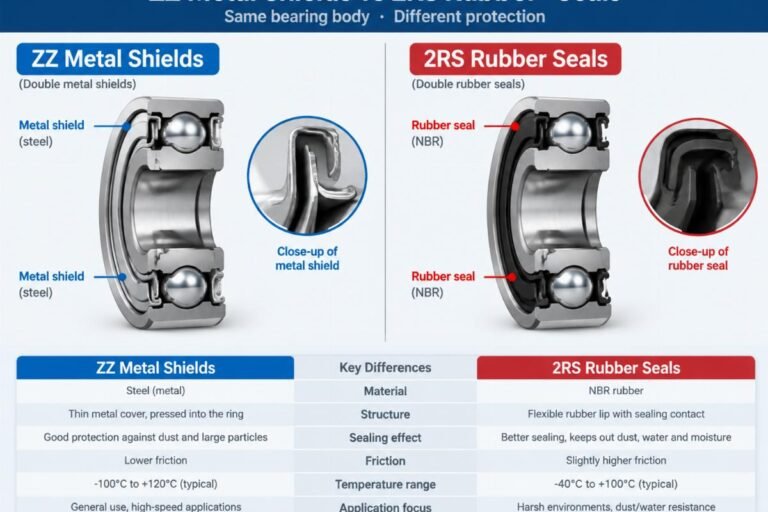

Leave a Reply