Grease Fill Differences: Bulk Bearing Supplier & Cross-Reference Guide
More grease does not mean better lubrication. In fact, overfilling a bearing cavity is one of the fastest ways to induce thermal runaway and premature seal failure.
Grease fill percentages vary significantly across major bearing brands due to differences in internal seal geometry and cage design. Ignoring these variations during cross-brand replacement leads to churning friction, excessive heat buildup, and reduced service life. Successful substitution requires verifying the original equipment manufacturer’s fill ratio and adjusting relubrication intervals accordingly, rather than assuming a one-to-one swap.
I still remember the heat radiating from a crusher housing at a cement plant in Saudi Arabia. The maintenance team had just replaced a set of tapered roller bearings, swapping a German brand for a Japanese equivalent. On paper, the dimensions matched perfectly. The load ratings were identical. Yet, within weeks, the outer ring temperature spiked by dozens of degrees. When we剖开 (cut open) the failed unit, the issue was not the steel quality or the clearance class. The cavity was packed solid with grease. The technicians had assumed that “full” meant “safe,” not realizing that the new brand’s seal design trapped heat more aggressively than the previous one. This experience reinforced a critical truth in industrial procurement: specifications go beyond dimensions. [NEED_CITE: impact of grease volume on bearing operating temperature per ISO 15243]
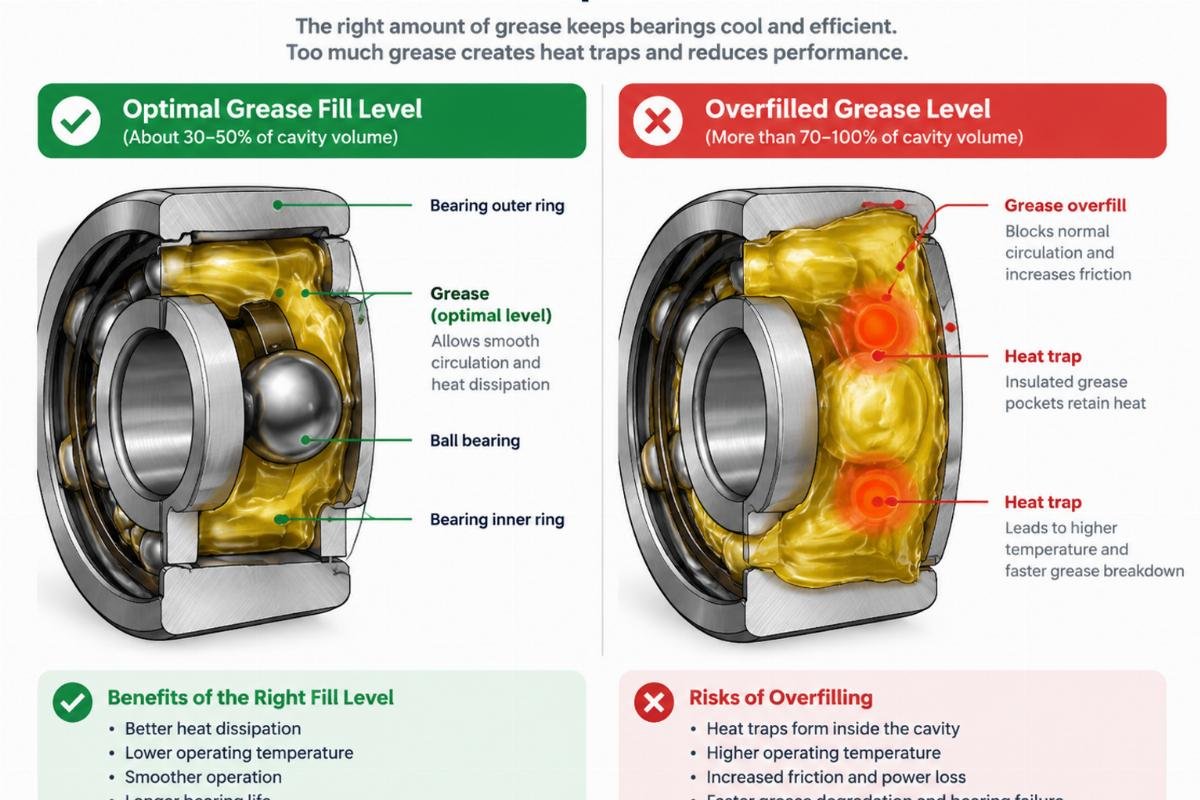
Understanding these nuances is essential for any bulk bearing supplier managing mixed-brand inventories. It is not enough to match part numbers; one must match the lubrication philosophy embedded in the original design.
Why Do Grease Fill Percentages Vary by Brand?
Internal seal designs and cage configurations dictate the optimal grease fill limits for each bearing series.
Manufacturers do not arbitrarily decide how much grease to put in a bearing. The volume is a calculated compromise between lubrication supply and heat dissipation. Different brands employ distinct sealing technologies. Some use contact seals that create a tighter barrier against contaminants but also restrict internal airflow. Others use non-contact shields that allow for easier grease escape but require higher initial fill volumes to ensure adequate coverage.
For instance, a deep-groove ball bearing from one premium brand might come factory-filled to thirty percent of its free space, while a comparable unit from another brand might be filled to forty percent. This difference stems from their respective assumptions about relubrication frequency and operating speed. [NEED_CITE: manufacturer technical catalogs regarding standard factory grease fill percentages]
| Feature | Brand A Design Philosophy | Brand B Design Philosophy |
|---|---|---|
| Seal Type | Contact rubber seals | Non-contact metal shields |
| Heat Dissipation | Lower due to seal friction | Higher due to open design |
| Standard Fill Ratio | Lower percentage to reduce churning | Higher percentage to ensure coverage |
| Relubrication Need | Frequent, smaller amounts | Less frequent, larger amounts |
This variance becomes critical when sourcing substitutes. If a buyer replaces a Brand A bearing with a Brand B unit without adjusting the grease volume, they may inadvertently introduce excess friction. The cage design also plays a role. Open cages allow grease to circulate more freely, while closed cages may trap pockets of lubricant that churn and generate heat. [NEED_CITE: tribology studies on cage design influence on grease distribution]
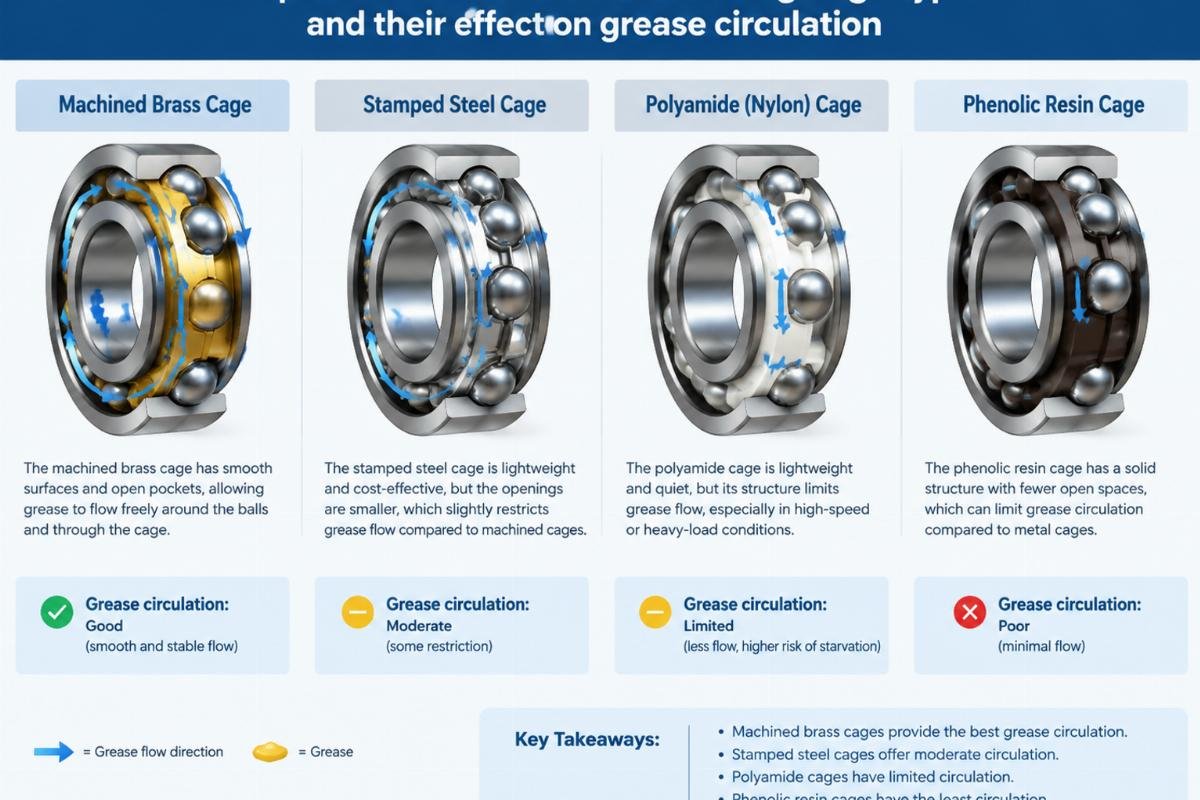
For a bulk bearing supplier, this means that technical datasheets must include not just dimensional drawings but also lubrication specifications. Providing this level of detail helps distributors avoid field failures caused by simple oversight.
What Happens When You Ignore Fill Differences During Replacement?
Overfilling causes churning friction, which generates excessive heat and can lead to seal blowouts or grease carbonization.
When a bearing cavity is completely filled, the rolling elements have no room to displace the grease as they rotate. Instead of lubricating, the grease acts as a viscous drag. This phenomenon, known as churning, converts mechanical energy into thermal energy. The temperature rise can be significant, often exceeding the thermal stability limit of the base oil.
In a recent case involving a high-speed motor application, a maintenance team replaced bearings without purging the excess grease from the new units. The result was a drastic reduction in the relubrication interval. The grease degraded rapidly, losing its consistency and ability to protect the raceways. [NEED_CITE: relationship between grease churning and base oil separation]
The consequences extend beyond just heat. Excessive pressure from expanding hot grease can force its way past seals, carrying contaminants into the bearing or expelling the lubricant entirely. Once the grease escapes, the bearing runs dry, leading to rapid wear and catastrophic failure.
| Consequence | Mechanism | Impact on Equipment |
|---|---|---|
| Temperature Rise | Churning friction | Thermal degradation of grease |
| Seal Failure | Internal pressure buildup | Contaminant ingress |
| Grease Leakage | Expulsion from housing | Loss of lubrication |
| Premature Wear | Oil separation | Raceway damage |
This risk is particularly acute in sealed-for-life applications where relubrication is not possible. In such cases, the initial fill ratio is the only defense against wear. A mismatch here guarantees a shorter lifespan. [NEED_CITE: failure analysis reports on sealed bearing overheating]
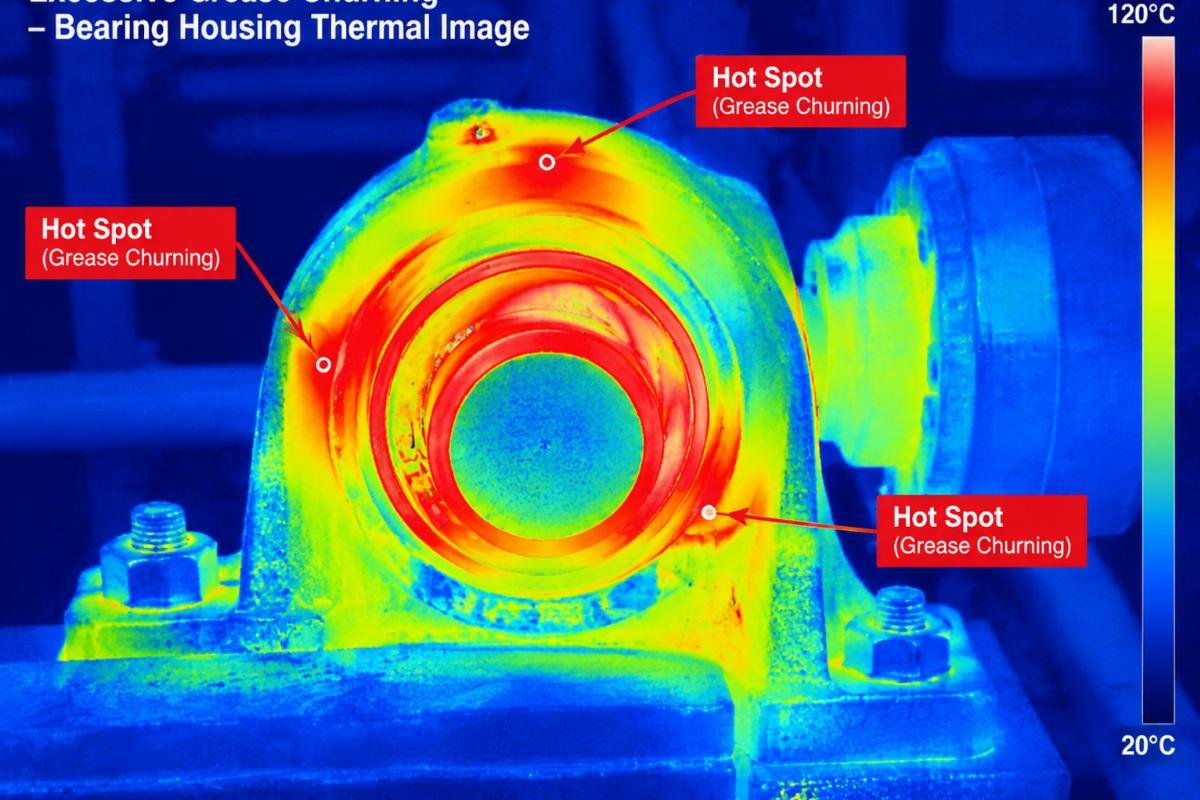
Buyers must recognize that a “new” bearing is not always ready for immediate high-load service if the grease volume is incorrect. Verification of the fill state is a crucial step in the quality assurance process.
How to Verify Grease Fill When Sourcing Substitute Brands?
Request factory fill certificates and match NLGI consistency grades to ensure compatibility with the original application.
Verifying grease fill is not always straightforward, as many suppliers do not list this parameter on standard product pages. However, it is a critical data point for cross-referencing. The first step is to consult the original equipment manufacturer’s documentation to determine the specified fill percentage. Then, compare this with the technical data provided by the substitute brand.
If the data is unavailable, physical inspection can provide clues. While difficult to measure precisely without specialized tools, the resistance felt when rotating a new bearing can indicate overfilling. A properly filled bearing should rotate smoothly with minimal drag. Significant resistance suggests excess grease. [NEED_CITE: ISO standards for bearing inspection and handling]
Another key factor is the NLGI consistency grade. Even if the fill volume is correct, using a grease with the wrong consistency can lead to similar issues. A softer grease may leak out, while a harder grease may not distribute evenly. Matching the NLGI grade ensures that the lubricant behaves as expected under operating conditions.
| Verification Step | Action Required | Expected Outcome |
|---|---|---|
| Documentation Review | Check OEM specs vs. substitute brand data | Matched fill percentages |
| Physical Inspection | Rotate bearing manually | Smooth rotation, low drag |
| Grease Analysis | Verify NLGI grade and base oil viscosity | Compatible lubricant properties |
| Supplier Consultation | Request fill certificates | Confirmed factory specifications |
For distributors, maintaining a database of these parameters for common brands adds significant value. It allows for quicker and more accurate cross-referencing, reducing the risk of error during urgent replacements. [NEED_CITE: industry best practices for bearing inventory management]
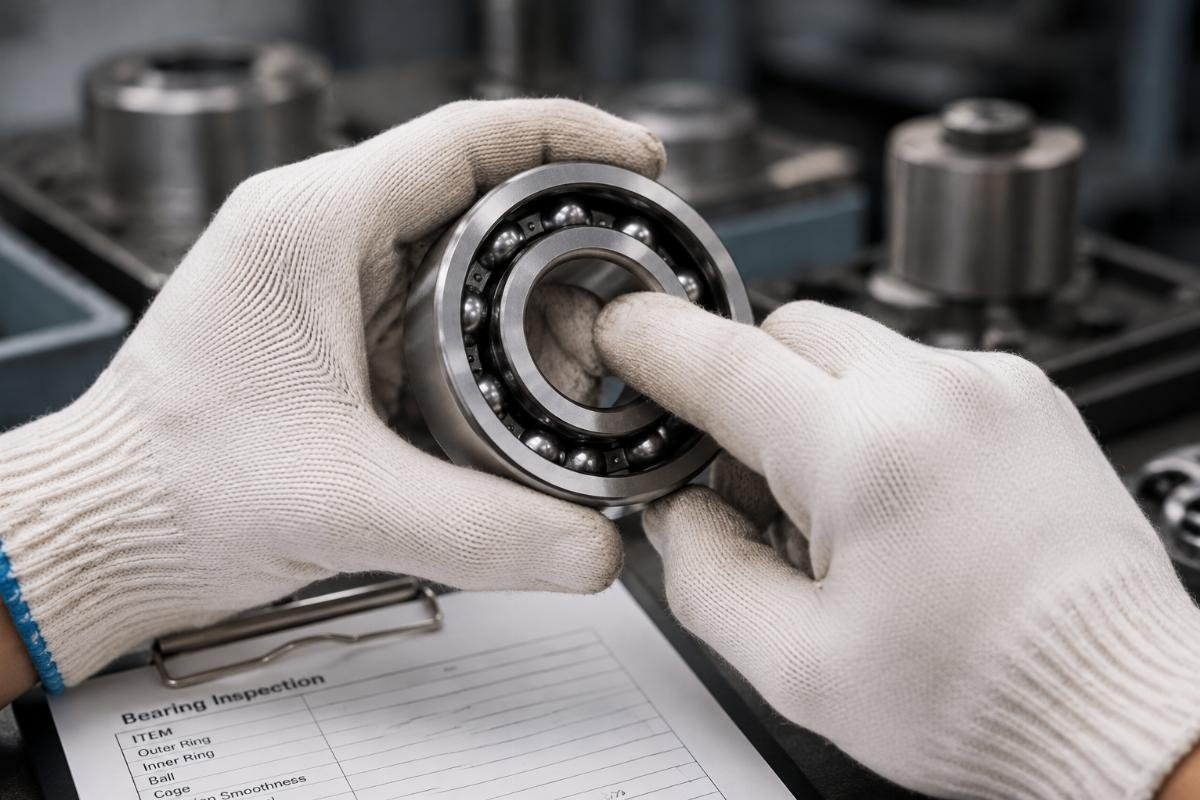
This proactive approach transforms a simple parts swap into a engineered solution, ensuring reliability and performance.
What Are the Best Practices for Cross-Brand Bearing Swaps?
Purge old grease and recalibrate relubrication intervals to accommodate the new bearing’s design characteristics.
Swapping brands is not a plug-and-play operation. It requires a systematic approach to ensure that the new component integrates seamlessly into the existing system. The first step is to thoroughly clean the housing and remove all remnants of the old grease. Mixing incompatible greases can cause chemical reactions that degrade lubrication performance. [NEED_CITE: compatibility charts for common bearing greases]
Next, adjust the relubrication schedule. If the new bearing has a different fill ratio or seal type, the frequency and volume of relubrication may need to change. For example, a bearing with a higher initial fill may require less frequent top-ups, while one with a lower fill may need more regular attention. Monitoring temperature and vibration levels after installation provides feedback on whether the new schedule is effective.
| Best Practice | Implementation | Benefit |
|---|---|---|
| Housing Cleaning | Remove all old grease and contaminants | Prevents chemical incompatibility |
| Schedule Adjustment | Recalculate relubrication intervals | Optimizes lubricant supply |
| Performance Monitoring | Track temperature and vibration | Early detection of issues |
| Documentation Update | Record changes in maintenance logs | Ensures consistency for future swaps |
In complex applications, such as those involving heavy loads or high speeds, consulting with a technical expert is advisable. They can help analyze the specific operating conditions and recommend the most suitable substitute. This level of support is invaluable for minimizing downtime and maximizing equipment life. [NEED_CITE: case studies on successful bearing cross-references in heavy industry]

By following these practices, buyers can confidently navigate the complexities of cross-brand substitution, ensuring that their equipment remains reliable and efficient.
Conclusion
Cross-brand bearing replacement demands attention to grease fill differences, not just dimensional matches.
Ignoring these subtle variations can lead to overheating, seal failure, and premature wear. By verifying fill ratios, matching NLGI grades, and adjusting maintenance schedules, operators can ensure seamless transitions between brands. This technical diligence protects assets and maintains operational continuity in demanding industrial environments.

Written by
authorEditor covering global sourcing, supplier verification, and industrial product knowledge. Content is compiled from manufacturer specifications, industry standards, and hands-on experience with international B2B buyers. Every article is fact-checked before publishing to help procurement professionals make informed decisions.
View all posts

Leave a Reply