How to Read a Competitor’s Bearing Catalog: Cross-Brand Equivalent Model Consultation & Technical Selection Support
Identical outer dimensions do not guarantee interchangeability.
To read a competitor’s bearing catalog effectively, you must look beyond the basic dimension tables and perform a deep structural comparison of internal clearance codes, cage materials, and raceway profiles. Relying solely on outer diameter, bore size, and width leads to premature failures because these external metrics ignore the critical internal engineering differences that dictate load distribution and thermal stability in industrial applications.
I still remember the humidity and the deafening silence of a refinery unit in Nigeria that had just gone offline. The line was down, and the pressure was physical. We needed spherical roller bearings immediately. The local stock was empty, so I arranged an urgent shipment of domestic alternatives from China. On paper, the part numbers matched the original specifications perfectly. The dimensions were identical. We installed them with confidence. Seven days later, the bearings burned out. The entire production line stopped again. The cost was not just the price of the new parts; it was the lost production time and the reputational damage. That failure happened because I had focused on the catalog’s dimension table while ignoring the internal clearance and cage material specifications. Since then, I have learned to read every competitor’s bearing catalog with a skeptic’s eye, focusing on the hidden parameters that actually determine performance.

This approach transforms how you handle cross-brand selection. It moves you from guessing based on size to validating based on engineering reality. When you understand how to decode these technical documents, you avoid the costly mistakes that come from superficial matching.
Why Basic Dimensions Are Not Enough for Cross-Referencing?
External dimensions are only the starting point for identification, not a guarantee of compatibility.
Most buyers assume that if a bearing fits into the housing and onto the shaft, it will work. This is a dangerous misconception. The basic dimension table in any bearing catalog lists the bore diameter, outside diameter, and width. These are standardized according to ISO norms [NEED_CITE: ISO dimensional standards for rolling bearings]. However, two bearings with identical external dimensions can have vastly different internal geometries.
The internal structure determines how the load is carried. For example, the curvature of the raceways and the profile of the rollers or balls differ significantly between manufacturers. One brand might use a logarithmic spiral profile for rollers to reduce edge stress, while another uses a standard cylindrical profile. If you replace one with the other without checking, the contact area changes. This leads to high stress concentrations at the edges of the rollers, causing early fatigue and spalling.
Consider a mining crusher OEM who once switched suppliers to cut costs. The new bearings matched the SKF dimensions exactly. However, the internal load rating was lower due to a different roller design. The discrepancy was not visible in the outer dimensions. Within months, the crushers experienced frequent failures. The variance in dynamic load capacity was significant enough to shorten the equipment life drastically. The catalog had listed the same boundary dimensions, but the internal engineering was not equivalent.
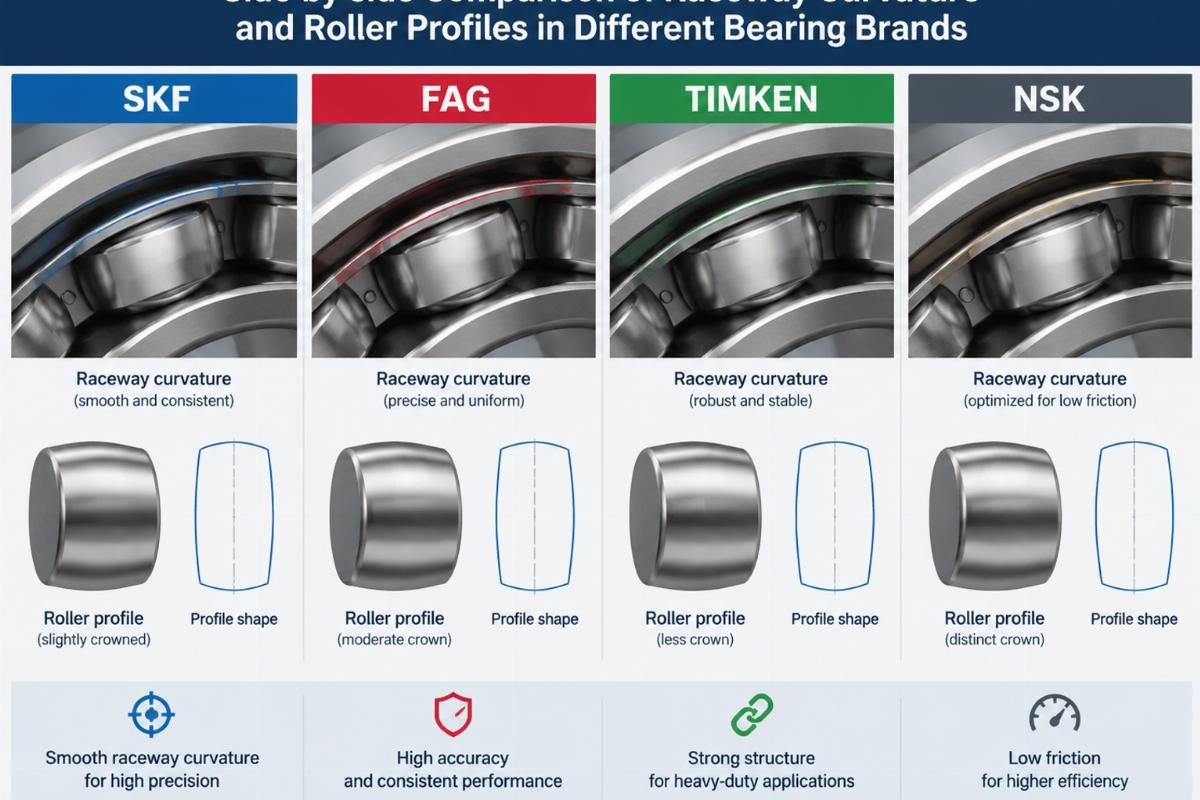
When you read a competitor’s bearing catalog, do not stop at the size chart. Look for the internal design descriptions. Check if the manufacturer specifies optimized raceway geometry or special roller crowning. These details are often buried in the technical notes or separate engineering sections. Ignoring them means you are buying a part that fits but does not function as required.
How to Compare Internal Structures Across Competitor Catalogs?
A matrix comparison of raceway designs, roller profiles, and cage materials reveals true equivalence.
To accurately cross-reference models, you need to build a comparison matrix. This involves extracting specific internal parameters from each catalog. The key elements to compare are the cage type, the roller or ball material, and the seal design.
Cage material is critical for high-speed or high-temperature applications. Polyamide cages offer low friction and good chemical resistance, while steel cages provide higher strength and temperature tolerance. Brass cages are often used for their machinability and moderate performance. If a competitor’s catalog specifies a polyamide cage for a high-temperature application where the original used steel, the replacement will fail. The heat will deform the plastic, leading to cage collapse and bearing seizure.
Roller profile also matters. Some manufacturers use symmetrical rollers, while others use asymmetrical designs for better guidance. The catalog should specify the roller type. If this information is missing, it is a red flag. You cannot assume equivalence without this data.
| Parameter | Original Specification | Competitor Catalog Data | Risk Assessment |
|---|---|---|---|
| Cage Material | Steel | Polyamide (PA66) | High risk in high-temp zones |
| Roller Profile | Logarithmic Crowning | Standard Cylindrical | Moderate risk of edge stress |
| Seal Type | Contact Rubber Seal | Non-contact Shield | Low protection against contaminants |
This table illustrates how qualitative differences impact performance. Notice that we do not use exact numerical values for material properties, as these vary by batch and testing method. Instead, we focus on the type and design.
A European wind farm operator once faced repeated gearbox failures. They had switched to a cheaper brand that matched the dimensions. However, the new bearings used a different cage design that was not suitable for the oscillating loads of the pitch system. The cage fractured under stress. By comparing the internal structure diagrams in the catalogs, they identified the mismatch. Switching back to a bearing with the correct cage design solved the problem.

When building your matrix, include columns for cage material, roller profile, and seal type. Fill these in from each catalog. If a competitor does not provide this information, treat the bearing as non-equivalent until proven otherwise. This rigorous approach prevents the kind of failures that cost far more than the savings from switching brands.
What Hidden Parameters in Catalogs Cause Field Failures?
Decoding clearance codes, seal types, and lubrication specs is essential to avoid mismatched replacements.
Beyond internal structure, several hidden parameters in bearing catalogs can lead to field failures if ignored. The most common culprit is internal clearance. Bearings are manufactured with different internal clearances, denoted by codes like C2, C3, C4, etc. [NEED_CITE: ISO internal clearance classes for rolling bearings]. A standard clearance bearing might work in a normal environment, but a high-temperature application requires a C3 or C4 clearance to allow for thermal expansion. If you replace a C4 bearing with a standard clearance one, the inner ring will expand more than the outer ring during operation. This reduces the internal clearance to zero, causing pre-load and rapid overheating.
Seal types are another critical factor. Catalogs often use suffixes to denote seal types. A rubber contact seal provides better protection against contaminants but generates more heat. A metal shield offers less protection but runs cooler. In a dirty environment like a cement plant, using a shielded bearing instead of a sealed one will allow dust and debris to enter, leading to abrasive wear.
Lubrication specifications are also vital. Some bearings come pre-lubricated with specific greases suitable for certain temperatures and speeds. If the competitor’s catalog does not specify the grease type or if it differs from the original, you risk incompatibility. Mixing incompatible greases can cause them to break down, losing their lubricating properties.
A Middle East steel mill experienced a series of motor failures. The maintenance team had replaced the original bearings with equivalents from a different brand. The dimensions and clearance codes matched. However, the new bearings were lubricated with a grease that had a lower dropping point. In the hot environment of the mill, the grease melted and leaked out. The bearings ran dry and failed. The catalog had not clearly specified the grease properties, leading to the oversight.

To avoid these issues, always check the suffixes in the part number. Decode them using the manufacturer’s key. Verify the clearance class, seal type, and lubrication specification. If the competitor’s catalog is vague on these points, request technical data sheets. Do not assume that a similar part number means similar performance.
How to Build a Reliable Cross-Brand Selection Matrix?
A step-by-step verification checklist ensures safe model substitution and prevents costly mismatches.
Creating a reliable selection matrix requires a systematic approach. Start by listing the critical parameters from the original bearing. Then, compare each parameter against the competitor’s catalog. If any parameter is missing or different, investigate further.
Step 1: Verify Boundary Dimensions. Check the bore, outside diameter, and width against ISO standards. Ensure they match exactly.
Step 2: Check Internal Clearance. Identify the clearance code (e.g., C3, C4). Ensure the competitor’s bearing has the same or compatible clearance. [NEED_CITE: Guidelines for selecting internal clearance based on operating conditions].
Step 3: Analyze Cage Material and Design. Compare the cage material (steel, brass, polyamide) and design. Ensure it is suitable for the application’s speed and temperature.
Step 4: Review Seal and Lubrication. Check the seal type and lubrication specification. Ensure they meet the environmental requirements.
Step 5: Confirm Load Ratings. Compare the dynamic and static load ratings. Ensure the competitor’s bearing meets or exceeds the original requirements.
Step 6: Validate Suffixes. Decode all suffixes in the part number to ensure no hidden differences exist.
In our practice, we use this checklist for every cross-brand inquiry. For example, when a client requested an equivalent for a specific FAG spherical roller bearing, we did not just look for a matching size. We compared the internal clearance, cage material, and roller profile. We found that the proposed alternative had a different cage design. We advised the client against using it for their high-load application. Instead, we sourced a bearing with a matching internal structure. This attention to detail prevented a potential failure.

This methodical approach ensures that you do not miss critical differences. It transforms the complex task of reading a competitor’s bearing catalog into a manageable and safe process. By focusing on technical validation rather than just dimensional matching, you protect your operations from unexpected downtime.
Conclusion
Accurate cross-referencing requires looking beyond dimensions to internal engineering details.
Reading a competitor’s bearing catalog is not just about finding a matching size. It is about understanding the internal structures, clearances, and materials that define performance. By using a structured comparison matrix and verifying hidden parameters, you can make informed decisions that prevent failures. This technical diligence is the key to reliable cross-brand selection.

Written by
authorEditor covering global sourcing, supplier verification, and industrial product knowledge. Content is compiled from manufacturer specifications, industry standards, and hands-on experience with international B2B buyers. Every article is fact-checked before publishing to help procurement professionals make informed decisions.
View all posts

Leave a Reply