John Deere Bearing Part Numbers & Equivalents Wholesale Supplier
Identical outer dimensions do not guarantee interchangeability.
Accurate cross-referencing of John Deere bearing part numbers to premium equivalents requires verifying original internal clearances and seal designs, not just matching external measurements. Relying solely on visual size matching leads to premature failures in heavy-duty agricultural gearboxes. Successful replacement depends on consulting dimensional tolerance verification methods and internal clearance guidelines rather than superficial appearance.
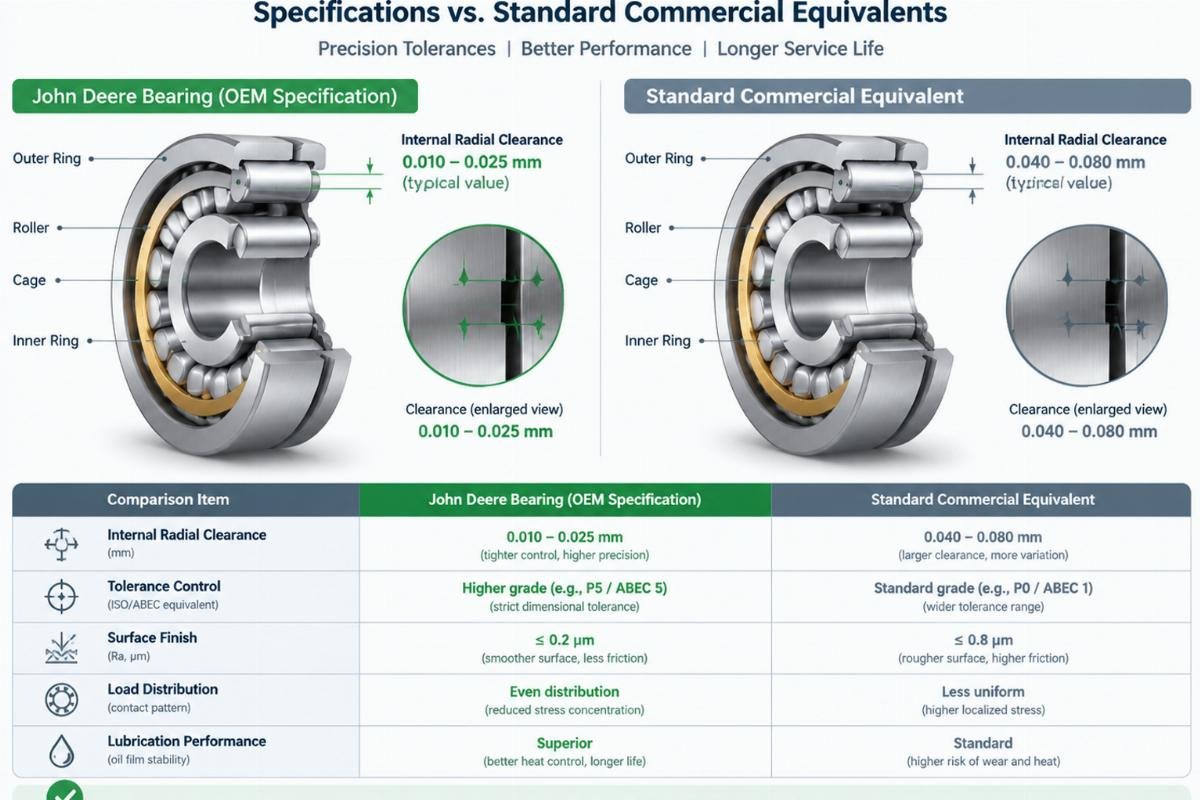
I still remember the humidity in Lagos when the call came through. A client in West Africa had installed a batch of replacements for a John Deere tractor gearbox. The parts looked identical to the originals. The outer diameter matched. The width was correct. Yet, within days, the bearings seized. The issue was not the size but the internal clearance. I had matched the part number based on standard catalogs without checking the specific C3 clearance required for high-temperature agricultural operations. That mistake cost us air freight fees and damaged trust. Since then, I have learned that a John Deere OEM part number is merely a starting point. True equivalence demands a deeper technical audit. [NEED_CITE: ISO standards for internal radial clearance in rolling bearings]
Many distributors assume that if a bearing fits into the housing, it will work. This assumption ignores the harsh reality of agricultural machinery. Tractors and harvesters operate under variable loads, high vibration, and significant temperature fluctuations. A standard commercial bearing might fit physically but fail mechanically because its internal play is too tight for thermal expansion or its seals cannot handle the dust and moisture of field work. Understanding these nuances is critical for any John Deere Bearing Part Numbers and Equivalents Wholesale Supplier aiming to provide reliable solutions.
Why Direct Visual Matching Fails in John Deere Bearing Replacements?
Outer dimensions deceive; internal clearance and seals are critical for agricultural gearboxes.
When replacing bearings in heavy equipment, the most common error is focusing exclusively on the bore, outer diameter, and width. While these dimensions ensure the bearing fits into the machine, they do not ensure it survives. Agricultural applications subject bearings to shock loads and contamination that standard industrial environments do not.
Consider the case of a harvester pivot bearing. A maintenance team replaced a failed unit with a visually identical alternative. The new bearing had the same outer size and brand prestige. However, the seal design differed. The original John Deere specification used a specialized contact seal to keep out chaff and dust. The replacement used a non-contact shield. Within a single harvest season, contaminants entered the raceway, causing abrasive wear and eventual failure. Proper seal verification could have extended the lifespan significantly. [NEED_CITE: Agricultural machinery engineering guidelines for sealing effectiveness]
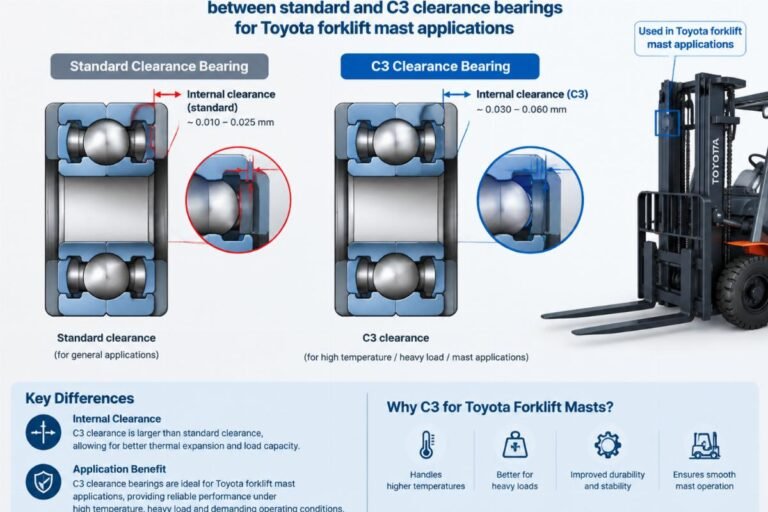
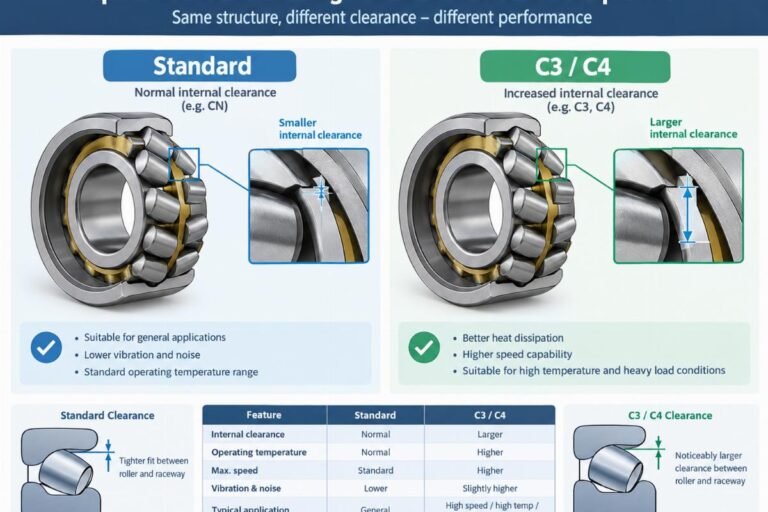
Another critical factor is internal clearance. Standard deep-groove ball bearings often come with normal clearance (CN). However, many John Deere gearbox applications require C3 or even C4 clearance to accommodate heat generation and shaft expansion during heavy operation. Installing a CN bearing in a C3 application results in preload as the metal expands, leading to rapid overheating and cage failure. This is not a manufacturing defect but a specification mismatch.
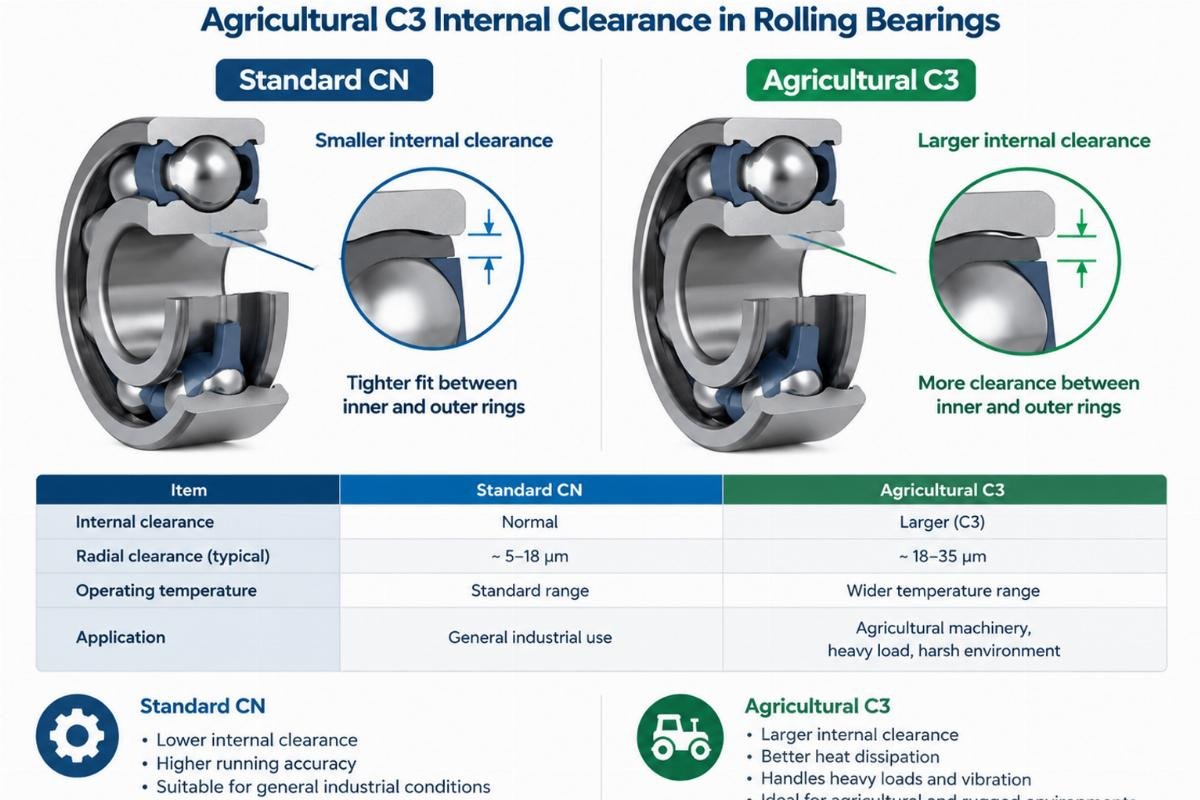
For a John Deere Bearing Part Numbers and Equivalents Wholesale Supplier, recognizing these differences is vital. It is not enough to offer a part that fits. The part must perform under the specific stresses of farming. Ignoring these internal specifications turns a simple replacement into a recurring downtime issue for the end-user.
How to Accurately Cross-Reference John Deere OEM Part Numbers?
Step-by-step methodology using original dimension verification and premium brand equivalence matrices.
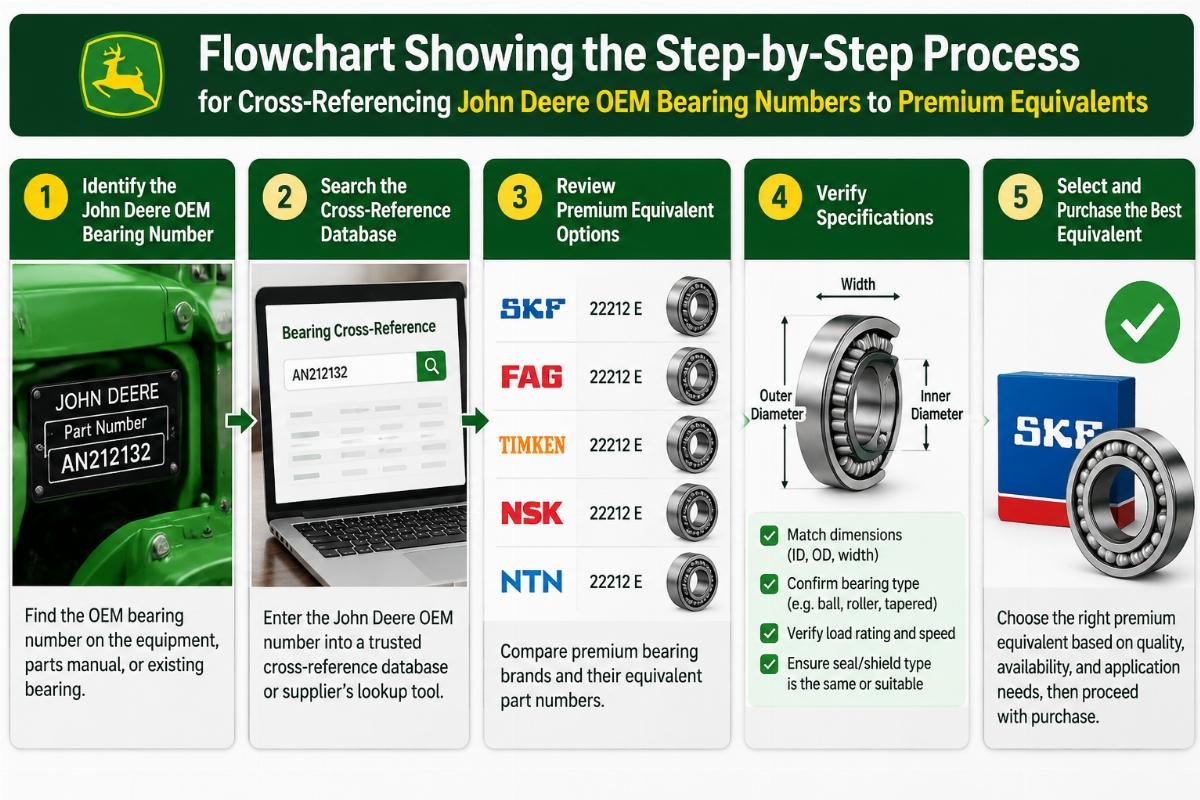
Cross-referencing is a systematic process, not a guess. It begins with the OEM number but ends with a full technical validation. The goal is to map the John Deere number to a global premium equivalent like SKF, FAG, or NTN while ensuring all performance criteria are met.
First, identify the base bearing type from the OEM number. John Deere often uses standard industry numbers but may add suffixes indicating special features. Strip away the branding to find the underlying ISO designation. For example, a specific John Deere number might correspond to a standard 6205 bearing, but with a modified cage or grease.
Second, verify the internal clearance. Consult the original equipment manual or technical service bulletins. If the manual specifies C3 clearance, do not substitute with a standard CN bearing. This step is non-negotiable for gearbox and wheel hub applications. [NEED_CITE: Technical service manuals for agricultural transmission systems]
Third, check the seal and lubrication. Agricultural bearings often use heavy-duty rubber seals rather than metal shields. They may also be pre-lubricated with high-temperature grease suitable for slow-speed, high-load conditions. Ensure the equivalent bearing matches these material specifications.
Fourth, use a cross-reference matrix. Compare the verified specifications against premium brands. Look for equivalents that explicitly state compliance with agricultural standards. Do not rely on generic databases that only match dimensions.
| Verification Step | Critical Check | Common Pitfall |
|---|---|---|
| Dimensions | Bore, OD, Width | Ignoring chamfer angles |
| Internal Clearance | C3/C4 vs CN | Assuming standard clearance is sufficient |
| Sealing | Contact rubber vs Metal shield | Overlooking dust exclusion needs |
| Lubrication | High-temp agricultural grease | Using standard industrial grease |
This method ensures that the replacement is not just a physical fit but a functional match. For buyers sourcing from a John Deere Bearing Part Numbers and Equivalents Wholesale Supplier, requesting this level of detail separates professional suppliers from simple box movers.
John Deere Bearing Equivalents: Premium vs. Domestic Brands Comparison
Specification matrix comparing SKF/FAG/NTN with ZWZ/HRB for cost-performance balance.
Not all bearings are created equal, but not every application requires the most expensive option. Understanding the tiered landscape helps in making cost-effective decisions without compromising reliability. Premium global brands like SKF, FAG, and NTN offer consistent quality and advanced materials. Domestic Chinese brands like ZWZ, HRB, and LYC have improved significantly and offer viable alternatives for less critical applications.
The key difference lies in material purity and manufacturing consistency. Premium brands use vacuum-degassed steel with controlled inclusion levels, resulting in longer fatigue life under heavy loads. They also maintain tighter tolerances across large batches. Domestic brands have closed the gap in standard applications but may show more variance in high-precision or extreme-load scenarios.
For a John Deere tractor operating in moderate conditions, a high-quality domestic bearing might suffice for routine maintenance. However, for a combine harvester working continuously during a short harvest window, the risk of failure outweighs the initial savings. In such cases, premium equivalents are the safer choice.
| Feature | Premium Global Brands (SKF/FAG/NTN) | Reliable Domestic Brands (ZWZ/HRB/LYC) |
|---|---|---|
| Material Purity | Controlled low-inclusion steel | Standard high-carbon chromium steel |
| Consistency | High batch-to-batch uniformity | Good, with occasional variance |
| Price Point | Higher | Competitive |
| Best Use Case | Critical high-load agricultural gearboxes | General purpose wheels and idlers |
| Traceability | Full documentation available | Variable depending on supplier |
Sourcing from a John Deere Bearing Part Numbers and Equivalents Wholesale Supplier who stocks both tiers allows for strategic mixing. You can use premium bearings for critical drivetrain components and cost-effective options for auxiliary roles. This approach balances budget constraints with operational reliability. [NEED_CITE: Comparative fatigue life studies in rolling element bearings]
Procurement Checklist: Avoiding Counterfeits and Ensuring Traceability
Required documentation, ISO compliance, and supplier verification for genuine parts.
The market for agricultural bearings is rife with counterfeits. Fake bearings often look convincing but use inferior steel and poor heat treatment. They fail prematurely, causing expensive collateral damage to gears and shafts. Protecting your supply chain requires strict verification protocols.
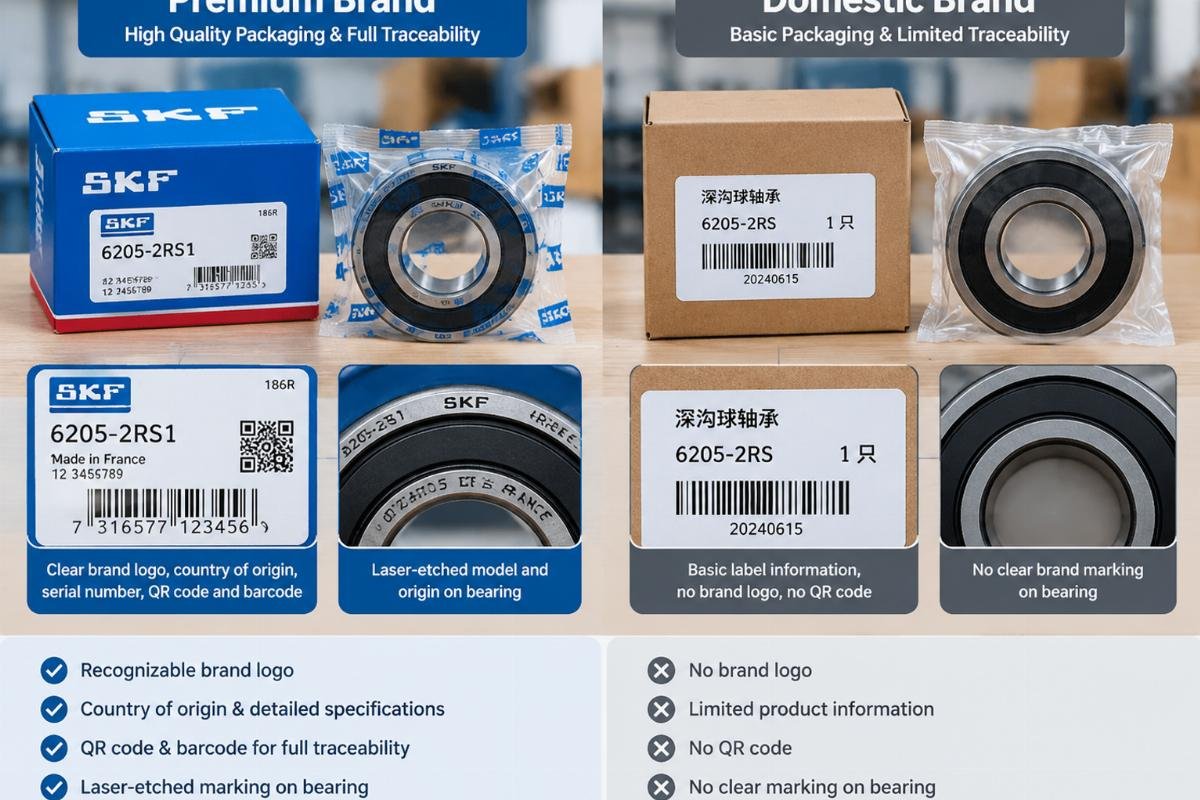
Start by demanding traceability documentation. Genuine bearings from reputable manufacturers come with batch numbers that can be traced back to the production facility. Ask for certificates of conformity that reference ISO standards. A reliable John Deere Bearing Part Numbers and Equivalents Wholesale Supplier will provide these documents without hesitation.
Inspect the packaging carefully. Counterfeiters often replicate logos but miss subtle details in font weight or color accuracy. Check the bearing itself for marking quality. Genuine markings are laser-etched or stamped cleanly, while fakes may appear blurred or uneven.
Verify the supplier’s authorization. While many distributors sell genuine products, some mix stock from unknown sources. Request proof of their supply chain origins. Ask about their quality control processes for incoming goods. Do they inspect samples? Do they test hardness and dimensions?
Finally, consider the logistics. Consolidating orders from multiple brands into a single container can reduce costs, but it increases the complexity of verification. Ensure that each brand in the mixed container is accompanied by its own set of documents. This prevents a single counterfeit batch from contaminating the entire shipment.
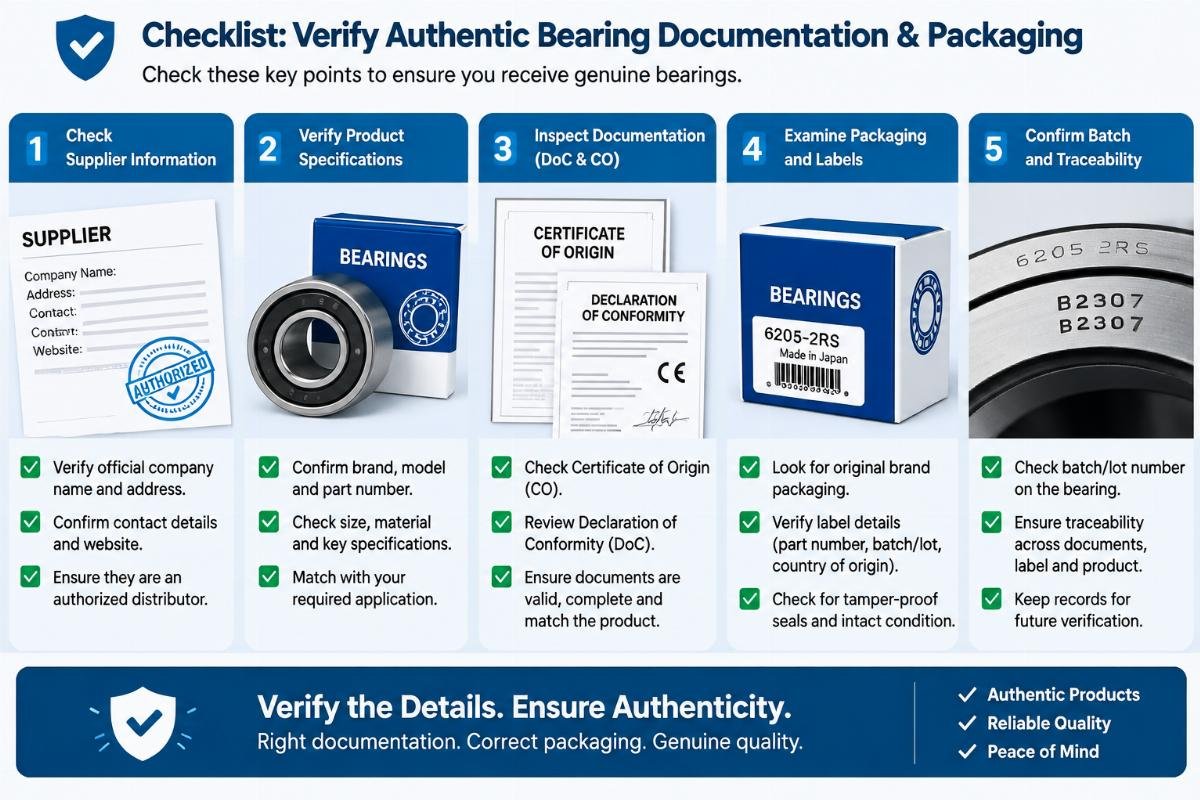
By following these steps, buyers can minimize the risk of receiving substandard parts. Trust is built on transparency, and a professional supplier will welcome these checks as proof of their integrity. [NEED_CITE: ISO 9001 quality management requirements for bearing distribution]
Conclusion
Precision in specification prevents downtime in the field.
Replacing John Deere bearings requires more than matching numbers. It demands an understanding of internal clearances, seal designs, and material quality. By verifying these technical details and sourcing from transparent partners, operators can ensure reliable performance. A knowledgeable John Deere Bearing Part Numbers and Equivalents Wholesale Supplier provides not just parts, but the technical confidence needed to keep machinery running.

Written by
authorEditor covering global sourcing, supplier verification, and industrial product knowledge. Content is compiled from manufacturer specifications, industry standards, and hands-on experience with international B2B buyers. Every article is fact-checked before publishing to help procurement professionals make informed decisions.
View all posts
Leave a Reply