Case IH & New Holland Bearing Equivalents Wholesale Supplier
Matching the part number is useless if the internal clearance is wrong for high-load harvesting.
Sourcing reliable Case IH and New Holland bearing equivalents requires strict adherence to dimensional tolerances and internal clearance specifications, not just matching alphanumeric part numbers. The core argument for preventing catastrophic agricultural machinery failures lies in verifying ISO 492 tolerance classes and ISO 5753 internal clearance standards before bulk ordering. Simply finding a cross-reference that fits the shaft diameter is insufficient; the bearing must withstand shock loads typical of combine harvesters and tractors without premature seizure or spalling.
I still remember the smell of burnt grease in a workshop in São Paulo. A distributor had sourced what he thought were cost-effective tapered roller bearings for a fleet of CNH combine harvesters. The part numbers matched the original equipment manufacturer’s catalog perfectly. On paper, it was a successful substitution. In the field, the inner ring tolerance failed under heavy shock loads during peak harvest season. The rollers seized, causing significant shaft damage. The cost of the returned container and the freight claims dwarfed the initial savings from buying cheaper alternatives. That incident reinforced a critical lesson: in agricultural machinery, a micron-level deviation in tolerance or an incorrect clearance class can lead to downtime costing far more than the bearing itself. This experience drives my approach to selecting Case IH and New Holland bearing equivalents, focusing on verifiable quality rather than just price parity.

Understanding why these failures occur requires looking beyond the part number. The next sections detail how to verify specifications, compare materials, and implement a sourcing strategy that minimizes risk while maintaining cost efficiency for New Holland agricultural bearing substitutes.
Why Do Cheap Case IH/New Holland Equivalents Fail in the Field?
Tolerance and clearance mismatches cause seized rollers under heavy shock loads.
Agricultural machinery operates in some of the harshest environments imaginable. Dust, moisture, variable loads, and continuous vibration are standard conditions. When sourcing Case IH tractor bearing cross reference options, many buyers focus solely on the outer diameter, inner diameter, and width. However, two other factors determine whether a bearing survives a season or fails in days: precision tolerance and internal clearance.
Precision tolerance refers to the allowable deviation in dimensions. For high-speed or high-precision applications, such as gearbox inputs in modern tractors, ISO Class P5 or P6 tolerances are often required. Cheaper equivalents may only meet P0 (standard) tolerances. While P0 is acceptable for many general industrial applications, it can lead to excessive play or tight fits in agricultural gearboxes, causing heat buildup and premature wear. [NEED_CITE: ISO 492 tolerance classes for rolling bearings]
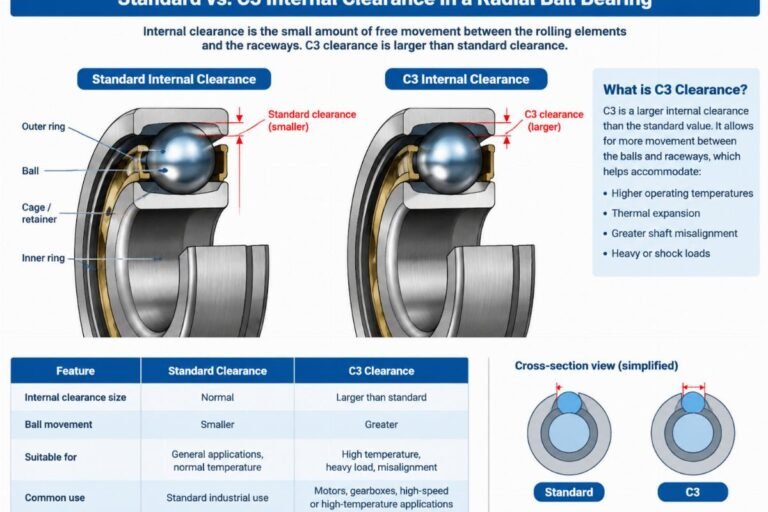
Internal clearance is even more critical for heavily loaded components like wheel hubs and cutter bars. Standard clearance (C2 or Normal) might seem adequate, but under heavy radial loads, the bearing components deform slightly. If there is insufficient initial clearance, this deformation leads to metal-to-metal contact, generating intense heat. For CNH combine harvester bearing equivalents, C3 or even C4 clearance is often specified to accommodate thermal expansion and load-induced deformation. Ignoring this specification is a common error. I have seen batches of bearings labeled as “equivalent” fail because they were manufactured with standard clearance instead of the required C3, leading to immediate seizure upon startup under load.

The failure mode is rarely sudden breakage. It usually starts with noise, progresses to heat, and ends with catastrophic seizure. By the time the operator notices, the housing or shaft may be damaged, turning a simple bearing replacement into a major repair job. This is why verifying the clearance code stamped on the bearing or provided in the technical datasheet is non-negotiable when evaluating tapered roller bearings for Case IH applications.
Specification Matrix: Original vs. Reliable Equivalents
Compare material grade, heat treatment, and precision grades side-by-side.
To avoid the pitfalls of vague “equivalent” claims, buyers need a clear framework for comparison. The following matrix outlines the key differences between original equipment specifications and reliable aftermarket alternatives. Note that “reliable” does not mean “cheapest.” It means meeting the engineering requirements without the brand premium.
| Specification Factor | Original Equipment Standard | Reliable Equivalent Requirement | Low-Cost Risk Alternative |
|---|---|---|---|
| Material Grade | High-carbon chromium steel (e.g., SAE 52100) | Verified SAE 52100 or equivalent DIN 100Cr6 | Unspecified carbon steel with high inclusion content |
| Heat Treatment | Through-hardened, controlled atmosphere | Through-hardened, hardness HRC 60-64 | Surface hardened only or inconsistent hardness |
| Precision Tolerance | ISO P5/P6 for critical apps | ISO P5/P6 verified by inspection report | ISO P0 (Standard) only |
| Internal Clearance | C3/C4 for heavy load apps | C3/C4 verified per ISO 5753 | Normal/C2 clearance (incorrect for load) |
| Cage Material | Stamped steel or machined brass | Stamped steel or polymer (PA66) if specified | Thin, poorly formed steel cages |
| Traceability | Full batch tracking | Batch-level heat number traceability | No traceability, generic packaging |
[NEED_CITE: ABMA guidelines for bearing material and manufacturing standards]
The table highlights that material and heat treatment are foundational. Bearings made from inferior steel with high oxygen content will suffer from early fatigue spalling. The hardness range of HRC 60-64 is a white-listed industry standard for through-hardened bearing steel, ensuring the raceways can resist indentation from debris or heavy loads. [NEED_CITE: General bearing steel hardness standards]
A European MRO workshop once struggled with mixed-brand consolidation for CNH gearboxes. They switched to a supplier who provided full material certificates and hardness test reports for each batch. While the unit price was slightly higher than the lowest bidder, the return rate dropped noticeably. The workshop technicians reported that the installation fit was consistent, and the bearings ran cooler during initial break-in periods. This consistency is crucial for urgent harvest-season repairs, where there is no time for rework.
When reviewing Case IH and New Holland bearing equivalents, always request the technical datasheet that specifies these parameters. If a supplier cannot provide hardness data or tolerance class verification, they are likely trading on brand recognition alone, not engineering merit.

How to Verify Bearing Equivalents Before Bulk Ordering
Request traceability docs, inspect packaging, and verify cross-reference charts.
Verification is not just about checking a website. It involves physical and documentary evidence. Before committing to a large order of New Holland agricultural bearing substitutes, implement a three-step verification process.
First, demand traceability documentation. A reliable manufacturer will provide a certificate of conformity that links the specific batch of bearings to the raw material heat number. This document should confirm the steel grade and the results of hardness testing. Without this link, you have no way to verify if the bearings meet the HRC 60-64 standard. [NEED_CITE: Importance of material traceability in bearing manufacturing]
Second, inspect the packaging and marking. Genuine-quality equivalents will have clear, laser-etched or deeply stamped markings on the rings. These markings should include the brand logo, part number, and crucially, the clearance code (e.g., C3). Fuzzy printing or missing clearance codes are red flags. Additionally, check the packaging for damage or signs of repackaging. Authentic bearings are typically packed in anti-corrosion paper and sealed boxes.
Third, verify the cross-reference charts independently. Do not rely solely on the supplier’s claim. Use multiple independent cross-reference tools or consult the original equipment manual to confirm the required specifications. For example, if the manual specifies a P6 tolerance for a spindle bearing, ensure the equivalent explicitly states P6. A mismatch here can lead to improper fit and vibration issues.
A Southeast Asian OEM scenario illustrates this well. They were upgrading local assembly lines with verified equivalents. By insisting on batch-to-batch consistency and material traceability documentation, they ensured that every bearing installed met the same standard. This reduced variability in the final product and minimized warranty claims from end-users.

This rigorous approach eliminates the guesswork. It transforms the procurement process from a price-based decision to a value-based one. When sourcing Case IH and New Holland bearing equivalents, this diligence protects your reputation and your customers’ equipment.
Sourcing Strategy: Consolidating CNH Bearing Packages
Mix SKF, FAG, TIMKEN, and premium Chinese brands for optimal cost-performance.
Not every bearing in a machine requires the same level of investment. A strategic sourcing approach involves categorizing bearings by criticality and application. For high-speed, high-precision, or heavily loaded positions, premium global brands like SKF, FAG, or TIMKEN are often justified due to their proven track record and advanced manufacturing technologies. However, for less critical applications, such as idler pulleys or low-speed auxiliary drives, high-quality domestic Chinese brands like ZWZ, HRB, or LYC can offer significant cost savings without compromising reliability.
The key is consolidation. Instead of managing multiple suppliers for different brands, work with a partner who can provide a mixed-brand package. This allows you to optimize costs across the entire bill of materials. For instance, use premium brands for the main gearbox and wheel hubs, and reliable premium Chinese brands for secondary supports. This strategy reduces inventory complexity and simplifies logistics.
Our approach supports this mixed-brand consolidation. We stock genuine products from major global brands alongside reliable domestic lines. This flexibility allows us to tailor packages to specific needs, whether it is a single-unit emergency spare part order or a full container consolidation shipment. By leveraging our massive spot inventory and cross-brand equivalent model consultation, we help clients balance cost and performance effectively.
For regional distributors, this means offering their customers a tiered solution. They can provide premium options for critical repairs and cost-effective alternatives for routine maintenance. This versatility strengthens their market position and improves customer satisfaction. When dealing with tapered roller bearings for Case IH applications, having access to both premium and value-tier options allows for better negotiation and service delivery.
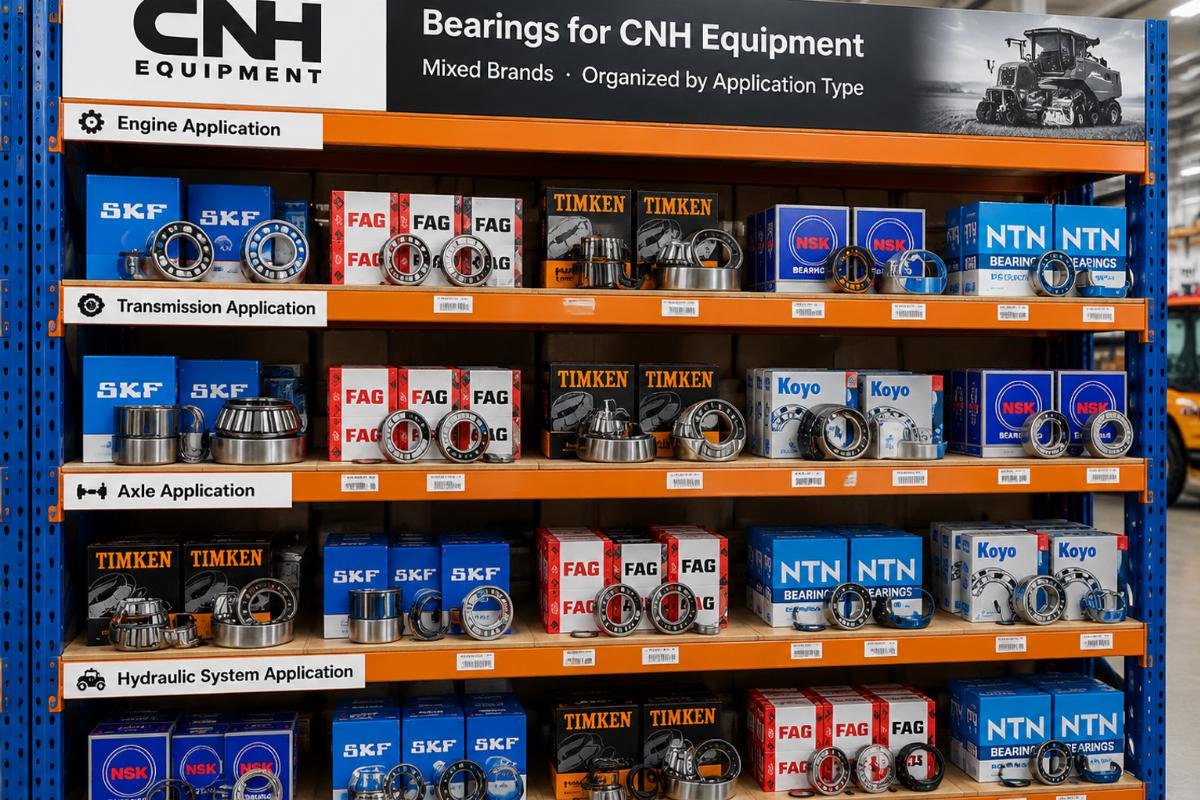
This strategy also mitigates supply chain risks. If one brand faces availability issues, having qualified alternatives from other manufacturers ensures continuity. It is about building a resilient supply chain that can adapt to market fluctuations while maintaining quality standards.
Conclusion
Reliable equivalents depend on verified specs, not just part numbers.
Sourcing Case IH and New Holland bearing equivalents is a technical challenge that demands attention to detail. By focusing on tolerance classes, internal clearance, and material traceability, buyers can avoid costly failures. A strategic mix of premium and value-tier brands offers the best balance of cost and reliability. Always verify specifications through documentation and independent checks to ensure your machinery stays in the field, not in the shop.

Written by
authorEditor covering global sourcing, supplier verification, and industrial product knowledge. Content is compiled from manufacturer specifications, industry standards, and hands-on experience with international B2B buyers. Every article is fact-checked before publishing to help procurement professionals make informed decisions.
View all posts

Leave a Reply