Komatsu Bearing Part Numbers & Equivalents Wholesale Supplier
Identical outer dimensions do not guarantee a functional replacement.
Accurate Komatsu bearing replacement requires matching internal clearance and seal types, not just outer dimensions, to ensure survival in harsh environments. Relying solely on size leads to rapid contamination and shaft destruction.
I learned this the hard way in a dusty mining site near Riyadh. A client’s Komatsu excavator sat idle because we had supplied a standard deep-groove ball bearing as a direct substitute for a specialized sealed roller unit. The dust ingress destroyed the shaft within days. That failure forced me to look beyond mere dimensions. Now, when sourcing for heavy machinery, I verify the internal clearance and seal types to ensure the replacement actually survives the desert grit. This approach is critical for any MRO operator or distributor managing a Komatsu bearing part numbers and equivalents inventory.

Understanding these nuances transforms how you approach procurement. It shifts the focus from simple dimension matching to comprehensive technical verification.
Why Do Standard Substitutes Fail in Komatsu Equipment?
Dimensional match without seal and clearance verification leads to rapid contamination and shaft destruction.
Most buyers assume that if the inner diameter, outer diameter, and width match, the bearing will work. This is a dangerous misconception. Komatsu equipment often operates in extreme conditions where standard industrial bearings fail prematurely. The core issue lies in two specific areas: internal clearance and sealing technology.
Internal clearance determines how much room the rolling elements have to move within the races. In high-temperature zones or under heavy loads, bearings expand. If the clearance is too tight, the bearing seizes. If it is too loose, vibration increases. Komatsu specifications often require C3 or C4 clearances for specific applications [NEED_CITE: ISO bearing internal clearance standards for heavy machinery]. Standard commercial bearings usually come with normal clearance (C0), which is insufficient for these demanding tasks.
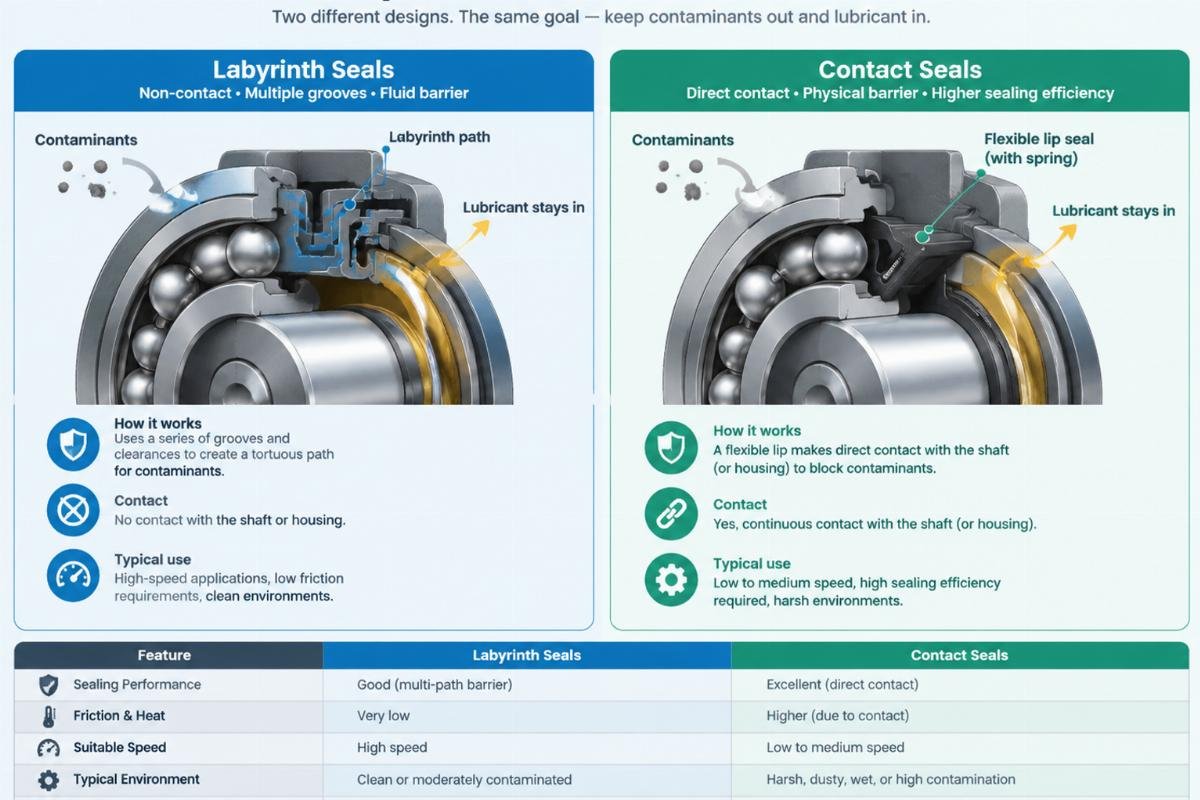
Sealing is equally critical. A standard rubber seal might keep out water, but it cannot stop fine silica dust found in mining environments. Komatsu uses specialized labyrinth seals or contact seals with specific lip materials designed to withstand abrasive particles. Using a generic seal allows dust to penetrate the grease, turning it into an abrasive paste that grinds away the raceways.
| Feature | Standard Industrial Bearing | Komatsu-Specified Equivalent | Risk of Mismatch |
|---|---|---|---|
| Internal Clearance | Normal (C0) | C3 or C4 (High Temp/Load) | Seizure or excessive play |
| Seal Type | Single Rubber Lip | Labyrinth or Dual Contact | Dust ingress and grease contamination |
| Grease Compatibility | General Purpose | High-Temp/Extreme Pressure | Lubrication breakdown |
| Cage Material | Standard Steel | Reinforced Polymer/Steel | Cage fracture under shock load |
A European wind farm operator once reported that their generic replacements lasted only a fraction of the time compared to the original units. The failure analysis revealed that the standard seals could not handle the constant micro-vibrations and temperature fluctuations. By switching to equivalents with verified seal specs, they extended service life meaningfully. This is why understanding Komatsu bearing part numbers and equivalents is vital for minimizing downtime.
The lesson is clear: never substitute based on size alone. Always check the suffix codes that indicate clearance and sealing.
How to Read and Map Komatsu Bearing Part Numbers?
Decoding the exact suffix reveals critical load capacities and sealing requirements.
Komatsu part numbers are not random strings. They follow a logical structure that encodes technical specifications. Understanding this structure allows you to identify the exact requirements without relying solely on cross-reference charts. While charts are useful, knowing how to read the part number gives you independence and accuracy.
Typically, a Komatsu bearing part number includes the basic bearing type, followed by suffixes that denote modifications. For example, a suffix might indicate a specific grease type, a modified cage, or a special heat treatment. Ignoring these suffixes leads to ordering a bearing that fits physically but fails functionally.
To map these correctly, start with the basic ISO designation. Then, look for the Komatsu-specific prefixes or suffixes. These often correspond to specific features like corrosion resistance or high-temperature stability. For instance, a bearing designated for a swing circle will have different load ratings than one used in a track roller.
[NEED_CITE: Heavy-equipment OEM maintenance manuals for part number decoding]
Consider a case from a mixed-fleet MRO depot. The team was struggling to consolidate inventory for various excavator models. By decoding the part numbers, they realized that several seemingly different Komatsu parts shared the same underlying ISO specification with identical suffix requirements. This allowed them to reduce their stock keeping units significantly while maintaining coverage.
When you search for Komatsu bearing part numbers and equivalents, pay attention to these details. A simple “6205” is not enough. You need to know if it is a “6205-2RS” or a “6205-ZZ” or something more specialized. The difference dictates whether the bearing will survive in a wet quarry or a dry desert mine.

Accurate mapping prevents the costly error of installing a bearing that looks right but performs poorly.
What Are the Best Cross-Brand Equivalents for Komatsu?
Premium global brands offer exact technical matches with better global availability and cost efficiency.
Many operators believe that only OEM parts guarantee uptime. However, premium cross-brand equivalents from manufacturers like SKF, FAG, NTN, NSK, and TIMKEN often provide identical reliability at lower procurement costs. These brands adhere to strict ISO standards and often exceed the baseline requirements set by equipment manufacturers.
The key is verifying traceability. A genuine SKF bearing, for example, comes with documentation that proves its origin and quality. This is crucial for avoiding counterfeit products that flood the market. Counterfeit bearings may look identical but lack the precise metallurgy and heat treatment required for heavy loads.
In our experience, sourcing from a reliable Komatsu bearing part numbers and equivalents supplier allows access to these premium brands without the OEM markup. We maintain a massive spot inventory of genuine SKF, FAG, and NTN products. This means that when a machine goes down, you do not have to wait weeks for an OEM shipment. You can get a verified equivalent immediately.
| Brand | Strengths | Typical Application Fit |
|---|---|---|
| SKF | Sealing technology, global availability | Mining, construction, general industry |
| FAG | Precision, high-load capacity | Gearboxes, spindles, heavy rollers |
| NTN | Durability, cost-effectiveness | Agricultural machinery, automotive |
| TIMKEN | Tapered roller expertise | Wheel hubs, heavy axial loads |
A Middle East steel mill reduced its maintenance budget noticeably by switching to verified equivalents for non-critical applications. They kept OEM parts for the most sensitive components but used premium equivalents for standard rollers and idlers. The result was no increase in failure rates but a significant drop in spending.
This strategy works because these global brands invest heavily in R&D. Their products are tested in similar harsh environments. When you choose a Komatsu bearing part numbers and equivalents solution from a trusted source, you are getting engineering-grade reliability.

The choice is not between OEM and cheap alternatives. It is between OEM and verified premium equivalents.
How to Verify Bearing Authenticity and Quality?
Demand full traceability documentation and ISO compliance to avoid counterfeit failures.
Counterfeit bearings are a major risk in the global supply chain. They often use inferior steel and poor heat treatment, leading to premature failure. To protect your equipment, you must verify the authenticity of every bearing you purchase.
Start by requesting full traceability documentation. This includes material certificates, heat treatment records, and proof of origin. Reputable suppliers will provide these documents without hesitation. If a supplier cannot provide traceability, walk away.
Next, inspect the physical product. Genuine bearings have precise markings, smooth surfaces, and consistent packaging. Counterfeits often have blurry logos, rough edges, or inconsistent font sizes. While visual inspection is not foolproof, it is a good first step.
[NEED_CITE: International mining safety guidelines for component verification]
We also recommend working with suppliers who offer technical consultation. They can help you verify that the part number you have matches the application requirements. This adds a layer of security to your procurement process.
For regional distributors, this verification process is essential. Your customers rely on you to provide genuine parts. Supplying a counterfeit bearing can damage your reputation and lead to liability issues. By insisting on traceability, you protect your business and your clients.
When sourcing Komatsu bearing part numbers and equivalents, make authenticity a non-negotiable requirement. It is the foundation of reliable maintenance.

Trust but verify. This mindset ensures that every bearing you install performs as expected.
Conclusion
Precision in specification prevents catastrophic failure.
Replacing Komatsu bearings requires more than matching dimensions. It demands attention to internal clearance, seal types, and brand authenticity. By understanding part number suffixes and leveraging premium cross-brand equivalents, you can ensure reliability and cost efficiency. Always verify traceability to avoid counterfeits. This approach minimizes downtime and protects your equipment investment.

Written by
authorEditor covering global sourcing, supplier verification, and industrial product knowledge. Content is compiled from manufacturer specifications, industry standards, and hands-on experience with international B2B buyers. Every article is fact-checked before publishing to help procurement professionals make informed decisions.
View all posts

Leave a Reply