Koyo 2RS ZZ C3 Equivalents: Cross-Reference & Wholesale Supplier
ZZ and 2RS are not interchangeable.
Koyo bearing suffixes define critical operational boundaries. 2RS indicates double rubber seals for contamination protection, ZZ denotes metal shields for high-speed low-friction applications, and C3 specifies internal clearance larger than standard to accommodate thermal expansion. Accurate decoding of these suffixes is the primary step in identifying valid SKF, FAG, or NSK equivalents to prevent premature failure and ensure sourcing efficiency.
I still remember the silence in a Nigerian cement plant control room. It was not peaceful; it was the sound of a stopped production line. The client needed a specific deep-groove ball bearing with C3 clearance and 2RS seals to handle the intense heat and dust. Local stocks were empty. Relying on memory rather than verification, I sourced a standard clearance alternative with metal shields. Within days, the bearing seized. The heat expanded the inner ring, eliminating the tiny internal space required for movement, while the dust penetrated the open shields. That downtime cost far more than the bearing itself. Since then, I have dedicated my career to mastering cross-brand technical specifications. When I see a part number now, I do not just see a code; I see the operating environment. This guide breaks down how to decode Koyo suffixes accurately and find reliable equivalents across major brands.

Understanding these distinctions is vital for any procurement strategy. Misinterpreting a single character can lead to catastrophic equipment failure. Let us explore what these suffixes truly mean and how they translate across the global bearing market.
What Do Koyo Bearing Suffixes Actually Mean?
Suffixes are not arbitrary labels; they are engineering constraints.
The alphanumeric codes following a Koyo bearing number dictate its physical interaction with the shaft, housing, and environment. Ignoring them is akin to ignoring the fuel type required by an engine. The most common sources of confusion lie in sealing types and internal clearance classes.
The suffix 2RS stands for two rubber seals. These are typically made of nitrile rubber (NBR) and provide superior protection against moisture, dust, and other contaminants. However, this protection comes at a cost: friction. The contact between the rubber lip and the inner ring generates heat and increases torque. In high-speed applications, this heat buildup can degrade the lubricant faster than expected. [NEED_CITE: frictional torque comparison between contact seals and non-contact shields]
In contrast, ZZ indicates two metal shields. These are non-contacting, meaning there is a small gap between the shield and the inner ring. This design minimizes friction and allows for higher rotational speeds and better heat dissipation. However, ZZ bearings offer minimal protection against fine dust or water ingress. They are suitable for clean environments or where external housing seals provide the primary defense.
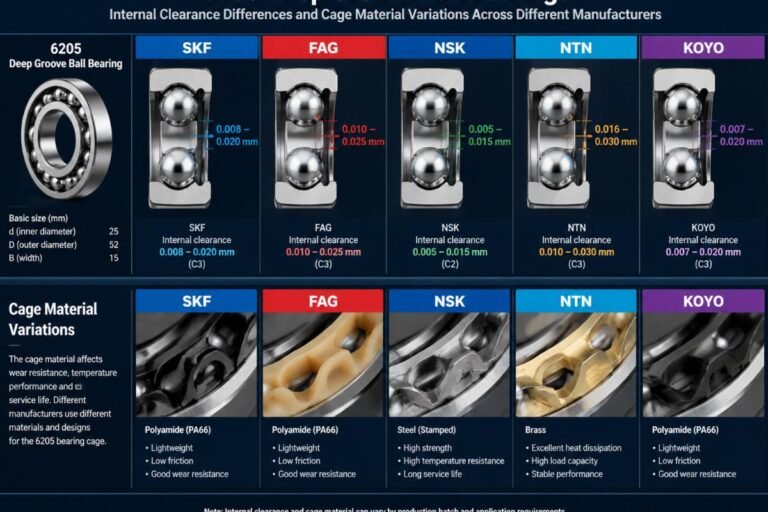
C3 refers to radial internal clearance. Standard clearance is denoted by CN (often omitted in part numbers). C3 clearance is larger than standard. This extra space is crucial in applications where temperature differentials exist. As a bearing operates, it heats up. The inner ring, attached to the rotating shaft, often expands more than the outer ring. Without sufficient internal clearance (like C3), this thermal expansion can cause the rolling elements to bind, leading to rapid overheating and seizure. [NEED_CITE: ISO 15 standard definitions for radial internal clearance classes]
Many buyers assume that C3 is always “better” because it allows for expansion. This is a dangerous misconception. In low-speed, heavy-load applications, excessive clearance can lead to increased vibration and noise as the rolling elements move too freely within the raceways. The correct choice depends entirely on the specific thermal and load conditions of the application.
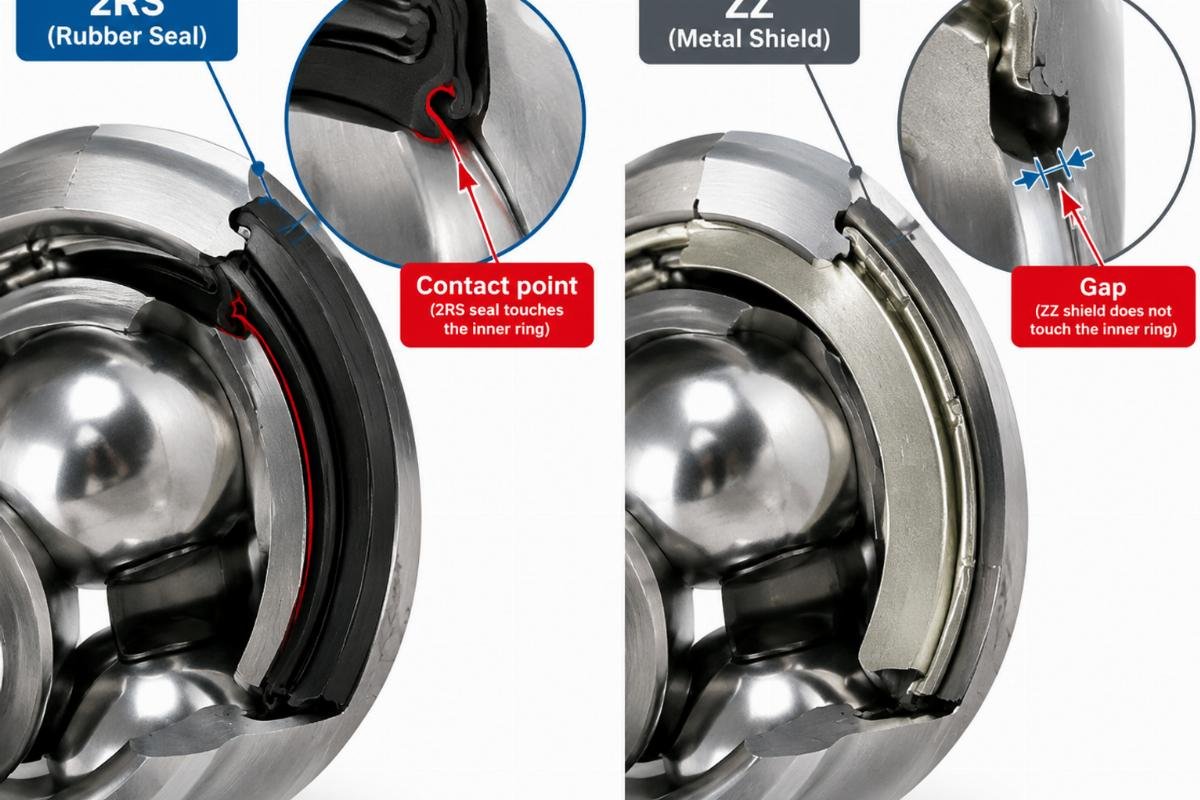
When sourcing replacements, matching these physical characteristics is non-negotiable. A ZZ bearing cannot simply replace a 2RS in a dirty environment, nor can a standard clearance bearing safely replace a C3 in a high-temperature setting.
How to Cross-Reference 2RS, ZZ, and C3 to SKF/FAG/NSK?
Brand-specific suffixes describe identical physical features using different languages.
Global bearing manufacturers adhere to similar dimensional standards (ISO 15, ISO 492), but their naming conventions for features like seals and clearance vary significantly. Creating a mental or digital cross-reference matrix is essential for efficient sourcing, especially when dealing with mixed-brand inventories or urgent substitutions.
For instance, Koyo’s 2RS is equivalent to SKF’s 2RS1 or RS1, FAG’s 2SR, and NSK’s VV or DDU (depending on the specific rubber compound and design series). Koyo’s ZZ corresponds to SKF’s Z, FAG’s ZR, and NSK’s ZZ. The C3 clearance class is remarkably consistent across major brands, with SKF, FAG, NSK, and NTN all using C3 to denote the same radial clearance range defined by ISO standards. [NEED_CITE: manufacturer catalog cross-reference tables for seal and clearance suffixes]
Below is a simplified comparison matrix for common deep-groove ball bearing suffixes. Note that while dimensions are standardized, slight variations in seal material or shield geometry may exist between brands. Always verify the specific datasheet for critical applications.
| Feature | Koyo Suffix | SKF Equivalent | FAG Equivalent | NSK Equivalent |
|---|---|---|---|---|
| Double Rubber Seal | 2RS | 2RS1 / RS1 | 2SR | VV / DDU |
| Double Metal Shield | ZZ | Z | ZR | ZZ |
| Greater Radial Clearance | C3 | C3 | C3 | C3 |
| Standard Radial Clearance | CN (omitted) | CN (omitted) | N (omitted) | CN (omitted) |
This matrix serves as a starting point. However, nuances exist. For example, some NSK series use “VV” for non-contact rubber seals and “DDU” for contact rubber seals, which aligns differently with Koyo’s 2RS depending on the specific series. Similarly, FAG might use “RSR” for certain contact seal designs. [NEED_CITE: detailed technical documentation on seal types per manufacturer series]
When I assist clients in sourcing hard-to-find parts, I do not just look for a matching number. I look for the functional equivalent. If a client needs a Koyo 6205-2RS-C3, and it is out of stock, I can confidently propose an SKF 6205-2RS1/C3 or an NSK 6205VVCMC3, provided the operational conditions match. This flexibility is key to maintaining supply chain resilience.
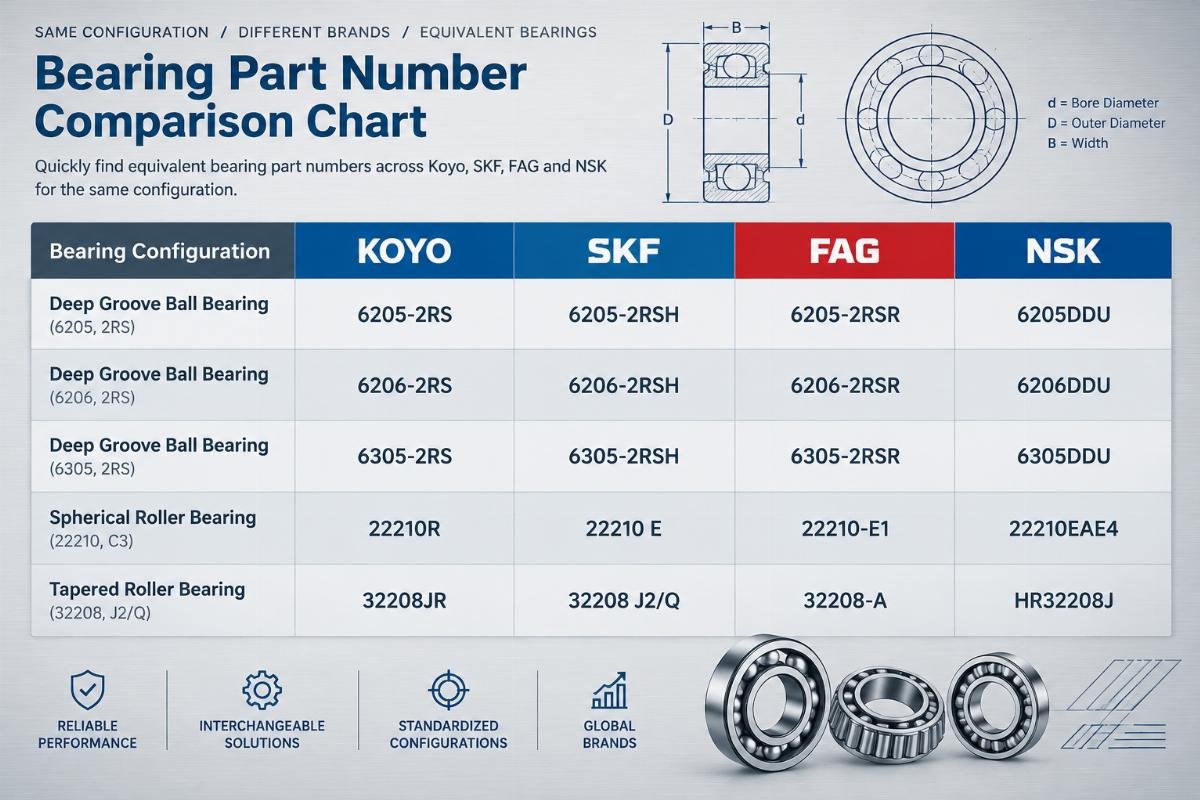
Reliable cross-referencing reduces dependency on a single brand’s availability. It opens up a global pool of inventory, allowing for faster procurement and often better pricing. However, this requires rigorous verification to ensure that the “equivalent” truly meets the mechanical demands of the application.
Why Suffix Mismatches Cause Premature Failures?
Failure is rarely random; it is usually a mismatch between specification and reality.
Misinterpreting suffixes leads to specific, predictable failure modes. Understanding these mechanisms helps in diagnosing past failures and preventing future ones. The two most common errors involve swapping seal types and ignoring clearance requirements.
Consider the case of a wet environment motor. A maintenance team replaced a failed 2RS bearing with a ZZ bearing, assuming they were functionally similar because they both “cover” the sides. The ZZ shield’s non-contact design allowed moisture-laden air to enter the bearing cavity. The water contaminated the grease, leading to corrosion of the raceways and rolling elements. The bearing failed prematurely, not due to load, but due to environmental ingress. [NEED_CITE: failure mode analysis related to lubricant contamination and corrosion]
Conversely, using a 2RS bearing in a high-speed application designed for ZZ can cause overheating. The friction from the rubber seals generates excess heat. If the speed exceeds the limit for the seal material, the rubber can harden, crack, or even melt, losing its sealing effectiveness and potentially damaging the bearing surface. This is a classic case of over-engineering protection at the expense of thermal management.
The C3 clearance mismatch is perhaps the most insidious. In the Nigerian cement plant incident, the lack of C3 clearance in a high-temperature environment led to thermal seizure. The inner ring expanded into the rolling elements, creating immense pressure. This not only destroyed the bearing but also damaged the shaft and housing. On the other hand, using C3 clearance in a precision, low-vibration application can lead to excessive play. This play causes vibration, noise, and uneven load distribution, accelerating fatigue failure. [NEED_CITE: impact of internal clearance on vibration and fatigue life]
These failures are not just technical glitches; they are financial drains. Each unplanned downtime event costs significantly more than the price difference between the correct and incorrect bearing. Proper suffix interpretation is a risk management tool.

By understanding why these mismatches fail, procurement professionals and engineers can make more informed decisions. It shifts the focus from mere part replacement to system reliability.
How to Source Equivalent Bearings for Urgent MRO?
Speed without accuracy is just faster failure.
In Maintenance, Repair, and Operations (MRO) scenarios, time is critical. When a machine goes down, the pressure to find a replacement is immense. This is where having a robust cross-reference strategy and a reliable supplier network becomes invaluable. Relying solely on one brand’s local availability can lead to prolonged downtime.
Sourcing equivalents involves three steps. First, identify the exact Koyo part number and decode its suffixes. Second, use a verified cross-reference matrix to identify potential alternatives from other major brands like SKF, FAG, or NSK. Third, verify the availability of these alternatives with suppliers who hold multi-brand inventory.
A European wind farm operator once faced a critical gearbox issue. The specified Koyo spherical roller bearings were on a long lead time. By utilizing a cross-reference guide, we identified equivalent FAG and SKF models with matching dimensions, clearance, and sealing. Because we maintained a diverse stock of premium brands, we were able to ship the alternatives within days, avoiding weeks of downtime. [NEED_CITE: case study on supply chain agility in renewable energy sector]
This approach requires a supplier who understands technical equivalencies, not just part numbers. Many distributors sell boxes; few understand the engineering inside them. A competent partner will question a request if the proposed substitute does not match the operational context. They will check if the C3 clearance is truly needed or if a standard clearance would suffice, ensuring that the solution is both available and appropriate.

Building relationships with suppliers who offer technical consultation and mixed-brand sourcing capabilities is crucial. It transforms the procurement process from a transactional hunt into a strategic partnership. This ensures that when urgency strikes, you have options, not just obstacles.
Conclusion
Correct suffix interpretation prevents costly downtime.
Decoding Koyo bearing suffixes like 2RS, ZZ, and C3 is fundamental to selecting the right component for the job. These codes define the bearing’s ability to handle contamination, speed, and thermal expansion. Cross-referencing these specifications with equivalents from SKF, FAG, and NSK expands sourcing options and enhances supply chain resilience. Avoiding mismatches in seal type and clearance class is critical for preventing premature failures and ensuring operational reliability. Prioritize technical accuracy over mere availability to maintain optimal equipment performance.

Written by
authorEditor covering global sourcing, supplier verification, and industrial product knowledge. Content is compiled from manufacturer specifications, industry standards, and hands-on experience with international B2B buyers. Every article is fact-checked before publishing to help procurement professionals make informed decisions.
View all posts
Leave a Reply