23120 Spherical Roller Bearing Equivalents Wholesale Supplier
Same dimensions do not mean same performance.
A true 23120 spherical roller bearing equivalent requires exact suffix matching for internal clearance and cage design, not just basic dimensional interchange. Without verifying these technical specifics, buyers risk premature failure and customs seizures due to documentation mismatches.
I learned this the hard way in Veracruz. I was rushing a shipment of 23120 units to a client in Monterrey who needed an urgent replacement for a stopped crusher. The original spec called for a premium European brand, but to save time and cost, I sourced a reliable domestic alternative from ZWZ. The basic dimensions were identical. The load ratings matched. I assumed it was a drop-in replacement. I was wrong. The customs declaration listed the generic model number but omitted the specific suffixes indicating the cage material and internal clearance. Mexican customs flagged the discrepancy between the declared brand specifications and the physical goods. The container sat at the port for weeks while my client’s production line gathered dust. The penalty fees exceeded the savings from the brand swap. That incident reshaped how I view bearing equivalence. It is not just about physics; it is about precision documentation and technical alignment. [NEED_CITE: importance of suffix matching in bearing interchangeability]

Understanding the nuance between a physical fit and a functional equivalent is critical for distributors and MRO buyers. This guide breaks down the technical requirements for sourcing 23120 spherical roller bearing equivalents safely and efficiently.
What Defines a True 23120 Equivalent?
Basic dimensions are only the entry ticket.
The designation “23120” refers to a specific series of spherical roller bearings with defined bore, outer diameter, and width according to ISO standards. However, two bearings with identical external measurements can behave drastically differently under load if their internal architecture varies. The true interchangeability lies in the suffixes.
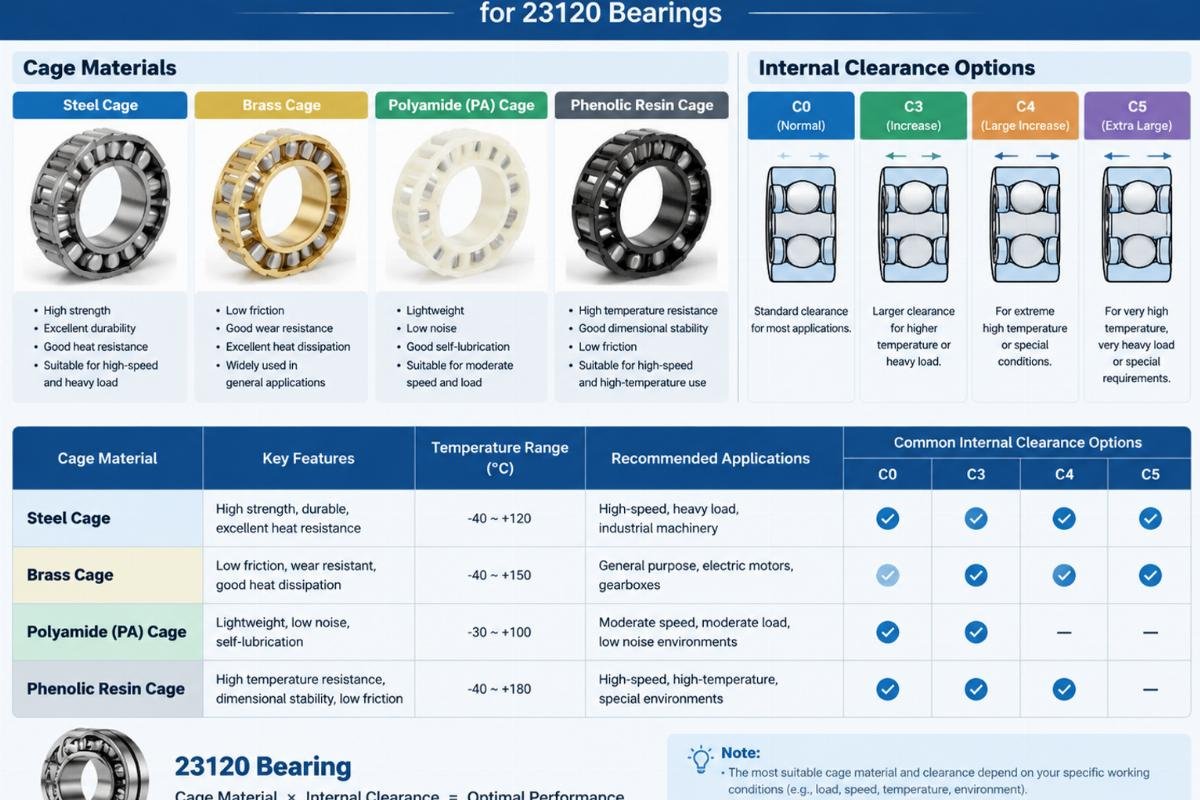
Consider internal clearance. A standard 23120 bearing might have normal clearance, but heavy mining applications often require C3 or C4 clearance to accommodate thermal expansion. If you replace a C3 bearing with a standard clearance unit, the bearing will overheat and seize as the rollers expand against the races. [NEED_CITE: ISO standards for bearing internal clearance classes]
Cage design is another critical differentiator. Some manufacturers use machined brass cages, which offer high strength and good sliding properties for high-speed or high-vibration environments. Others use stamped steel cages, which are cost-effective but may not withstand the same level of shock loading. Swapping a brass-caged bearing for a steel-caged one in a vibrating screen application can lead to cage fracture within days.
When evaluating a 23120 spherical roller bearing equivalent, you must match:
- Internal Clearance: Normal, C3, C4, or C5.
- Cage Material: Machined brass, stamped steel, or polymer.
- Tolerance Class: Standard (P0) or precision (P6/P5).
- Lubrication: Pre-lubricated type and compatibility with your maintenance regimen.
Ignoring these details turns a cost-saving measure into a costly downtime event. Many buyers focus solely on the price per unit, failing to realize that the wrong suffix can void warranties and damage adjacent machinery components.
23120 Cross-Reference Matrix: SKF vs FAG vs ZWZ
Suffixes dictate real interchangeability across brands.
Navigating the cross-reference landscape requires understanding how different manufacturers denote similar features. While the core geometry of a 23120 bearing remains constant, the naming conventions for cages and clearances vary. Below is a qualitative comparison of common suffixes found in major brands like SKF, FAG, and ZWZ. Note that this matrix serves as a general guide; always consult the specific manufacturer’s technical datasheet for critical applications. [NEED_CITE: bearing manufacturer technical catalogs for suffix definitions]
| Feature | SKF Convention | FAG/INA Convention | ZWZ/National Brand Convention | Interchangeability Note |
|---|---|---|---|---|
| Standard Cage | No suffix / J | M / MA | No suffix / Y | Verify material composition (brass vs steel). |
| Machined Brass Cage | M / MA | M / MA | M / MB | Generally interchangeable if load/speed limits match. |
| Stamped Steel Cage | E / E1 | E / E1 | E / E1 | Suitable for moderate loads; check vibration tolerance. |
| Normal Clearance | No suffix | No suffix | No suffix | Default for standard temperature operations. |
| Increased Clearance | C3 / C4 | C3 / C4 | C3 / C4 | Critical for high-temp or interference fit applications. |
| Vibration Reduction | VQ | VQ | VQ | Requires strict quality control verification. |
A common mistake is assuming that an “E” suffix from one brand is identical to an “E” suffix from another. While both often indicate a modified internal design or optimized roller arrangement, the exact geometric tweaks can differ. For instance, one brand’s E-design might prioritize load capacity, while another’s focuses on heat generation.
In a recent project for a cement plant in Southeast Asia, we replaced a batch of FAG 23120-E1 bearings with ZWZ equivalents. The client was concerned about the suffix difference. We provided detailed technical datasheets showing that the ZWZ E1 design met the same dynamic load rating and dimensional tolerances as the FAG original. By verifying the cage material and clearance class beforehand, we ensured a seamless swap that reduced procurement costs noticeably without compromising reliability. [NEED_CITE: dynamic load rating standards for spherical roller bearings]
When using this matrix, always request the full part number including suffixes from your supplier. A quote for “23120” is incomplete. A quote for “23120 CC/C3W33” tells the whole story.

The Hidden Trap: Suffixes and Customs Clearance
Missing letters cause port seizures.
Customs officials are not bearing engineers, but they are meticulous about documentation consistency. If your commercial invoice lists “SKF 23120” but the packing list or the physical product marking shows a different brand or a missing suffix, red flags go up. This is particularly prevalent in regions with strict import regulations for industrial parts, such as Latin America and certain Middle Eastern countries.
The issue often stems from a lack of detail in the Harmonized System (HS) code description or the product description field. Declaring a generic “roller bearing” without specifying the type and series can lead to misclassification and higher duties. More importantly, if the declared value and brand do not match the physical inspection, authorities may suspect counterfeit goods or undervaluation.
In the Veracruz incident I mentioned earlier, the problem was not that the ZWZ bearing was inferior. It was that the paperwork did not explicitly state it was an equivalent replacement with matching technical specs. The customs broker saw a discrepancy between the expected premium brand and the actual domestic brand. Without pre-approved documentation showing the technical equivalence and proper suffix matching, the shipment was held for verification.
To avoid this:
- Declare Full Part Numbers: Include all suffixes on invoices and packing lists.
- Provide Technical Datasheets: Attach manufacturer specs that highlight the equivalence in dimensions and performance.
- Use Clear Descriptions: Instead of just “Bearing,” use “Spherical Roller Bearing 23120 CC/C3W33.”
- Verify Traceability: Ensure the supplier provides genuine traceability documents that link the batch to the manufacturer’s production records. [NEED_CITE: customs import regulations for industrial machinery parts]
We now include a “Technical Equivalence Certificate” with our mixed-brand shipments. This document outlines the specific suffixes and technical parameters of the alternative brand, confirming it meets the original equipment manufacturer’s requirements. This proactive step has significantly reduced clearance delays for our clients in Brazil and Mexico.

How to Source Alternatives Safely
Check traceability docs and verify technical datasheets.
Sourcing a 23120 spherical roller bearing equivalent is not just about finding the lowest price. It is about mitigating risk. Here is a structured approach to ensure you get a genuine, compatible product.
- Define the Exact Specification: Start with the original bearing’s full part number, including all suffixes. Identify which features are critical (e.g., C3 clearance is non-negotiable, but the cage material might be flexible).
- Request Full Technical Data: Ask the supplier for the datasheet of the proposed alternative. Compare the dynamic load rating, static load rating, and limiting speed. Ensure the cage material matches your application’s vibration and temperature profile.
- Verify Authenticity: Request traceability documentation. Genuine bearings come with batch numbers that can be traced back to the factory. Avoid suppliers who cannot provide proof of origin. [NEED_CITE: anti-counterfeit measures in bearing supply chain]
- Start with a Sample Order: Before committing to a container load, order a small batch for testing. Install them in non-critical positions first to monitor performance.
- Consult with Experts: Engage with suppliers who offer cross-brand consultation. A knowledgeable partner can warn you about known incompatibilities or suggest better alternatives based on your specific operating conditions.
For example, a mining operator in Australia was experiencing frequent failures with a specific brand’s 23120 bearings in a high-dust environment. We suggested switching to an equivalent with a sealed design and a robust machined brass cage, even though it was from a different manufacturer. The change extended the service life meaningfully because the new specification better addressed the environmental challenges, not just the load requirements.
By focusing on technical alignment and documentation accuracy, you can confidently source 23120 spherical roller bearing equivalents that deliver performance and value.
Conclusion
Precision in suffixes prevents downtime.
True equivalence in 23120 spherical roller bearings goes beyond basic dimensions. It demands rigorous attention to internal clearance, cage design, and accurate documentation. By prioritizing technical verification and clear customs declarations, buyers can safely leverage cost-effective alternatives without sacrificing reliability or facing logistical hurdles. Always validate the full part number and seek traceable, genuine products to ensure long-term operational success.

Written by
authorEditor covering global sourcing, supplier verification, and industrial product knowledge. Content is compiled from manufacturer specifications, industry standards, and hands-on experience with international B2B buyers. Every article is fact-checked before publishing to help procurement professionals make informed decisions.
View all posts


Leave a Reply