22222 Spherical Roller Bearing Equivalents Wholesale Supplier
Matching the suffix is more critical than matching the outer diameter.
A true 22222 spherical roller bearing equivalent requires identical internal clearances and cage materials, not just basic boundary dimensions. Substituting a standard clearance unit for a C4 application or swapping a brass cage for steel in high-vibration environments leads to rapid thermal locking and premature failure. Buyers must verify dynamic load ratings and cage design specifications across brands like SKF, FAG, and NSK to ensure operational reliability in heavy machinery.
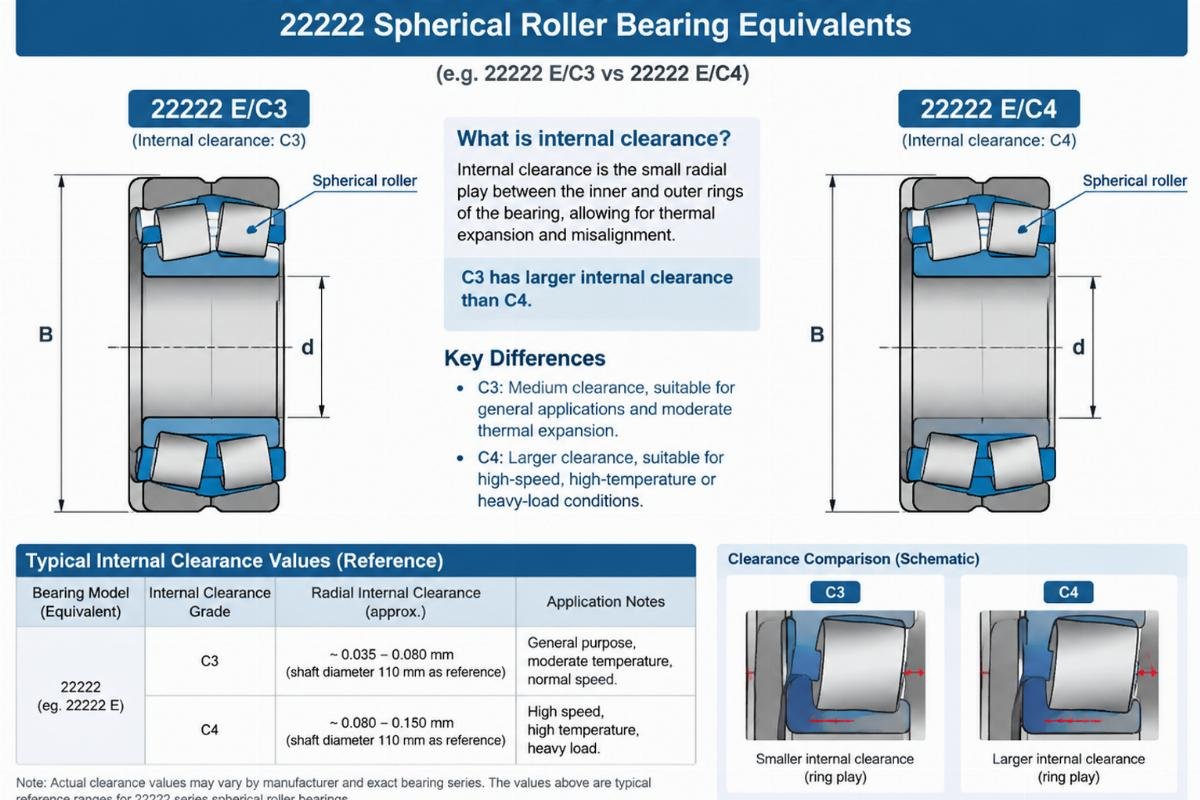
In the humid heat of a nickel mine in Sulawesi, I watched a crusher seize up after only two months of operation. The maintenance team had replaced an SKF 22222E1 with a generic alternative that matched the 110mm bore and 200mm outer diameter perfectly. On paper, it was a direct fit. In reality, the substitute lacked the necessary C4 internal clearance required for the extreme thermal expansion generated by the crushing process. The rollers expanded, locked against the raceways, and destroyed the housing. This was not a manufacturing defect in the traditional sense; it was a specification mismatch. [NEED_CITE: ISO 15243 failure mode classification for thermal seizure]
Understanding these nuances separates a functional supply chain from a costly downtime cycle. When sourcing replacements, the focus must shift from simple part number matching to technical validation of internal geometry.
What Defines a True 22222 Equivalent Beyond Basic Dimensions?
Internal geometry dictates performance, not just external size.
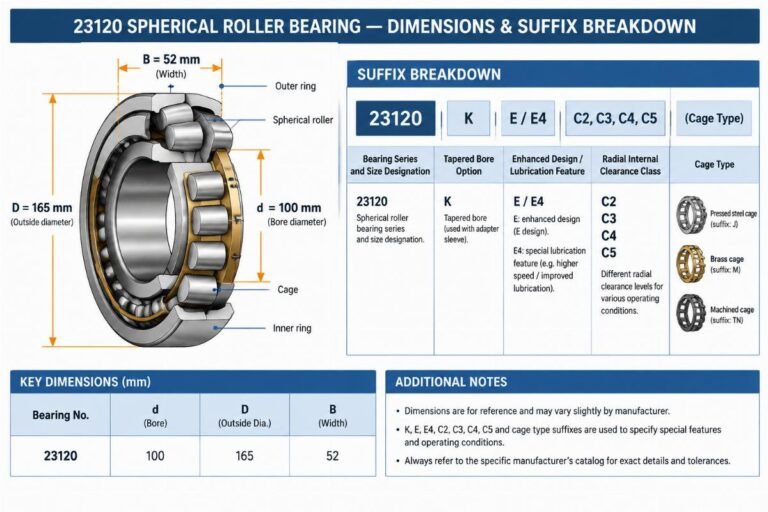
Many procurement officers assume that if the bore, outside diameter, and width match, the bearing is interchangeable. This assumption ignores the critical role of internal clearance and cage design. The 22222 series is designed for heavy radial loads and moderate axial loads in harsh environments. However, the suffixes attached to the base number define how the bearing handles heat, vibration, and misalignment.
For instance, the ‘E’ in SKF’s 22222E1 denotes an optimized internal design with higher load capacity. Similarly, FAG uses ‘-E1’ and NSK uses ‘EA’ or ‘EAE4’ to indicate enhanced roller profiles. A substitute lacking this optimized geometry will have lower dynamic load ratings, leading to faster fatigue even if it fits the shaft. [NEED_CITE: ABMA standard definitions for spherical roller bearing internal design variants]
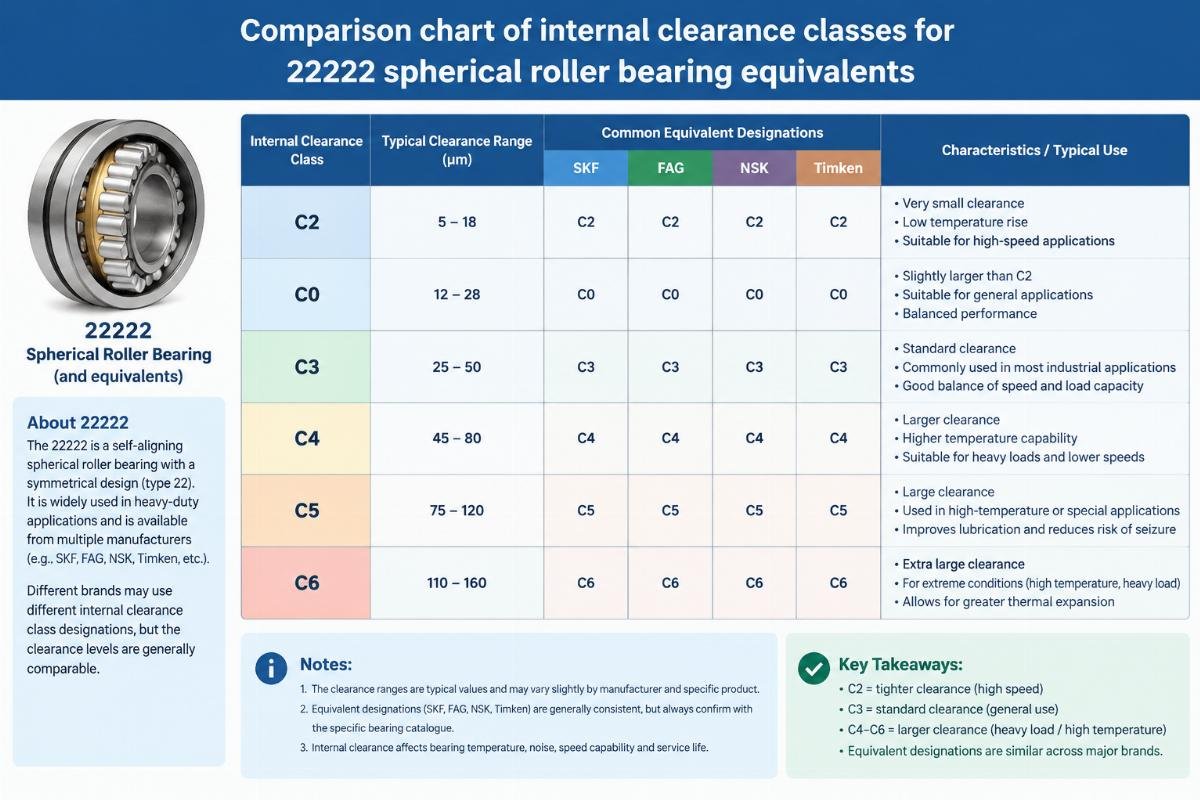
Consider a cement plant fan application where standard clearance bearings were used as substitutes for C3 specified units. The fan operated at high temperatures, causing the inner ring to expand more than the outer ring. Without the extra space provided by the C3 clearance, the rolling elements became preloaded, generating excessive heat and vibration. The solution was not a different brand, but a correct clearance class.
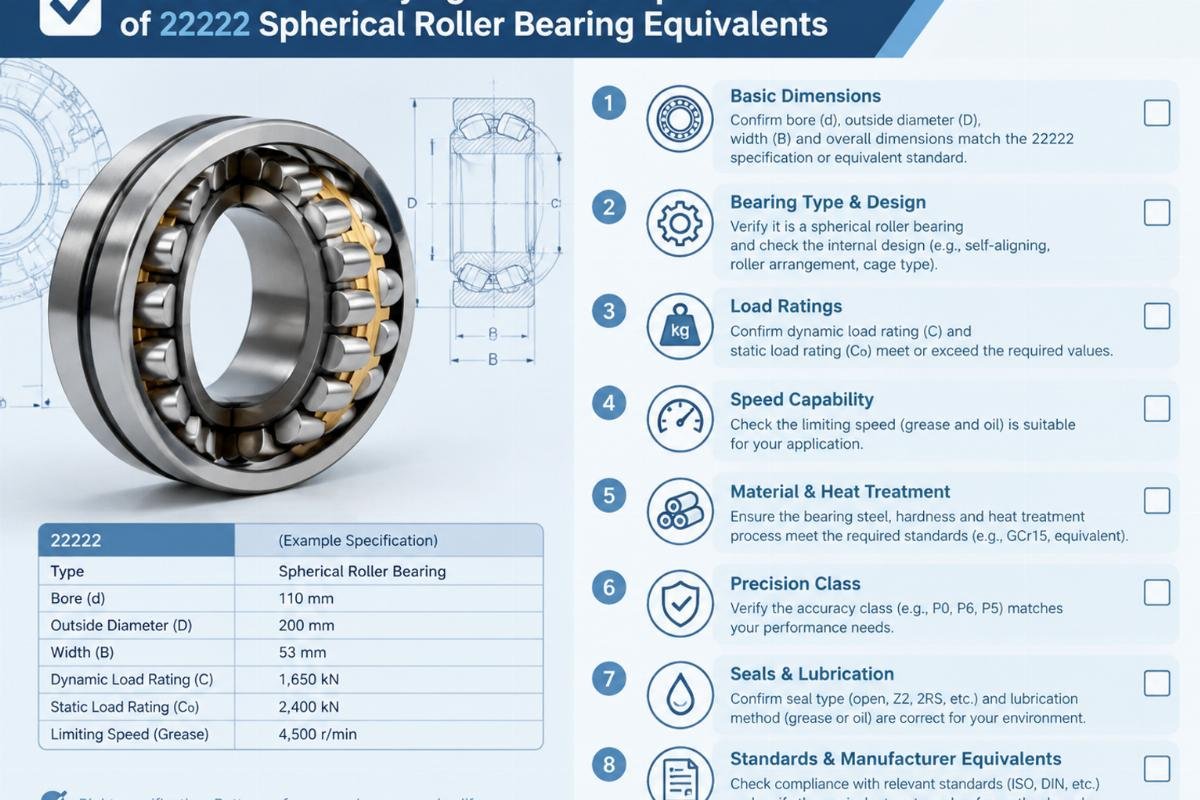
When evaluating a 22222 spherical roller bearing equivalent, buyers must request detailed dimensional sheets that specify:
- Internal radial clearance class (C2, Normal, C3, C4).
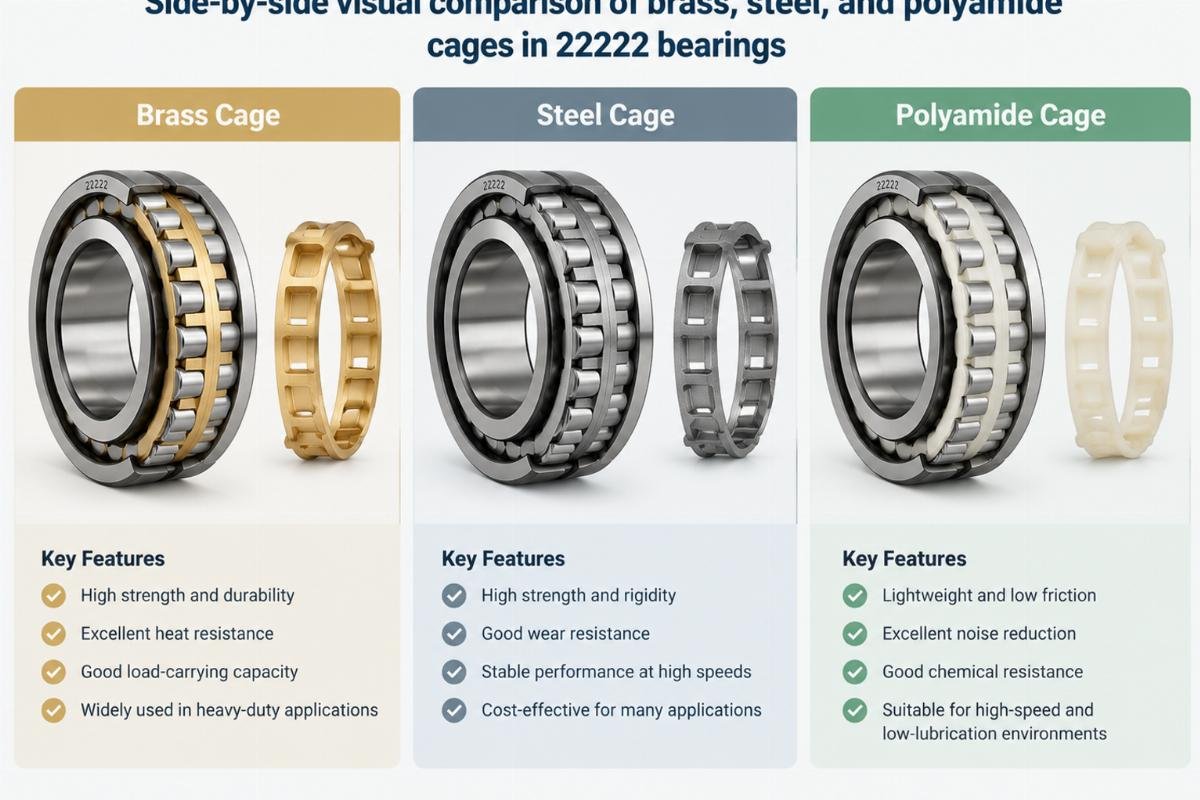
- Cage material and type (steel, brass, or polyamide).
- Dynamic and static load ratings (Cr and Cor).
Ignoring these parameters turns a cost-saving measure into a liability. The physical fit is merely the entry requirement; the internal specification is the performance guarantee.
How Do Major Brands Map to 22222 Spherical Roller Bearings?
Core specs are shared, but cage designs and suffixes differ significantly.
Navigating the cross-reference landscape requires understanding how major manufacturers label their enhancements. While the boundary dimensions are standardized globally under ISO standards, the internal construction varies. A buyer seeking a 22222 spherical roller bearing equivalent must map these variations accurately to avoid compatibility issues.
| Brand | Common Suffix for Enhanced Design | Typical Cage Material | Clearance Options |
|---|---|---|---|
| SKF | E1 | Brass or Steel | Normal, C3, C4 |
| FAG | -E1 | Brass or Polyamide | Normal, C3, C4 |
| NSK | EAE4 | Steel or Polyamide | Normal, C3, C4 |
| TIMKEN | EJ | Steel | Normal, C3, C4 |
[NEED_CITE: Manufacturer technical catalogs for spherical roller bearing suffix definitions]
The table above highlights that while the base model is 22222, the suffixes indicate critical differences. For example, a brass cage offers better emergency running properties in case of lubrication failure, while a polyamide cage is lighter and reduces friction. In a conveyor pulley application, switching from a steel cage to a polyamide cage equivalent reduced the overall weight and friction, improving energy efficiency in low-load zones. However, in a high-shock mining crusher, a polyamide cage might fracture under impact, making steel or brass the superior choice.
A regional distributor in Southeast Asia once ordered a bulk shipment of 22222 units without specifying the cage material. The supplier delivered steel-caged units, which were technically correct by dimension. However, the end-user’s equipment required brass cages for high-temperature stability. The entire batch had to be returned, causing delays and additional shipping costs. This incident underscores the need for precise suffix matching when selecting a 22222 spherical roller bearing equivalent.
Mapping these brands correctly ensures that the replacement not only fits but performs as intended under specific operating conditions.
Why Do Clearance (C3/C4) and Cage Materials Matter for Substitutes?
Wrong clearances cause thermal locking; wrong cages fail under shock loads.
The operating environment dictates the necessary internal clearance and cage material. Standard clearance bearings are suitable for normal operating temperatures and loads. However, heavy machinery often operates in conditions that require modified clearances.
C3 clearance provides extra internal space to accommodate thermal expansion of the inner ring relative to the outer ring. This is common in electric motors and fans. C4 clearance offers even more space, essential for applications with significant temperature differentials or where the housing expands differently than the shaft, such as in paper machines or crushers. [NEED_CITE: ISO 5753 standards for radial internal clearance of rolling bearings]
Using a standard clearance bearing in a C4 application results in the bearing running “tight.” As the machine heats up, the internal clearance disappears, leading to high friction, elevated temperatures, and eventual seizure. Conversely, using a C4 bearing in a standard application can lead to excessive vibration and noise due to too much play.
Cage material selection is equally critical. Brass cages are robust and handle high temperatures well, making them ideal for steel mills and mining equipment. Steel cages are strong and cost-effective but may suffer from higher friction. Polyamide cages are lightweight and offer good sliding properties but are sensitive to high temperatures and certain chemicals.
In a nickel mine case, a substitute bearing with a steel cage was used in a high-heat zone where a brass cage was specified. The steel cage deformed under the combined stress of heat and load, leading to roller misalignment and catastrophic failure. The correct 22222 spherical roller bearing equivalent would have maintained the brass cage specification to withstand the thermal environment.

Selecting the right combination of clearance and cage material prevents premature failure and extends service life.
How to Verify 22222 Equivalents Before Bulk Procurement?
Request dimensional sheets, material certs, and load rating proofs from suppliers.
Verification is the final safeguard against specification mismatches. Before placing a bulk order for a 22222 spherical roller bearing equivalent, buyers must demand technical documentation that confirms the internal specifications. Relying solely on the part number is insufficient.
The verification process should include:
- Dimensional Sheets: Confirm bore, OD, width, and most importantly, internal clearance class. Ensure the supplier specifies whether the unit is Normal, C3, or C4.
- Material Certificates: Verify the cage material and roller composition. For critical applications, request certification that the steel meets international purity standards. [NEED_CITE: ISO 683 standards for heat-treatable steels]
- Load Rating Data: Compare the dynamic (Cr) and static (Cor) load ratings of the substitute with the original OEM specification. Significant deviations indicate a difference in internal geometry or material quality.
A European wind farm operator implemented this verification step after experiencing repeated gearbox failures. By requiring suppliers to provide detailed test reports and material certificates for each batch of 22222 units, they identified a supplier whose bearings had inconsistent hardness levels. Switching to a verified supplier eliminated the failures.
This rigorous approach ensures that every unit delivered meets the technical requirements of the application. It transforms procurement from a transactional activity into a technical partnership.
Conclusion
Precision in specification prevents expensive downtime.
Selecting the correct 22222 spherical roller bearing equivalent demands attention to internal clearance, cage material, and load ratings, not just external dimensions. Mismatches in these areas lead to thermal locking, vibration, and premature failure in heavy machinery. By verifying technical documentation and understanding brand-specific suffixes, buyers can ensure reliable performance and operational continuity.

Written by
authorEditor covering global sourcing, supplier verification, and industrial product knowledge. Content is compiled from manufacturer specifications, industry standards, and hands-on experience with international B2B buyers. Every article is fact-checked before publishing to help procurement professionals make informed decisions.
View all posts

Leave a Reply