NU 2215 ECP E EM EW Equivalents: Wholesale Supplier for Sale
Matching the suffix is more critical than matching the dimensions.
When sourcing NU 2215 equivalents, you must match the cage material suffix (ECP, E, EM, or EW) to your specific operating temperature and load profile. Substituting a polyamide cage (ECP) for a brass cage (EM) in high-temperature applications will lead to catastrophic cage failure, regardless of dimensional accuracy.
I still remember the silence on the production floor in Hanover. It wasn’t the good kind. A major European manufacturing line had ground to a halt because a cylindrical roller bearing seized. The procurement team had saved a small margin by swapping a specified NU 2215 EM bearing for an NU 2215 ECP equivalent. On paper, the inner diameter, outer diameter, and width were identical. The load ratings looked comparable in the basic catalog. But they ignored the suffix. The ECP designation indicates a polyamide cage, while EM signifies a machined brass cage. Under the sustained high heat of that specific application, the polyamide softened, deformed, and eventually melted into the rolling elements. The resulting downtime cost far more than the price difference between the two bearings. That incident reshaped how I approach cross-brand substitutions. It is not just about finding a part that fits; it is about understanding the engineering logic behind the designation codes. [NEED_CITE: ISO standard for bearing designation systems]

Understanding these distinctions is vital for distributors and MRO buyers who manage inventory for diverse industrial applications. The market is flooded with NU 2215 equivalents from various manufacturers, but without a clear grasp of what the suffixes represent, you risk stocking parts that are technically compatible but operationally disastrous.
What Do NU 2215 Suffixes Actually Mean?
The basic model number NU 2215 tells you the geometry: a single-row cylindrical roller bearing with a specific bore size. It does not tell you how the bearing behaves under stress. That information is hidden in the suffixes. Different manufacturers use different codes, but certain patterns have become industry standards, particularly among major brands like SKF, FAG, and NSK. Confusion arises when buyers assume a suffix means the same thing across all brands. [NEED_CITE: Manufacturer technical catalogs for bearing suffix definitions]
For the NU 2215 series, the most common suffixes relate to the cage design and material. This is the primary differentiator for performance limits.
| Suffix | Cage Material | Typical Application Focus | Temperature Limit |
|---|---|---|---|
| ECP | Polyamide (Nylon) | Low noise, moderate speed, light to medium load | Limited |
| E | Reinforced Steel Cage | High load, shock resistance, heavy machinery | High |
| EM | Machined Brass Cage | High speed, high temperature, precision applications | High |
| EW | Window-type Brass Cage | Very high speed, low vibration, machine tools | High |
The ECP suffix is often the default for general-purpose bearings. Polyamide cages are lightweight and offer good sliding properties, which reduces noise. However, they have a strict thermal ceiling. If your application involves continuous operation above a certain temperature threshold, ECP is not a viable option. [NEED_CITE: Material thermal degradation limits for polyamide cages]
In contrast, the EM suffix denotes a machined brass cage. Brass is robust, handles higher temperatures well, and is suitable for high-speed operations where centrifugal forces are significant. The EW suffix is a variation, often featuring a window-type design that further reduces weight and friction, making it ideal for precision machine tools where vibration must be minimized.
The E suffix, usually indicating a reinforced steel cage, is built for toughness. It is common in mining and construction equipment where shock loads are frequent. Steel cages can withstand impacts that would shatter a polyamide cage, but they may generate more noise and have different lubrication requirements.
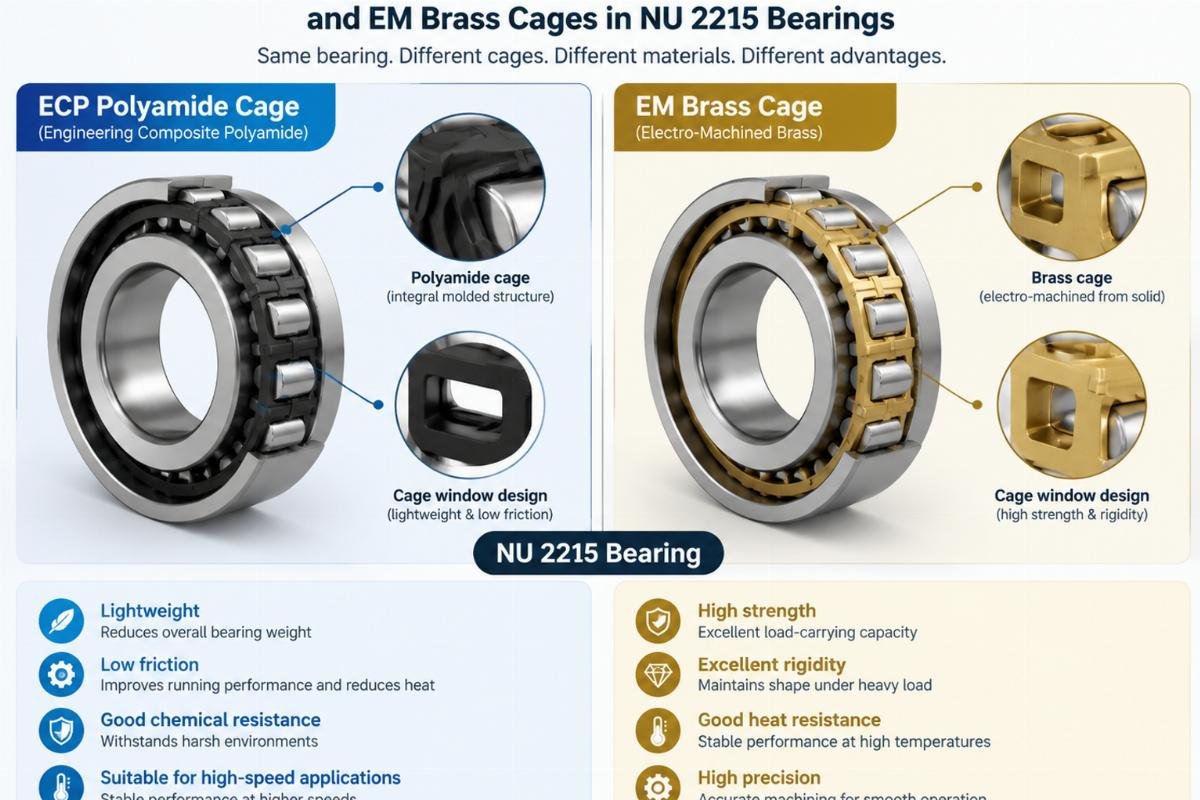
When you search for NU 2215 equivalents, you are not just looking for a bearing with a 75mm bore. You are looking for a specific combination of geometry and cage technology. Ignoring this distinction is the most common error in cross-brand sourcing.
Why Dimensional Equivalence Isn’t Enough
Many buyers operate under the assumption that if the dimensions match, the bearing is interchangeable. This is a dangerous oversimplification. While the basic dynamic load rating might appear similar across different NU 2215 variants, the operational limits defined by the cage material create vastly different performance profiles.
Consider the temperature limits. A polyamide cage (ECP) typically has a maximum continuous operating temperature that is significantly lower than that of a brass (EM) or steel (E) cage. In applications like steel mills or cement plants, ambient temperatures alone can exceed the safe limit for polyamide. If you substitute an ECP bearing for an EM bearing in such an environment, the cage will lose its structural integrity. [NEED_CITE: Thermal stability data for bearing cage materials]
Speed is another critical factor. Cylindrical roller bearings are often used in high-speed applications. The mass of the cage affects its behavior at high RPMs. A heavy steel cage might cause excessive centrifugal force, leading to wear or failure, whereas a lightweight polyamide or window-type brass cage (EW) performs better. Conversely, in low-speed, high-load scenarios, the robustness of a steel cage might be preferred over the lighter alternatives.
Load capacity is also influenced by the cage design. While the rollers carry the radial load, the cage must guide them accurately. Under heavy shock loads, a polyamide cage can fracture. A steel or brass cage offers greater resistance to impact. Therefore, a NU 2215 ECP is not a direct equivalent to a NU 2215 E in a crusher application, even though they share the same basic model number.
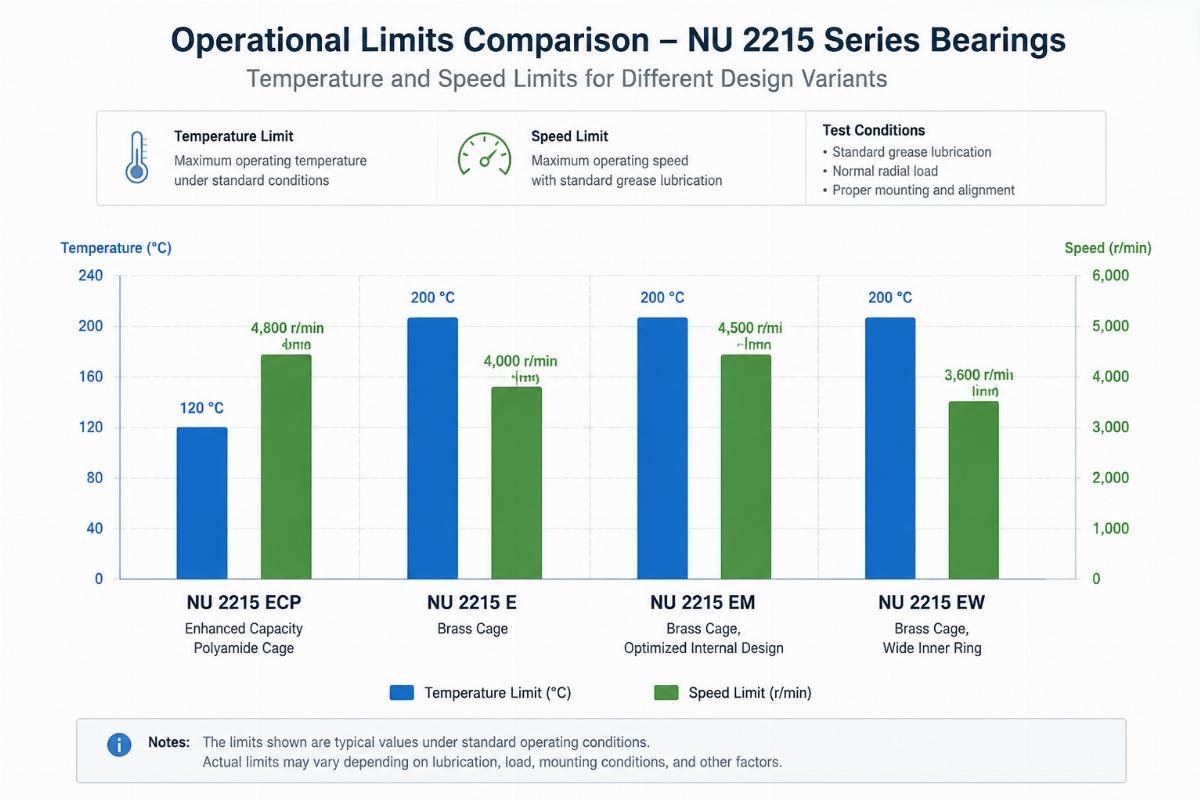
This is why simply checking a dimension table is insufficient. You must evaluate the operating conditions. A mismatch in suffixes can lead to premature failure, unplanned downtime, and increased maintenance costs. For distributors, this means that stocking only one variant of NU 2215 is risky. You need to understand the application to provide the correct equivalent.
How to Choose the Right Equivalent for Your Application
Selecting the correct NU 2215 equivalent requires a systematic assessment of the operating environment. Start by identifying the current bearing’s suffix. If the original bearing is marked NU 2215 EM, do not automatically accept an NU 2215 ECP as a replacement. Investigate why the EM suffix was specified in the first place.
First, assess the temperature. If the bearing operates in a hot environment, such as near a furnace or in a high-friction gearbox, stick with brass (EM or EW) or steel (E) cages. Avoid polyamide (ECP) unless you can guarantee the temperature remains within safe limits. [NEED_CITE: Guidelines for bearing selection based on operating temperature]
Second, evaluate the load type. Is the load steady or shock-heavy? For mining crushers, excavators, or heavy presses, where impact loads are common, a steel cage (E) is often the best choice. It provides the durability needed to survive sudden shocks. For applications with steady loads and high speeds, such as electric motors or machine tool spindles, a brass cage (EM or EW) is preferable due to its balance of strength and low friction.
Third, consider the speed. High-RPM applications benefit from lighter cages. The EW suffix, with its window-type design, is optimized for very high speeds and low vibration. If noise reduction is a priority, such as in HVAC systems or precision manufacturing, the ECP or EW variants are suitable, provided the temperature and load conditions allow it.
Finally, check the lubrication requirements. Different cage materials interact differently with lubricants. Polyamide cages may have specific compatibility issues with certain synthetic oils. Ensure that the lubricant used in the application is compatible with the cage material of the equivalent bearing you are considering.

By following this process, you can avoid the pitfalls of simple dimensional matching. It ensures that the equivalent bearing you choose will perform reliably in its specific application. This approach minimizes the risk of failure and extends the service life of the machinery.
Common Pitfalls in Cross-Brand Substitution
Even with careful selection, cross-brand substitution presents unique challenges. One major pitfall is the inconsistency in suffix logic between manufacturers. While ECP, E, EM, and EW are widely recognized, not every brand uses them exactly the same way. Some manufacturers may use different codes for similar cage designs. Always consult the specific manufacturer’s catalog to verify the meaning of the suffix. [NEED_CITE: Comparative analysis of bearing designation systems across major brands]
Another common error is assuming that “enhanced” capacity is universal. The letter “E” often suggests an enhanced design, but what is enhanced can vary. In some brands, it refers to the cage material; in others, it might refer to the internal geometry or roller design. Without verifying the technical specifications, you might end up with a bearing that does not meet the required performance criteria.
Cost pressure also leads to poor decisions. Buyers often opt for the cheapest equivalent, which is frequently the ECP variant due to the lower cost of polyamide compared to brass or steel. However, as seen in the Hanover case, this short-term savings can result in long-term losses. The cost of a failed bearing includes not just the part itself, but also the labor for replacement, the downtime of the machine, and the potential damage to other components.
A Middle East steel mill once faced repeated failures in their conveyor system. They had been substituting specified brass-cage bearings with cheaper polyamide-cage equivalents. The high ambient temperature and dust contamination accelerated the degradation of the polyamide. Switching back to the correct brass-cage specification resolved the issue, despite the higher initial cost. This case highlights the importance of adhering to the original specification’s intent, not just its dimensions.
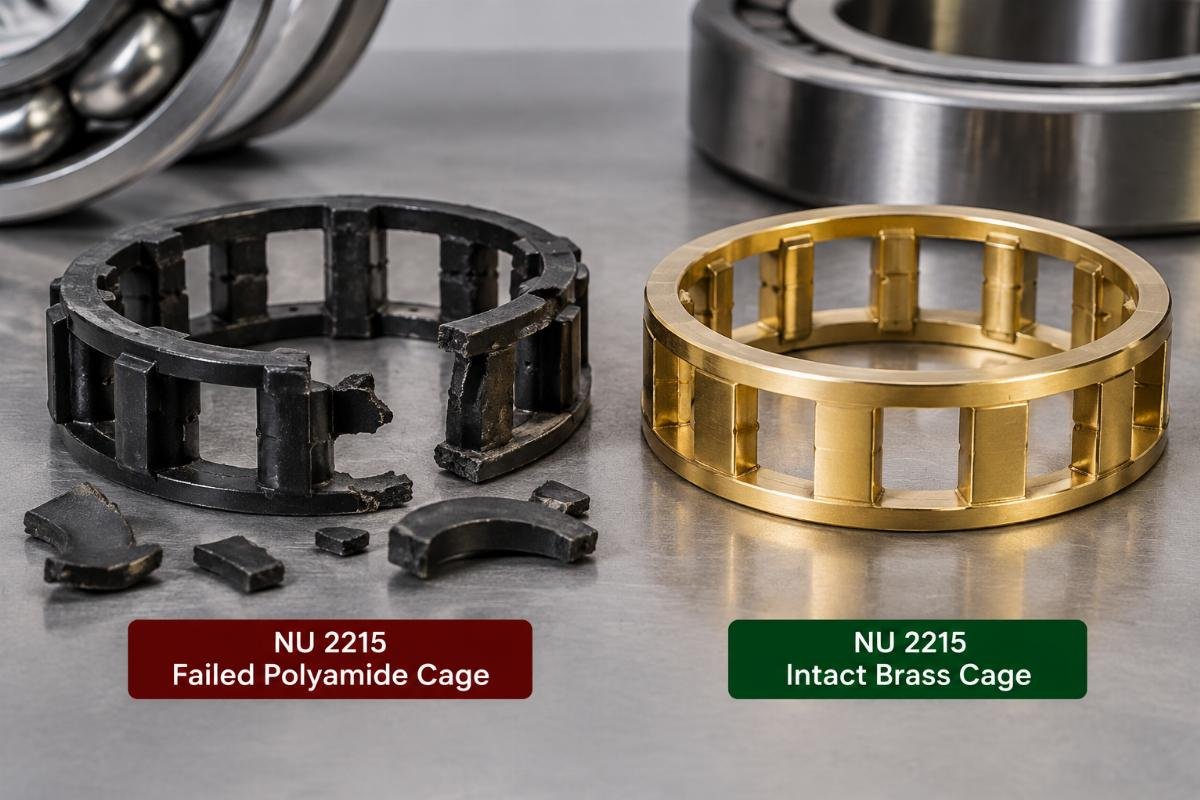
To avoid these pitfalls, maintain open communication with your supplier. Provide detailed information about the application, including temperature, load, speed, and environmental conditions. A knowledgeable supplier can help you navigate the complexities of cross-brand equivalents and ensure you select the right product for your needs.
Conclusion
Suffixes define performance, not just identity.
Selecting the correct NU 2215 equivalent demands more than a dimensional check. It requires a deep understanding of how cage materials like ECP, E, EM, and EW respond to heat, speed, and load. Ignoring these factors invites failure. By prioritizing operational compatibility over simple part number matching, you ensure reliability and protect your operations from costly downtime.

Written by
authorEditor covering global sourcing, supplier verification, and industrial product knowledge. Content is compiled from manufacturer specifications, industry standards, and hands-on experience with international B2B buyers. Every article is fact-checked before publishing to help procurement professionals make informed decisions.
View all posts

Leave a Reply