Wind Turbine Pitch & Yaw Bearing Interchange: Genuine Supplier for Sale
Same model suffix does not guarantee interchangeability.
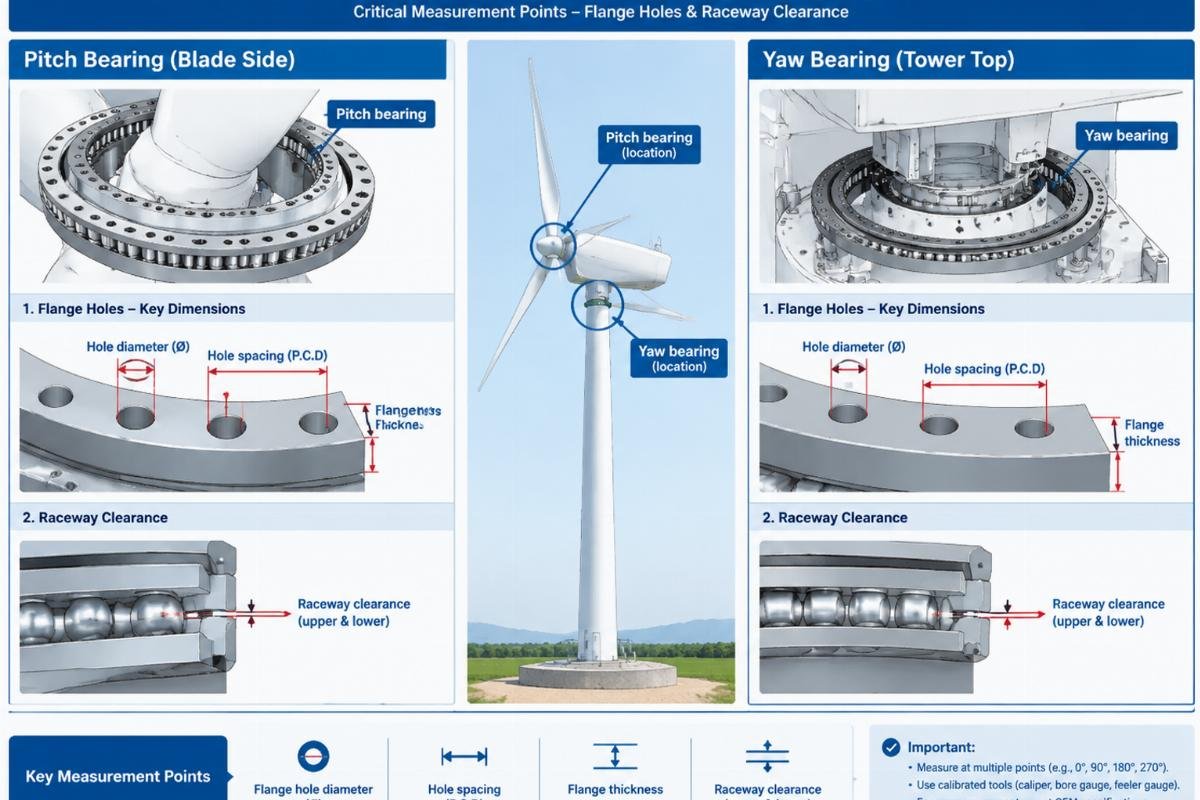
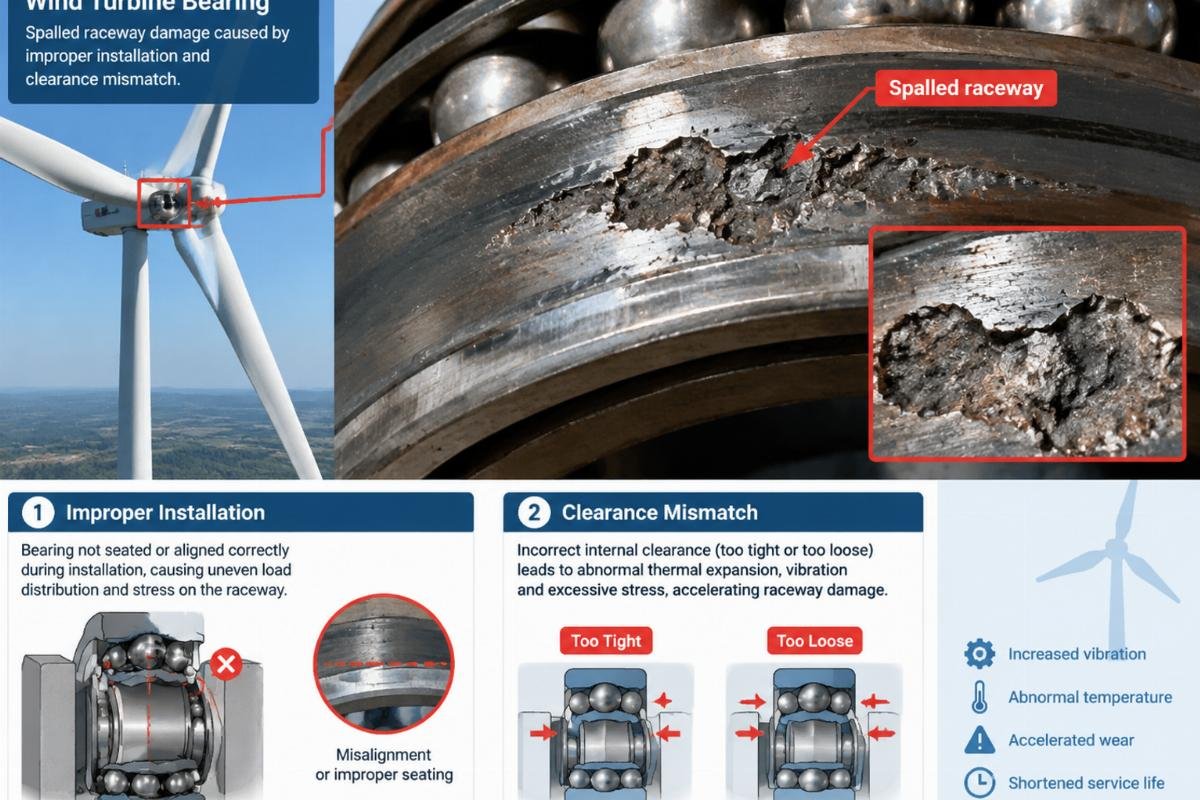
Safe wind turbine pitch and yaw bearing interchange requires verifying installation dimensions, flange hole pitch, and internal clearance rather than relying solely on part numbers. Catastrophic failures often stem from sub-millimeter deviations in mounting surfaces that force improper fitment, leading to rapid raceway spalling under heavy wind loads.
I still remember the silence in the inspection room when I first saw the damaged bearing from a South American wind farm. The client had replaced an imported legacy unit with a domestic alternative, assuming the matching suffix meant a direct drop-in solution. They were wrong. The flange hole pitch differed by a fraction of a millimeter. To make it fit, the installation team used force. Within months, the raceway spalled, causing unplanned downtime and a costly claim. That incident shifted my focus from simple part number matching to rigorous dimensional verification. Now, when discussing wind turbine pitch and yaw bearing interchange, I prioritize physical measurements over catalog descriptions. [NEED_CITE: industry maintenance guidelines for bearing installation tolerances]
This approach minimizes risk for MRO operators and distributors who need reliable cross-brand replacements. Understanding the hidden variables in bearing geometry is the only way to ensure long-term reliability in harsh offshore and onshore environments.
Why Model Suffixes Are Misleading for Bearing Interchange?
Model suffixes are marketing labels, not engineering guarantees.
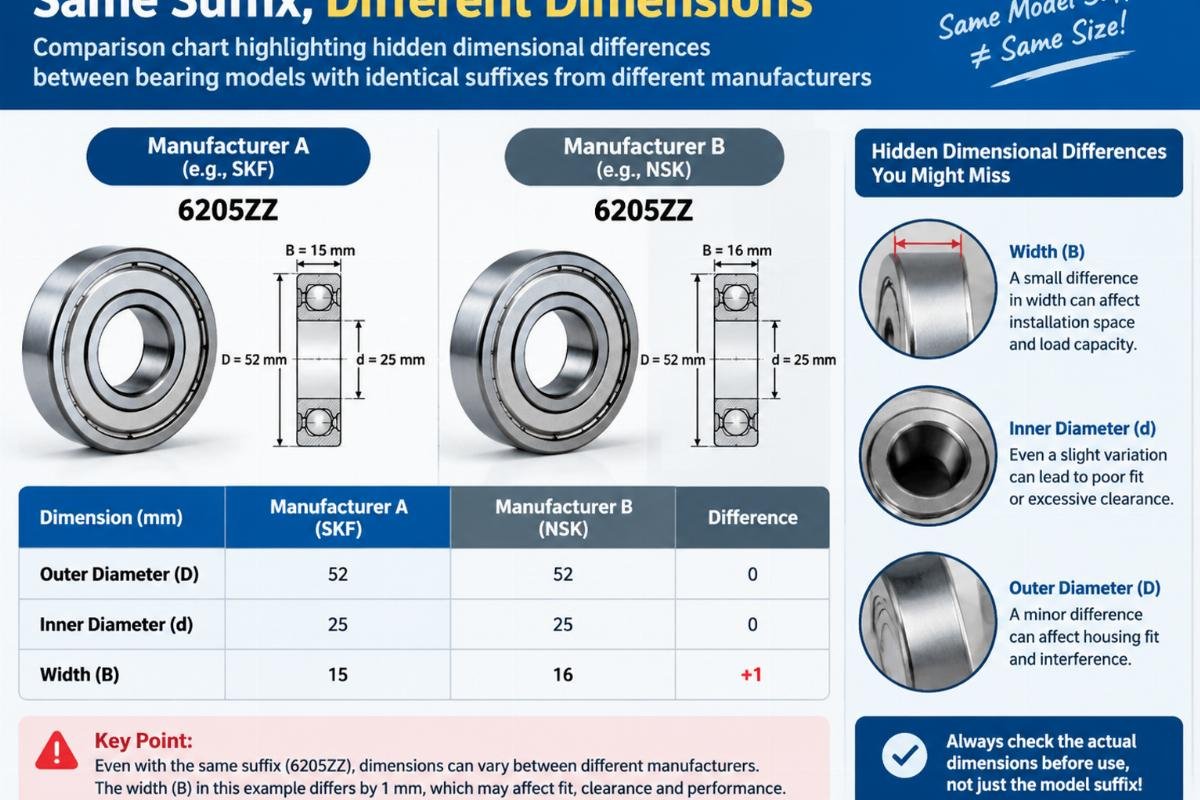
Manufacturers use suffixes to denote internal design variations, seal types, or cage materials, but they do not standardize external mounting dimensions across different brands. A bearing labeled with the same alphanumeric code by two different producers may have distinct flange thicknesses, bolt hole circles, or chamfer angles. These differences are often invisible in digital catalogs but become critical during physical installation. [NEED_CITE: international wind turbine bearing standards on dimensional tolerances]
When sourcing for wind turbine pitch and yaw bearing interchange, assuming equivalence based on suffixes invites mechanical stress. For instance, a slight variation in the outer diameter chamfer can prevent the bearing from seating fully against the housing shoulder. This misalignment creates point loading, which accelerates fatigue failure. I have seen distributors stock large quantities of “equivalent” bearings only to face returns after site engineers discovered the bolt holes did not align with the existing tower structure.
The risk is not just theoretical. In one case, a European wind farm operator attempted to swap yaw bearings using a competitor’s catalog cross-reference. The suffix matched, but the inner ring width was slightly narrower. This created axial play that the original design did not account for. Under variable wind loads, this play caused micro-movements that fretted the mating surfaces. The resulting damage required a full hub replacement, costing far more than the initial savings from the cheaper bearing. [NEED_CITE: root cause analysis of wind turbine drivetrain failures]
To avoid these pitfalls, buyers must request detailed dimension drawings for any proposed substitute. Comparing these drawings against the original equipment manufacturer’s specifications reveals discrepancies that suffixes hide. This step is non-negotiable for safe wind turbine pitch and yaw bearing interchange.
What Are the Critical Parameters for Pitch and Yaw Bearing Swap?
Flange hole pitch, internal clearance, and raceway specs define true compatibility.
Successful wind turbine pitch and yaw bearing interchange depends on three physical parameters that must match the original design intent. Ignoring any one of them compromises the structural integrity of the turbine.
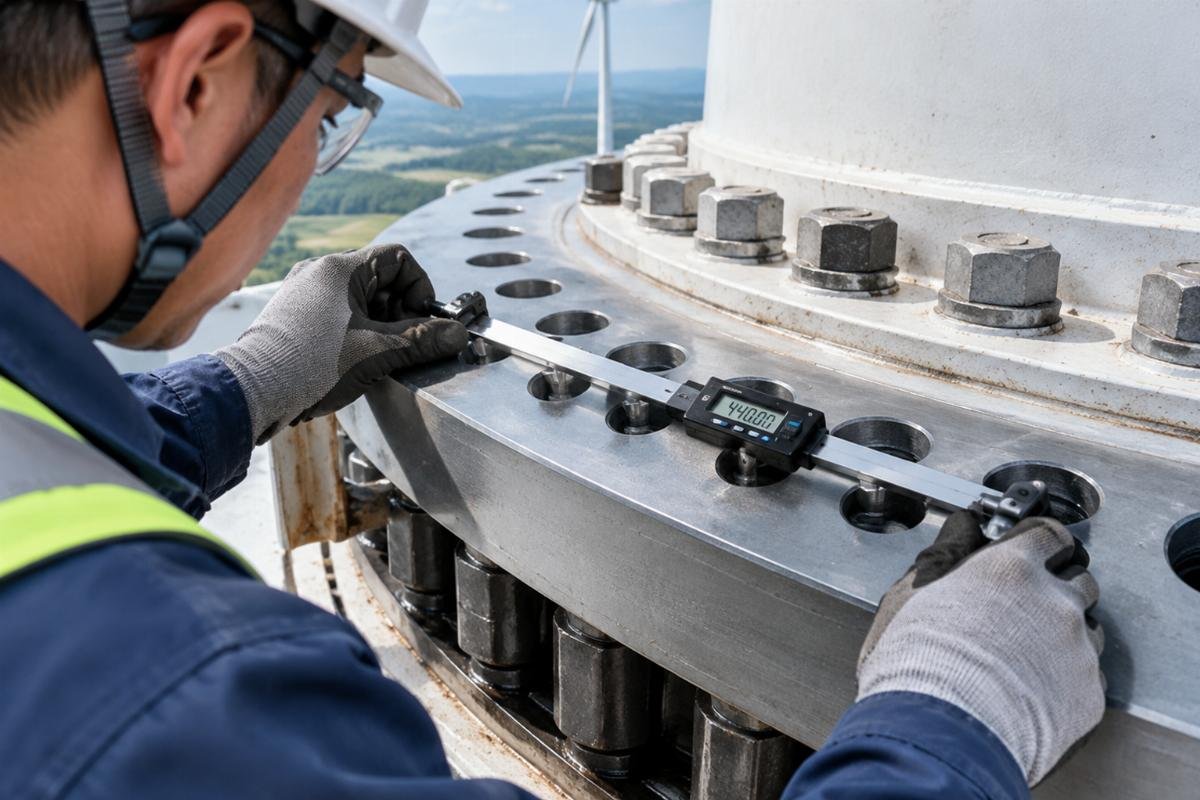
First, flange hole pitch is the most common failure point. Even a sub-millimeter deviation forces installers to drill new holes or force bolts, inducing residual stress in the bearing rings. This stress concentrates at the bolt holes, leading to cracks that propagate into the raceway. Verifying the pitch circle diameter and individual hole spacing is essential before any procurement decision.
Second, internal clearance determines how the bearing handles thermal expansion and load distribution. Wind turbines operate in varying temperatures, from freezing offshore winters to hot desert summers. If the replacement bearing has a tighter clearance than the original, thermal expansion can preload the rolling elements excessively. This preload increases friction and heat, leading to premature seizure. Conversely, excessive clearance causes vibration and noise, accelerating wear. [NEED_CITE: technical guidelines for bearing internal clearance selection]
Third, raceway specifications, including hardness and surface finish, affect fatigue life. While many brands use similar steel grades, the heat treatment processes vary. A softer raceway may deform under heavy yaw loads, creating brinelling. Ensuring the replacement bearing meets the same hardness range as the original is crucial for longevity.
| Parameter | Risk of Mismatch | Verification Method |
|---|---|---|
| Flange Hole Pitch | Forced fit, ring cracking | Coordinate measuring machine (CMM) check |
| Internal Clearance | Preload, overheating, vibration | Feeler gauge or dial indicator measurement |
| Raceway Hardness | Brinelling, premature fatigue | Hardness tester verification on sample |
These parameters form the basis of any reliable wind turbine pitch and yaw bearing interchange strategy. Without verifying them, the replacement is a gamble.
How to Avoid Catastrophic Failures During Cross-Brand Replacement?
Real-world spalling cases reveal the cost of skipping dimensional checks.
The majority of premature bearing failures in wind turbines are not due to material defects but to installation errors driven by incorrect assumptions. When performing wind turbine pitch and yaw bearing interchange, the temptation to skip detailed inspections to save time is high. However, this shortcut often leads to catastrophic outcomes.
Consider the case of a Middle East steel mill that also operated a small wind farm for auxiliary power. They replaced a pitch bearing with a lower-cost alternative, ignoring the slight difference in mounting surface flatness requirements. The new bearing required a flatter surface than the existing tower flange provided. Installers shims were used to compensate, but these shims compressed unevenly under load. Within months, the uneven support caused the inner ring to distort, leading to severe spalling on the raceway. The turbine had to be shut down for weeks, erasing any cost savings from the cheaper bearing. [NEED_CITE: case studies on wind turbine bearing installation failures]
Another example involves internal clearance mismatch. A distributor in Southeast Asia supplied a batch of yaw bearings with standard clearance instead of the specified C3 clearance required for the high-temperature environment. The bearings overheated during operation, causing the lubricant to break down. The resulting metal-to-metal contact destroyed the rolling elements in less than a year. This incident highlights why verifying clearance is as important as checking dimensions.
To prevent such failures, a strict protocol must be followed. First, inspect the mounting surface for flatness and cleanliness. Second, verify the internal clearance of the replacement bearing before installation. Third, ensure the lubrication type matches the operational environment. These steps, though time-consuming, are far cheaper than a turbine outage. [NEED_CITE: best practices for wind turbine maintenance and repair]
Where to Source Verified Interchangeable Wind Turbine Bearings?
Traceability and technical selection support ensure safe cross-brand swaps.
Finding a reliable source for wind turbine pitch and yaw bearing interchange requires more than just a large inventory. It demands a partner who understands the technical nuances of cross-brand replacements. Many suppliers offer parts, but few provide the verification services necessary to ensure those parts will fit and function correctly.
A genuine supplier for sale of these components must offer complete traceability documentation. This includes material certificates, heat treatment records, and dimensional inspection reports. Without this data, buyers cannot verify that the bearing meets the required specifications. Traceability also protects against counterfeit products, which are prevalent in the global bearing market. [NEED_CITE: guidelines for identifying genuine industrial bearings]
Technical selection support is equally critical. A knowledgeable supplier will not just ship a part number but will review the application details. They will check flange dimensions, clearance requirements, and load conditions against their inventory. This proactive approach prevents mismatches before they occur. For instance, when a client requests a replacement for a specific imported brand, a competent supplier will compare the physical samples or detailed drawings of both the original and the proposed substitute.
Our portfolio covers full-spectrum bearing types, including those from premium global brands like SKF, FAG, NSK, and TIMKEN, as well as reliable domestic lines. We stock genuine products with complete traceability, ensuring that every bearing meets ISO-compliant quality standards. For clients seeking wind turbine pitch and yaw bearing interchange, we provide technical consultation to verify dimensional compatibility and clearance suitability. This service minimizes the risk of forced fits and premature failures, ensuring that replacements perform as intended.
By combining genuine product availability with rigorous technical verification, we help MRO operators and distributors minimize downtime. Whether for emergency spare parts or bulk project orders, our approach prioritizes safety and reliability over simple transaction speed. This commitment to quality makes us a trusted partner for complex bearing needs.

Conclusion
Verification prevents failure in wind turbine bearing replacement.
Safe wind turbine pitch and yaw bearing interchange relies on checking physical dimensions and clearance, not just model suffixes. Ignoring these details leads to costly failures and unplanned downtime. By prioritizing traceability and technical verification, operators can ensure reliable performance and extend the service life of their turbines.

Written by
authorEditor covering global sourcing, supplier verification, and industrial product knowledge. Content is compiled from manufacturer specifications, industry standards, and hands-on experience with international B2B buyers. Every article is fact-checked before publishing to help procurement professionals make informed decisions.
View all posts

Leave a Reply