Printing Press Bearing Equivalents: Cross-Reference & Wholesale Supplier
Identical external dimensions do not guarantee interchangeability in high-speed printing machinery.
True printing press bearing equivalents require matching internal clearance and cage designs, not just part numbers, to prevent misregistration and costly downtime. A spherical roller bearing with the same bore and outer diameter but a different radial internal clearance class will behave differently under thermal load, directly impacting print quality.
I still remember the silence in the press room after a major web offset run was scrapped. The blanket cylinder bearings had been replaced with what looked like perfect matches from a different brand. The dimensions were identical. The part numbers seemed to align. But the internal clearance was standard where it should have been C3. As the press ran at speed, friction generated heat. The inner rings expanded. The clearance vanished. The result was not just a stopped machine, but tons of wasted paper with severe color misregistration. That loss cost several times the savings from the cheaper bearings. This experience drives my approach to sourcing. I no longer look at a drawing and see only steel circles. I see thermal dynamics, load paths, and precision classes. [NEED_CITE: impact of internal clearance on thermal expansion in rolling bearings]

When you search for printing press bearing equivalents, you are not just looking for a spare part. You are looking for stability. You need to know that the replacement will handle the dynamic loads of the ink form rollers or the suction pumps without introducing vibration. This guide breaks down how to cross-reference major brands accurately and avoid the hidden risks of incorrect substitution.
Why External Dimensions Aren’t Enough for Printing Press Equivalents?
Internal clearance and cage design dictate high-speed stability and print accuracy.
Most buyers start with the basic dimensions: bore, outside diameter, and width. If these match, they assume the bearing is interchangeable. In low-speed applications like conveyor idlers, this might work. In printing presses, it is a recipe for failure. The critical variables are hidden inside the bearing.
Radial internal clearance is the most common point of failure. Printing presses operate in environments where temperature fluctuates. Ink viscosity changes with heat. Roller temperatures rise during long runs. If a bearing has too little clearance, thermal expansion locks the rolling elements. Friction spikes. The bearing seizes. If it has too much clearance, vibration increases. This vibration transfers to the printed sheet, causing banding or ghosting. [NEED_CITE: ISO standards for radial internal clearance classes]
Consider the cage design. In ink form roller applications, cylindrical roller bearings are common. A brass cage offers good strength and moderate friction. However, some equivalents use polymer cages. While lighter, polymer may not handle the specific chemical exposure or heat buildup in certain press sections. I once saw a case where a switch to a polymer-caged equivalent led to increased friction. The roller temperature rose noticeably. The ink viscosity changed locally, leading to inconsistent color density across the web.
| Feature | Standard Equivalent | Precision Printing Equivalent | Risk of Mismatch |
|---|---|---|---|
| Internal Clearance | Standard (CN) | C3 or C4 (as specified) | Thermal seizure or excessive vibration |
| Cage Material | Steel or Polymer | Brass or Machined Bronze | Chemical incompatibility or heat buildup |
| Precision Class | P0 (Normal) | P6 or Higher | Runout affecting print registration |
| Lubrication | General Purpose | High-Speed/Low-Torque | Increased drag and energy consumption |
This table highlights why a simple dimension check is insufficient. When evaluating printing press bearing equivalents, you must verify the internal geometry. A bearing that looks right on the outside can be wrong on the inside. [NEED_CITE: relationship between bearing precision class and rotational accuracy]

How to Cross-Reference Major Brands (SKF, FAG, NSK) Accurately?
Match load ratings and precision classes, not just part numbers, for critical roller positions.
Cross-referencing is not a simple lookup task. It requires understanding the design philosophy of each manufacturer. SKF, FAG, and NSK all produce high-quality bearings, but their naming conventions and internal designs differ. A direct part number swap often fails because one brand’s “standard” might be another brand’s “light series.”
Start with the dynamic load rating. In heavy-duty sections like the main drum or impression cylinder, the bearing must withstand significant radial loads. If an equivalent has a lower dynamic load rating, its service life will drop noticeably. Even if it fits, it will fail prematurely. I always compare the basic dynamic load rating (C) and the static load rating (C0) from the technical datasheets. [NEED_CITE: method for calculating bearing life based on dynamic load rating]
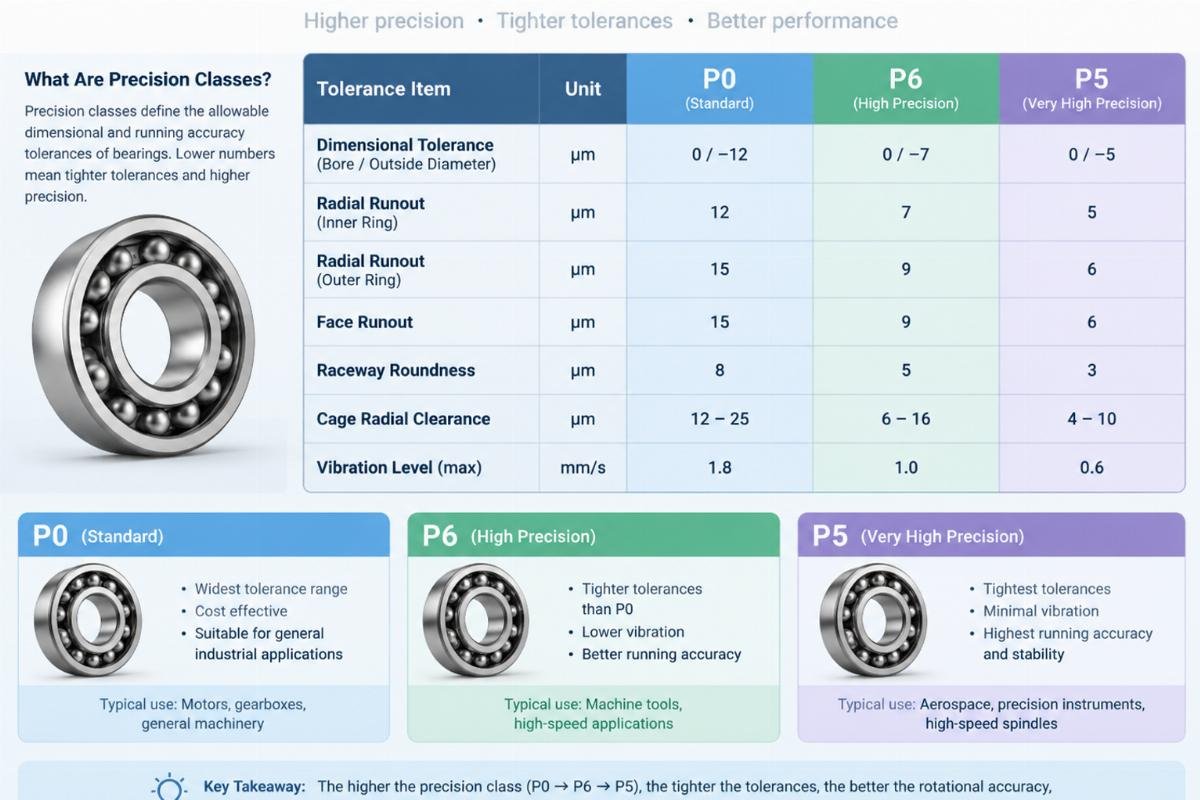
Precision class is another critical factor. Printing presses require high rotational accuracy. Standard industrial bearings are often P0. Printing applications frequently require P6 or higher. A P0 bearing has wider tolerances for runout. In a high-speed press, this runout translates to visible defects in the print. When I source printing press bearing equivalents, I ensure the precision class matches or exceeds the original specification.
A European printer once faced a recurring issue with their folder section. They were using a well-known brand’s spherical roller bearings. To cut costs, they switched to a cheaper equivalent with the same part number structure. The dimensions matched. But the precision class was lower. The result was increased vibration in the folding blades. The folds were uneven. The waste rate climbed. We replaced them with verified P6 class equivalents from a trusted stock. The vibration dropped. The fold quality returned to spec.
What Are the Hidden Risks of Incorrect Bearing Substitution?
Wrong clearance causes thermal expansion, leading to severe color misregistration and web breaks.
The cost of a wrong bearing is never just the price of the part. It is the cost of the downtime. It is the cost of the wasted material. It is the risk of secondary damage to the press itself.
In web offset presses, the blanket cylinder rotates at high speeds. The bearings support the cylinder while maintaining precise alignment with the plate and impression cylinders. If the bearing internal clearance is incorrect, thermal expansion during operation can shift the cylinder position. Even a micron-level shift can cause color misregistration. I have seen jobs where a 15% increase in waste was traced back to a batch of bearings with mismatched C3 clearance. The press operators spent hours adjusting the registers, but the problem was mechanical, not digital. [NEED_CITE: effects of thermal expansion on printing press registration]
Another risk is cage failure. In high-speed applications, the cage guides the rolling elements. If the cage material is not suitable for the operating conditions, it can fracture. A fractured cage can jam the bearing. This sudden stop can damage the shaft, the housing, and even the gear train. Repairing such damage takes days, not hours.
For paper feed suction pumps, the stakes are different. These bearings run continuously. If they fail, the paper feed stops. The press halts. An urgent replacement is needed. Using mixed-brand consolidation can cut lead time from weeks to days. But if the equivalent bearing has poor sealing or incorrect lubrication, it will fail again quickly. The goal is to restore production within 48 hours, not to create a recurring nightmare.

How to Source Genuine Equivalents for Urgent MRO Needs?
Prioritize traceable, mixed-brand consolidation from verified global suppliers over unverified cheap alternatives.
When a press goes down, time is the enemy. You need parts now. But rushing leads to mistakes. Sourcing printing press bearing equivalents urgently requires a supplier who understands both the technical specs and the logistics.
Traceability is non-negotiable. Counterfeit bearings are a real threat. They look real. They have the right logos. But the steel quality is poor. The heat treatment is inconsistent. They fail early. A genuine supplier provides full traceability documentation. You can verify the origin of every bearing. This is crucial for MRO managers who need to justify their purchases and ensure reliability. [NEED_CITE: importance of supply chain traceability in preventing counterfeit industrial parts]
Mixed-brand consolidation is a powerful tool. Instead of ordering from multiple official channels with long lead times, a specialized supplier can consolidate SKF, FAG, NSK, and other premium brands into one shipment. This reduces shipping costs and simplifies customs clearance. For urgent needs, having access to a massive spot inventory covering thousands of standard and special part numbers is vital.
I work with clients who need flexible MOQs. Sometimes they need one single bearing for an emergency repair. Sometimes they need a full container for a planned overhaul. A professional supplier handles both. They offer cross-brand technical consultation. If you send a drawing, they check the工况 (operating conditions). They ask about speed, load, and temperature. They do not just quote a price. They quote a solution.

Conclusion
Precision matching prevents downtime and ensures print quality.
Selecting the right printing press bearing equivalents goes beyond matching dimensions. It requires careful attention to internal clearance, cage design, and precision class. Incorrect substitutions lead to thermal issues, vibration, and costly waste. By prioritizing traceable sources and technical verification, you can minimize unplanned downtime and maintain consistent production quality. Trust expertise over price alone.

Written by
authorEditor covering global sourcing, supplier verification, and industrial product knowledge. Content is compiled from manufacturer specifications, industry standards, and hands-on experience with international B2B buyers. Every article is fact-checked before publishing to help procurement professionals make informed decisions.
View all posts

Leave a Reply