Replace Inch Bearings with Metric: Genuine Supplier for Bulk Orders
Simple arithmetic conversion is not enough.
Replacing inch bearings with metric equivalents is feasible but demands strict dimensional mapping, dynamic clearance recalculation, and verified sourcing to prevent catastrophic equipment failure.
I still remember the heat radiating from a crusher housing in the Atacama Desert. The maintenance supervisor was furious, pointing at a seized tapered roller bearing that had failed months after a retrofit. The original spec was an imperial size, common in older North American mining equipment. To cut costs and reduce lead time, the site manager had swapped it for a seemingly identical metric part from a local generalist supplier. The outer diameter fit the housing, and the shaft slid into the inner ring. On paper, it looked like a perfect match. In reality, the micron-level difference in raceway geometry and the miscalculated internal clearance created a friction trap. Under heavy load, the lubricant film collapsed, and the bearing locked up. This was not a manufacturing defect in the traditional sense; it was a specification mismatch disguised as a cost-saving measure. When dealing with legacy equipment, the temptation to substitute inch to metric bearing replacement parts is strong, but the margin for error is virtually zero.
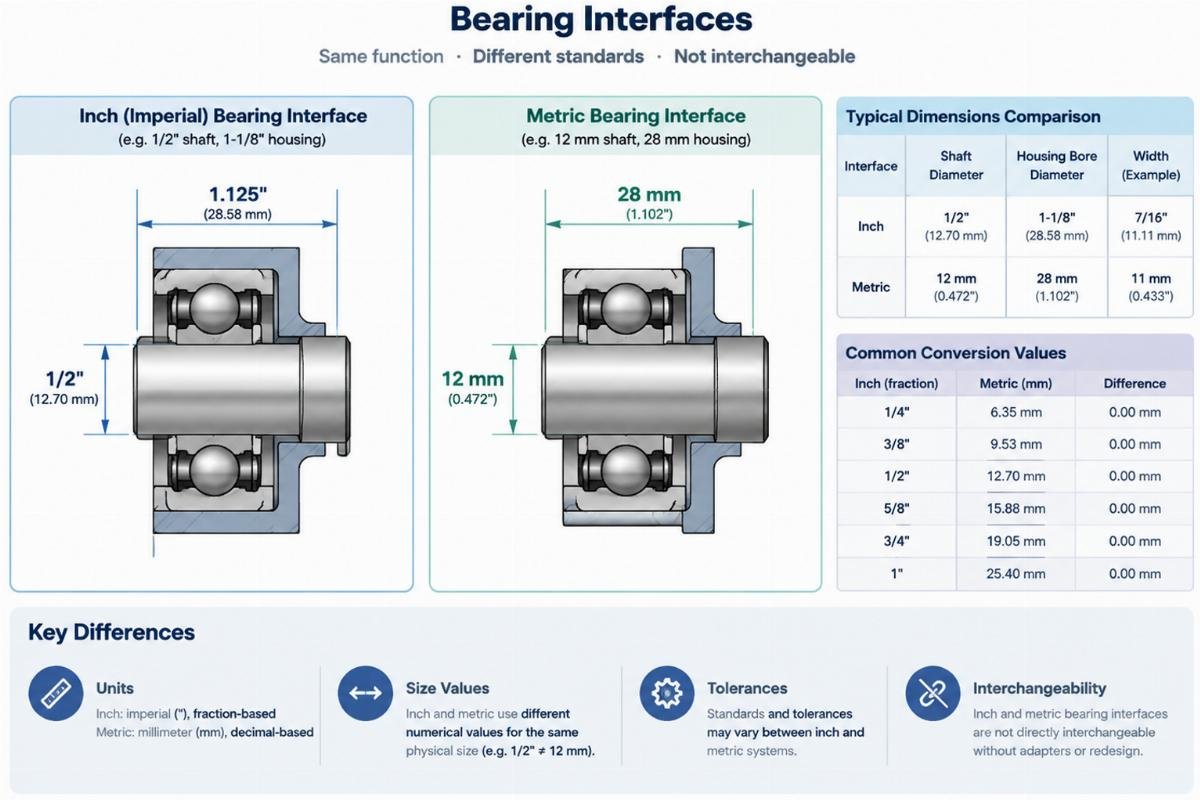
The core issue lies in the assumption that a close numerical approximation equals functional equivalence. It does not. The transition from imperial to ISO standards involves more than just multiplying by 25.4. It requires a holistic review of load ratings, tolerance classes, and operational clearances. For distributors and MRO managers handling bulk orders, understanding these nuances is critical to maintaining client trust and avoiding costly downtime claims.
Can You Really Swap Inch for Metric?
Yes, but only with precise dimensional mapping and rigorous clearance adjustments.
Many buyers assume that if the bore and outer diameter are within a fraction of a millimeter, the bearing will work. This is a dangerous oversimplification. The fundamental geometry of inch and metric bearings often differs in ways that are not immediately visible. For instance, the width of the bearing, the radius of the raceways, and the angle of contact in tapered rollers may vary significantly even if the primary dimensions appear compatible.
When executing an inch to metric bearing replacement, the first step is to verify the dimensional tolerance class. Imperial bearings often adhere to ABMA (American Bearing Manufacturers Association) standards, while metric counterparts follow ISO norms. These standards define different limits for deviation. A bearing that fits snugly in an inch-designed housing might have excessive play or be too tight in a metric equivalent, leading to premature wear or overheating.
Consider a scenario involving a conveyor pulley upgrade in a Southeast Asian cement plant. The engineering team replaced worn inch-sized spherical roller bearings with metric alternatives. They matched the bore and OD but ignored the internal clearance shift. The metric bearings had a standard C3 clearance, which was insufficient for the thermal expansion expected in that high-ambient-temperature environment. Within weeks, the bearings began to overheat, causing the grease to break down and the rollers to seize. The downtime cost far exceeded the savings from using readily available metric stock.
To avoid such pitfalls, a detailed cross-reference check is mandatory. This involves not just comparing basic dimensions but also analyzing the load rating equivalence. A metric bearing might have a higher dynamic load rating on paper, but if its static load capacity is lower due to different ball or roller geometry, it may fail under shock loads typical in crushing or screening applications.
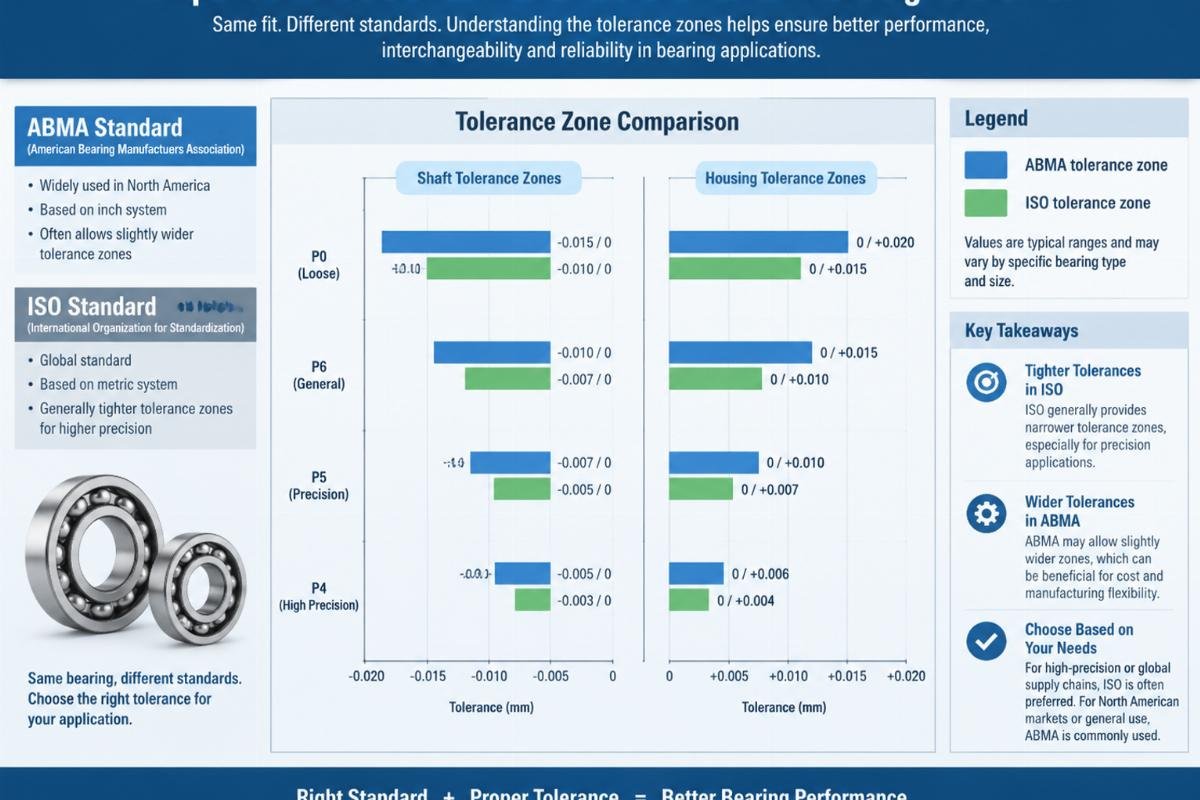
For those managing large-scale retrofits, relying on a generic inch to metric bearing conversion chart is risky. These charts often provide approximate values without accounting for specific series variations. Instead, consult technical datasheets from reputable manufacturers and perform a side-by-side comparison of all critical parameters. If uncertainty remains, seek expert consultation to validate the substitution before placing bulk orders.
Critical Dimension & Clearance Conversions
Direct comparison reveals hidden discrepancies in tolerances and internal clearance shifts.
The most common error in replacing inch bearings with metric equivalents is focusing solely on the bore and outer diameter. While these are the primary mounting dimensions, they do not tell the whole story. The width, shoulder heights, and fillet radii must also align with the existing housing and shaft design. Even a minor mismatch in shoulder height can prevent proper seating of the bearing, leading to misalignment and uneven load distribution.
Internal clearance is another critical factor. Inch bearings often use a different numbering system for clearance than metric ones. For example, an ABMA standard clearance might not directly correspond to an ISO C3 or C4 clearance. When converting, it is essential to calculate the required operational clearance based on the application’s temperature range, load conditions, and speed. Failure to adjust for this can result in either excessive preload, causing heat generation, or excessive looseness, leading to vibration and noise.
| Parameter | Inch Standard (ABMA) | Metric Standard (ISO) | Conversion Risk |
|---|---|---|---|
| Dimensional Tolerance | Class 0, 6, 5, 4, 2 | P0, P6, P5, P4, P2 | Mismatched fit leads to fretting or slippage |
| Internal Clearance | Numbered series (e.g., 2, 3, 4) | Lettered series (C2, C3, C4) | Incorrect thermal compensation causes seizure |
| Load Rating Basis | Dynamic/Static per ABMA | Dynamic/Static per ISO | Overestimation of life under shock loads |
| Material Standards | SAE/AISI grades | DIN/ISO grades | Variations in hardness and fatigue resistance |
[NEED_CITE: tolerance class equivalence between ABMA and ISO standards]
A practical example involves a gearbox overhaul in a Latin American sugar mill. The maintenance team replaced inch-sized cylindrical roller bearings with metric ones from a mixed-brand batch. The dimensions seemed correct, but the traceability of the parts was poor. Some bearings in the batch had inconsistent hardness levels due to substandard heat treatment. Under heavy torque, the softer races deformed, causing the rollers to skid rather than roll. This led to rapid surface damage and eventual failure. The lack of genuine traceability documentation made it impossible to identify the root cause quickly, prolonging the outage.
When sourcing replacements, always demand full traceability. Verify that the bearings meet the specified ISO or ABMA standards and come with material certificates. This ensures that the physical properties of the bearing match the design requirements, reducing the risk of unexpected failures.

Hidden Risks of Poor Substitution
Micron-level errors cause overheating, seizure, and catastrophic downtime.
The belief that inch-to-metric conversion is simple math is a pervasive myth. In reality, it requires dynamic clearance recalculation and a deep understanding of tribology. A difference of a few microns in the inner ring diameter or raceway curvature can drastically alter the contact stress distribution. Under high loads, this leads to localized stress concentrations, initiating fatigue cracks that propagate rapidly.
Cheaper metric replacements may save upfront costs, but they often compromise on material quality and precision. Counterfeit or low-grade bearings may look identical to genuine products but lack the refined surface finish and precise geometry needed for high-performance applications. These defects are not visible to the naked eye but manifest as increased friction, noise, and heat during operation.
In one case, a mining operator in Africa attempted to replace inch-sized tapered roller bearings with budget-friendly metric alternatives. The initial installation went smoothly, and the equipment ran for a short period. However, the bearings were not designed for the heavy axial loads present in the application. The contact angle was slightly off, causing edge loading on the rollers. This led to premature spalling and eventual cage failure. The resulting downtime required a complete gearbox rebuild, costing significantly more than the original savings.
Another risk is the mixing of brands without proper validation. Different manufacturers may interpret standards slightly differently, leading to subtle variations in geometry. When mixed in the same assembly, these variations can cause uneven load sharing among rolling elements. This accelerates wear and reduces the overall life of the bearing set.
[NEED_CITE: impact of microscopic geometric errors on bearing fatigue life]
To mitigate these risks, avoid sourcing from unauthorized distributors who cannot guarantee product authenticity. Stick to suppliers who provide genuine traceability documentation and have a proven track record in handling complex cross-brand substitutions. Technical support is also crucial; a knowledgeable supplier can help verify the suitability of a metric equivalent for a specific inch application, ensuring that all critical parameters are aligned.

How to Source Genuine Metric Equivalents
Verify traceability, ISO compliance, and avoid counterfeit parts through rigorous checks.
Sourcing genuine metric equivalents for inch applications requires a disciplined approach. The market is flooded with counterfeit and substandard bearings that mimic the appearance of premium brands but fail to meet performance standards. For bulk orders, the risk of receiving mixed-quality goods is high, making vendor selection critical.
Start by requesting full traceability documentation for every batch. This includes material certificates, heat treatment records, and inspection reports. Genuine manufacturers maintain strict quality control processes, and their documentation reflects this. If a supplier cannot provide these documents, consider it a red flag.
Next, verify ISO compliance. Ensure that the bearings meet the relevant ISO standards for dimensions, tolerances, and load ratings. This provides a baseline for quality and performance. Additionally, check for brand authorization. Authorized distributors have direct access to manufacturer resources and technical support, enabling them to offer accurate cross-reference advice.
Consider the supplier’s inventory capabilities. A reliable partner should have a vast spot inventory covering thousands of standard and special part numbers. This ensures quick availability for urgent maintenance needs and allows for consolidated shipping, reducing logistics costs. Look for suppliers who offer mixed-batch sourcing options, allowing you to combine different brands and sizes in a single order. This flexibility is invaluable for MRO operations managing diverse equipment fleets.
Technical consultation is another key factor. Choose a supplier who offers cross-brand equivalent model consultation and technical selection support. Their engineers can help analyze your application requirements and recommend the most suitable metric alternatives, considering factors like load, speed, and environmental conditions. This proactive approach prevents costly mistakes and ensures long-term reliability.
[NEED_CITE: guidelines for verifying bearing authenticity and traceability]
Finally, evaluate the supplier’s after-sales support. A committed partner will assist with failure analysis and application guidance, helping you optimize bearing performance and extend service life. This ongoing support is essential for maintaining operational efficiency and minimizing unplanned downtime.

Conclusion
Precision matters more than price in bearing substitution.
Replacing inch bearings with metric equivalents is a viable strategy for modernizing legacy equipment, but it demands rigorous technical validation. Success depends on accurate dimensional mapping, correct clearance calculation, and sourcing from verified suppliers. By prioritizing genuine quality and technical expertise, operators can achieve cost-effective replacements without compromising reliability.

Written by
authorEditor covering global sourcing, supplier verification, and industrial product knowledge. Content is compiled from manufacturer specifications, industry standards, and hands-on experience with international B2B buyers. Every article is fact-checked before publishing to help procurement professionals make informed decisions.
View all posts


Leave a Reply