SEW Gearbox Bearing Equivalents: Cross-Reference & Wholesale Supplier
The OEM label on a bearing box is not a performance guarantee. It is a procurement specification that often leads to unnecessary downtime when local stock is unavailable.
SEW gearbox bearings do not require original packaging to function reliably. Matching the dimensional tolerances, radial internal clearance, and dynamic load ratings with premium equivalents from brands like SKF or FAG ensures identical operational integrity while significantly reducing lead times.
I still remember the dust choking the air at a quarry in Ethiopia. A critical SEW reducer had seized, halting the entire crushing line. The site manager insisted on waiting for an SEW-branded replacement, convinced that any other option would fail under the heavy shock loads. We waited three days for the part to clear customs. When it finally arrived, I opened the box and saw the same standard spherical roller bearing inside, just with a different sticker. If we had swapped it immediately with a locally available SKF equivalent of the same specification, the loss would have been minimal. That incident clarified a fundamental truth in industrial maintenance: the physics of load distribution does not care about the brand name on the outer ring. [NEED_CITE: ISO standards for bearing interchangeability]

Understanding how to identify these equivalents is crucial for maintaining operational continuity. This guide breaks down the technical parameters that matter, helping you make informed decisions without compromising on quality or reliability.
Why Stick to OEM SEW Bearings When Equivalents Work Better?
Insisting on original equipment manufacturer packaging often creates artificial supply bottlenecks that have no basis in mechanical engineering.
The belief that only OEM-labeled parts ensure safety is a common misconception in heavy industry. In reality, major bearing manufacturers produce components to strict international standards. An SEW gearbox typically uses standard bearing types such as deep-groove ball bearings, cylindrical roller bearings, or spherical roller bearings. These are not proprietary designs unique to SEW. They are off-the-shelf components sourced from global bearing producers.
When a gearbox fails, the urgency is rarely about the brand identity. It is about restoring torque transmission. Waiting for a specific branded box can result in extended downtime, costing far more than the price difference between an OEM part and a premium equivalent. By recognizing that the internal geometry and material quality of top-tier brands meet the same rigorous requirements, operators can access a much wider pool of immediate stock. [NEED_CITE: Global bearing market supply chain dynamics]
Consider a cement plant mixer that required urgent maintenance. The procurement team initially sought an OEM-specific part, facing a multi-week delay. By switching to a FAG cylindrical roller bearing with verified matching specifications, they reduced the procurement cycle dramatically. The equipment ran smoothly, proving that the performance metric is the bearing’s capability, not its packaging.

For distributors and MRO operators, this shift in perspective opens up opportunities for better inventory management. Instead of stocking slow-moving OEM-specific SKUs, maintaining a range of high-quality equivalents allows for faster response times. This approach is particularly valuable in regions where logistics can be unpredictable. The key is knowing which equivalents are truly compatible, which brings us to the technical details of matching.
How to Match Dimensions, Clearance, and Load Ratings?
Precise parameter alignment is the only metric that matters for gearbox longevity, not the logo on the seal.
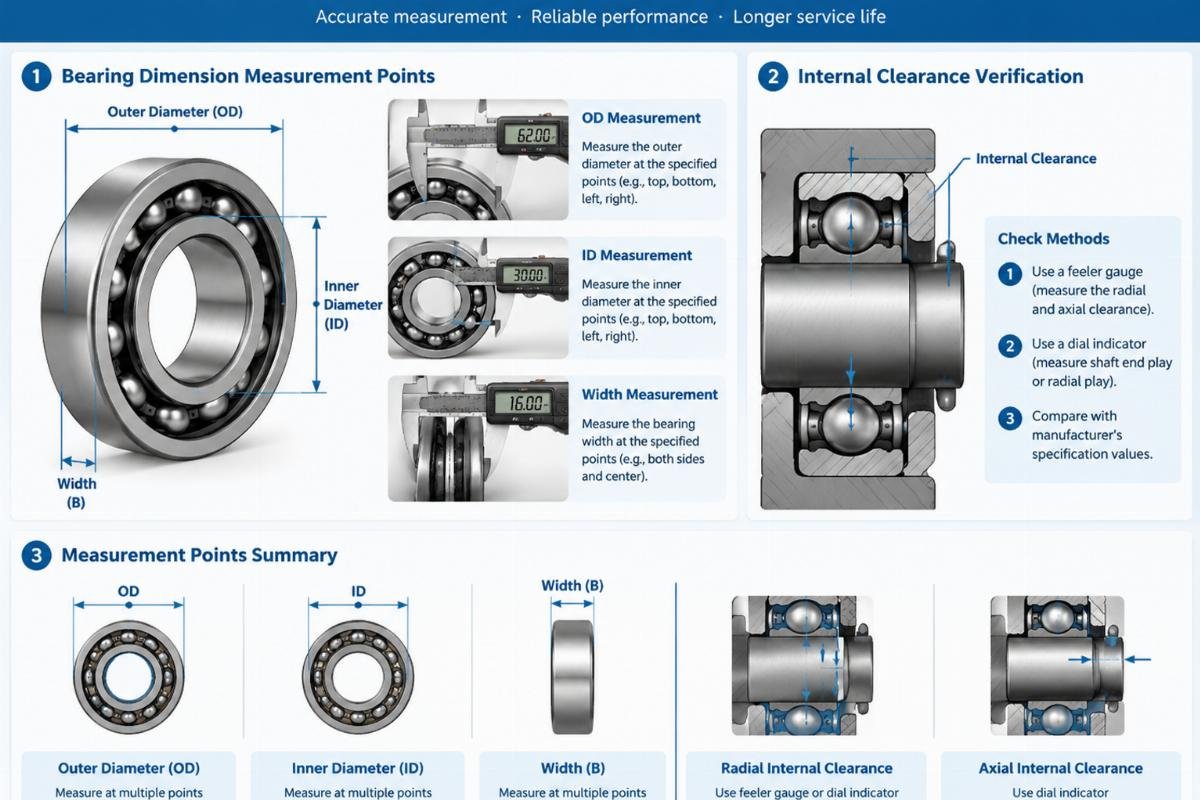
Matching a replacement bearing requires more than just checking the part number. It demands a thorough verification of three critical parameters: dimensions, radial internal clearance, and load ratings. Ignoring any of these can lead to premature failure, regardless of the brand’s reputation.
First, dimensional accuracy is non-negotiable. The bore diameter, outside diameter, and width must match the original design within ISO tolerance classes. Even a micron-level deviation can cause improper fit, leading to fretting corrosion or excessive heat generation. [NEED_CITE: ISO 15 dimensional standards for rolling bearings]
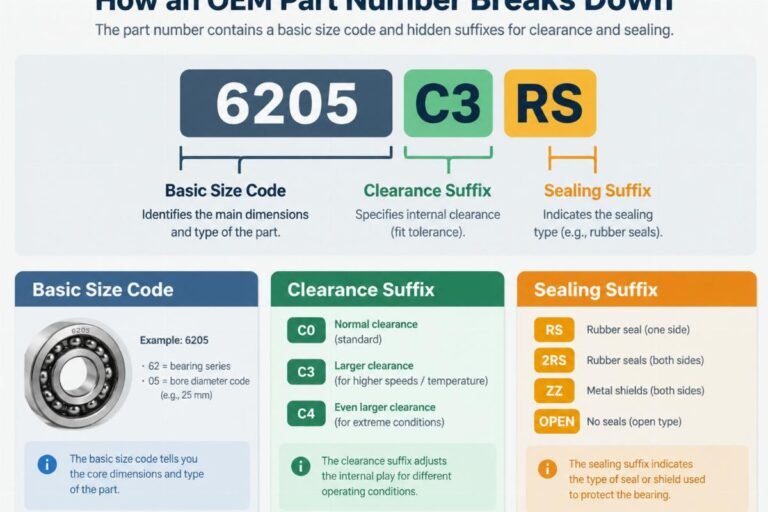
Second, radial internal clearance is vital, especially in high-temperature environments like mining conveyors or steel mills. Standard clearance (C0) may not suffice if the operating temperature causes significant thermal expansion. In such cases, selecting a C3 or C4 clearance equivalent ensures the bearing maintains optimal performance without seizing. Many OEMs specify these clearances in their technical manuals, but they are often overlooked during emergency replacements.
Third, the dynamic load rating (C) must meet or exceed the original specification. This rating determines the bearing’s ability to withstand repetitive stress. Using an equivalent with a lower load capacity will drastically reduce service life, even if the dimensions fit perfectly.
| Parameter | Verification Method | Risk of Mismatch |
|---|---|---|
| Dimensions | Caliper measurement against ISO tolerances | Improper fit, vibration, housing damage |
| Internal Clearance | Gauge check or manufacturer datasheet (C3/C4) | Seizing due to thermal expansion, premature wear |
| Load Rating | Comparison of dynamic load rating (C) values | Reduced service life, catastrophic failure under load |
A mining conveyor repair case illustrates this well. The team needed to consolidate mixed-brand urgent spares into one shipment. By carefully verifying the C3 clearance and load ratings of the SKF and FAG equivalents, they ensured compatibility across different gearbox models. This attention to detail prevented future failures and cut freight costs by allowing consolidated shipping. [NEED_CITE: Technical guidelines for bearing selection in heavy-duty applications]
For those sourcing these components, having access to detailed technical datasheets is essential. This allows for accurate cross-referencing and ensures that every replacement meets the rigorous demands of industrial applications.
SKF vs. FAG: Which Equivalent Brand Fits Your SEW Gearbox?
Both SKF and FAG offer premium quality, so the choice depends on specific load profiles and local stock availability rather than inherent superiority.
When looking for SEW gearbox bearing equivalents, SKF and FAG are the most common alternatives. Both brands adhere to stringent quality controls and produce bearings that meet or exceed ISO standards. The decision between them often comes down to specific application needs and logistical factors.
SKF is widely recognized for its extensive global distribution network and comprehensive technical support. Their spherical roller bearings are particularly noted for their robustness in misalignment scenarios, making them a strong choice for heavy-equipment applications where shaft deflection might occur. [NEED_CITE: SKF technical catalog performance data]
FAG, part of the Schaeffler group, is renowned for its precision engineering and expertise in cylindrical and tapered roller bearings. Their products are often preferred in high-speed or high-precision applications where minimal friction and heat generation are critical. [NEED_CITE: FAG technical catalog performance data]
In practice, both brands perform equally well in standard SEW gearbox applications. The key is to select the brand that offers the best availability for your specific location and timeline. For a regional distributor, stocking both brands provides flexibility. If one brand is out of stock, the other can serve as a reliable alternative without compromising quality.

A European wind farm operator once faced a critical turbine gearbox issue. With limited local stock, they evaluated both SKF and FAG equivalents. Based on the specific load profile and immediate availability, they chose the FAG option. The turbine returned to full operation without any issues, demonstrating that both brands are viable high-quality choices.
For buyers, understanding the strengths of each brand helps in making informed decisions. It also allows for strategic sourcing, ensuring that maintenance schedules are not disrupted by supply chain fluctuations.
What Documents Prove the Authenticity of Equivalent Bearings?
Traceability certificates and ISO compliance documentation are the definitive proof of genuine premium replacements, not just the presence of a brand logo.
In the global bearing market, counterfeit products pose a significant risk. To ensure that your SEW gearbox bearing equivalents are genuine, you must demand proper documentation. This includes traceability certificates that link the bearing to its manufacturing batch and origin.
ISO compliance is another critical factor. Genuine bearings from reputable manufacturers will comply with relevant ISO standards, such as ISO 281 for dynamic load ratings and ISO 15 for dimensions. Requesting certification of conformity from your supplier ensures that the products meet these international benchmarks. [NEED_CITE: ISO 9001 quality management requirements for bearing manufacturers]
Additionally, reputable suppliers provide material certificates that verify the steel grade and heat treatment processes used. This is particularly important for bearings operating in harsh environments, where material integrity is crucial for longevity.
| Document Type | Purpose | Verification Check |
|---|---|---|
| Traceability Certificate | Links product to manufacturing batch | Check batch number against manufacturer database |
| ISO Compliance Certificate | Confirms adherence to international standards | Verify standard numbers (e.g., ISO 281, ISO 15) |
| Material Certificate | Verifies steel grade and heat treatment | Confirm material specs match application requirements |
A Middle East steel mill once received a shipment of bearings that lacked proper documentation. Upon inspection, the bearings showed signs of inferior material quality. By insisting on full traceability and ISO compliance for subsequent orders, they eliminated the risk of counterfeit parts and ensured consistent equipment performance.

For distributors and end-users, establishing a relationship with a supplier who prioritizes transparency and documentation is essential. This ensures that every bearing purchased is a genuine, high-quality component capable of delivering reliable performance.
Conclusion
Reliable gearbox operation depends on precise technical matching, not brand loyalty.
By focusing on dimensions, clearance, and load ratings, you can confidently use premium equivalents from brands like SKF and FAG. This approach minimizes downtime and reduces procurement complexity. Ensuring authenticity through proper documentation further safeguards your investment. For those managing industrial maintenance, this strategy offers a practical path to sustained operational efficiency.

Written by
authorEditor covering global sourcing, supplier verification, and industrial product knowledge. Content is compiled from manufacturer specifications, industry standards, and hands-on experience with international B2B buyers. Every article is fact-checked before publishing to help procurement professionals make informed decisions.
View all posts

Leave a Reply