OEM Bearing Part Number to Brand Cross-Reference Supplier
An OEM part number is not a universal standard. It is a proprietary label that often hides critical internal specifications which generic cross-reference tools completely ignore.
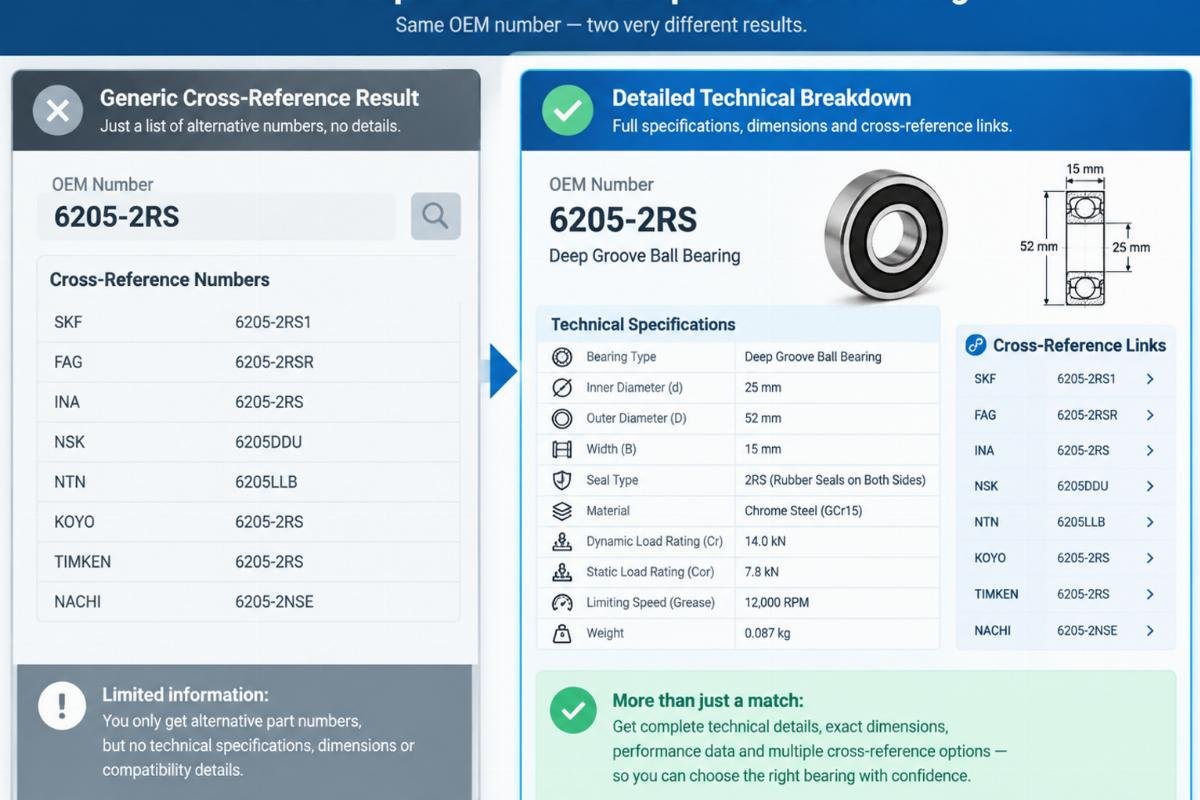
To find bearings from OEM part numbers accurately, you must decode the manufacturer-specific suffixes for clearance, sealing, and cage design rather than relying solely on basic dimensional matches. Blindly trusting automated cross-reference charts leads to premature failure because these tools typically match only the outer diameter, inner diameter, and width, ignoring the internal geometry that determines bearing life.
I learned this the hard way at a trade show in Chicago years ago. A European client handed me a list of OEM part numbers for heavy-duty crushers, asking for immediate replacements. I used a standard online database to find equivalents. The dimensions matched perfectly. We shipped the goods. Two weeks later, the client called. The bearings had seized within days. The issue was not the size; it was the internal clearance group and a specific lubrication groove on the inner ring that the OEM number implied but the generic equivalent lacked. That incident shifted my entire approach. Now, when I see an OEM number, I do not just look up the size. I look for the hidden parameters. [NEED_CITE: common causes of premature bearing failure related to incorrect clearance selection]
This guide explains why simple lookups fail and how to verify true equivalence before placing an order. Understanding these nuances is essential for anyone tasked with finding bearings from OEM part numbers for critical industrial applications.
Why Do Simple OEM Cross-Reference Tables Fail?
Most automated cross-reference tools are designed for speed, not precision. They prioritize matching the three primary physical dimensions: bore, outside diameter, and width. While this works for standard deep-groove ball bearings in non-critical applications, it is disastrous for heavy machinery.
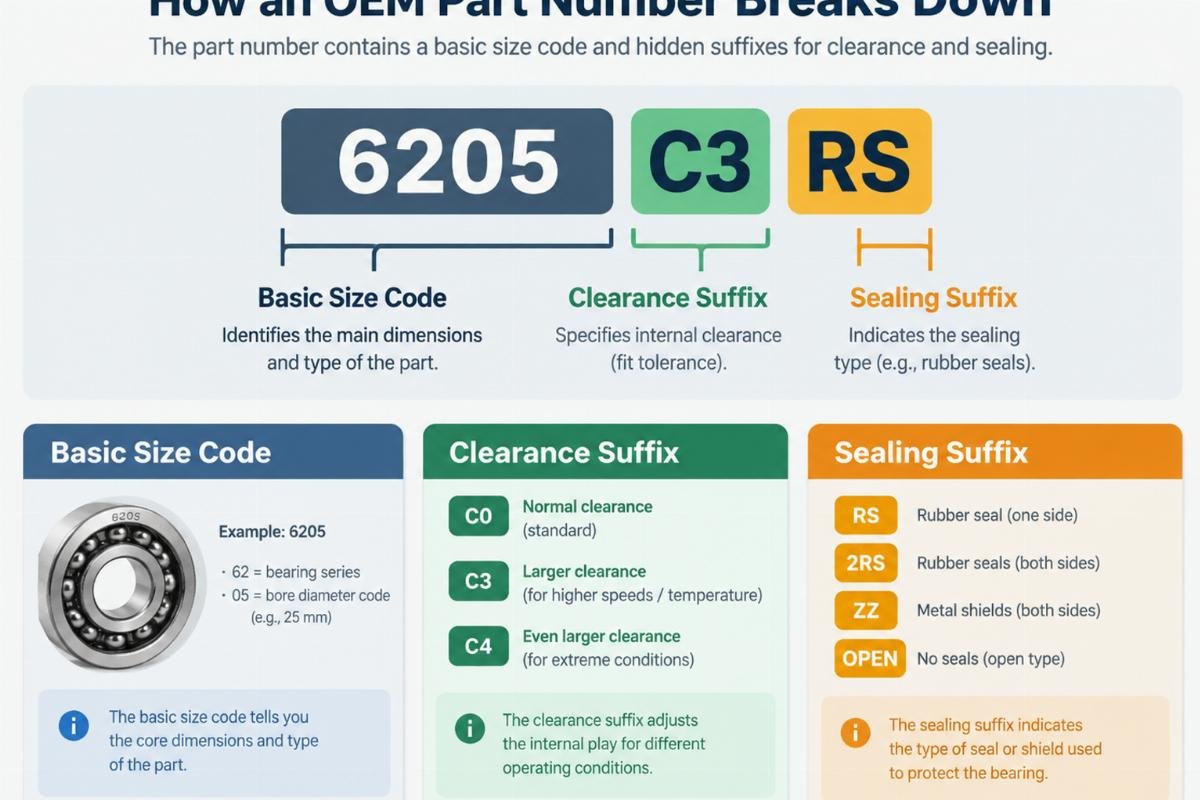
The fundamental flaw is that an OEM part number is often a composite code. It includes the basic bearing designation plus a series of suffixes that define internal modifications. Generic databases frequently strip these suffixes or map them to the most common standard variant. This creates a “dimensional match” but a “functional mismatch.”
Consider the case of a spherical roller bearing used in a mining conveyor. The OEM number might indicate a C3 clearance group, which allows for thermal expansion under heavy loads. A generic cross-reference might suggest a standard CN (Normal) clearance bearing because it shares the same boundary dimensions. When installed, the tighter internal clearance causes excessive friction as the bearing heats up. The result is rapid temperature rise and eventual seizure. [NEED_CITE: ISO standards for radial internal clearance groups]
Another common failure point is the cage material. An OEM specification might call for a brass cage for high-speed stability or a polyamide cage for lightweight performance. A generic lookup might substitute a steel cage, altering the dynamic load rating and heat generation characteristics. For buyers seeking to find bearings from OEM part numbers, relying on these incomplete tables is a significant risk. The cost of a wrong bearing is not just the unit price; it is the downtime, the labor for replacement, and the potential damage to the shaft or housing.
How to Decode Hidden Parameters in OEM Part Numbers?
The key to accurate substitution lies in decoding the suffixes. Every major bearing manufacturer uses a standardized yet brand-specific coding system. To find bearings from OEM part numbers correctly, you must treat the suffix as critically as the basic number.
Start by identifying the basic designation, which defines the type and size. Then, isolate the prefix and suffix codes. These often denote:
- Internal Clearance: Codes like C2, C3, C4, or CM indicate the radial play inside the bearing. Matching this is vital for applications with significant thermal gradients.
- Sealing Type: Suffixes such as RS, RZ, 2RS, or ZZ define whether the bearing is open, shielded, or sealed with contact lips. Using an open bearing where a sealed one is required invites contamination. Using a contact seal where a non-contact shield is specified can cause overheating due to friction.
- Cage Design: Materials like brass (M), steel (J), or polymer (TN9) affect speed limits and lubrication retention.
- Special Features: Look for codes indicating lubrication holes, locating tags, or special heat treatment.
For example, an OEM number ending in “S0” might indicate a special heat treatment for high-temperature environments. A standard bearing without this treatment will lose its hardness and deform under similar conditions. [NEED_CITE: bearing material standards for high-temperature applications]
When I review a customer’s request, I manually cross-check these suffixes against the original equipment manufacturer’s documentation. If the OEM number is obscure, I refer to the machine’s service manual or the original bearing’s physical markings. This manual verification step is what separates a reliable supplier from a mere order taker. It ensures that when you find bearings from OEM part numbers, you are getting a functional equivalent, not just a dimensional one.

What Are the Key Differences Between Standard and OEM-Specific Bearings?
OEM-specific bearings are often modified versions of standard designs. These modifications are engineered to solve specific problems in the original machine, such as vibration, misalignment, or contamination. Ignoring these differences is a primary cause of early failure in replacement scenarios.
The table below highlights the typical areas where OEM specifications diverge from standard catalog items. Understanding these differences is crucial when you attempt to find bearings from OEM part numbers.
| Parameter | Standard Catalog Bearing | OEM-Specific Modification | Risk of Mismatch |
|---|---|---|---|
| Internal Clearance | Normal (CN) or Standard C3 | Custom C3/C4 hybrid or pre-loaded | Overheating or excessive play |
| Sealing Structure | Standard rubber lip or steel shield | Double-lip with garter spring or labyrinth | Contamination ingress or friction heat |
| Lubrication | Standard grease fill | Special high-temp or food-grade grease | Grease breakdown or leakage |
| Cage Material | Standard steel or brass | Reinforced polymer or machined brass | Cage fracture at high speeds |
| Tolerance Class | Normal (P0) | Precision (P6 or P5) | Vibration and noise issues |
[NEED_CITE: ABMA standards for bearing tolerance classes]
A real-world example involves a wind turbine gearbox. The OEM specified a cylindrical roller bearing with a specific phosphate coating on the rollers to prevent micro-pitting under oscillating loads. A standard bearing without this coating was substituted based on a simple part number lookup. Within months, the rollers showed signs of false brinelling. The dimension was correct, but the surface treatment was missing. This illustrates why you cannot simply find bearings from OEM part numbers using basic databases. You must verify the material and surface treatments as well.
For distributors and MRO managers, this means maintaining a library of technical datasheets, not just part number lists. When in doubt, request the full specification sheet from the supplier. A reputable partner will provide this data to confirm that the proposed equivalent matches the OEM’s hidden requirements.

How to Verify Bearing Equivalence Before Mass Ordering?
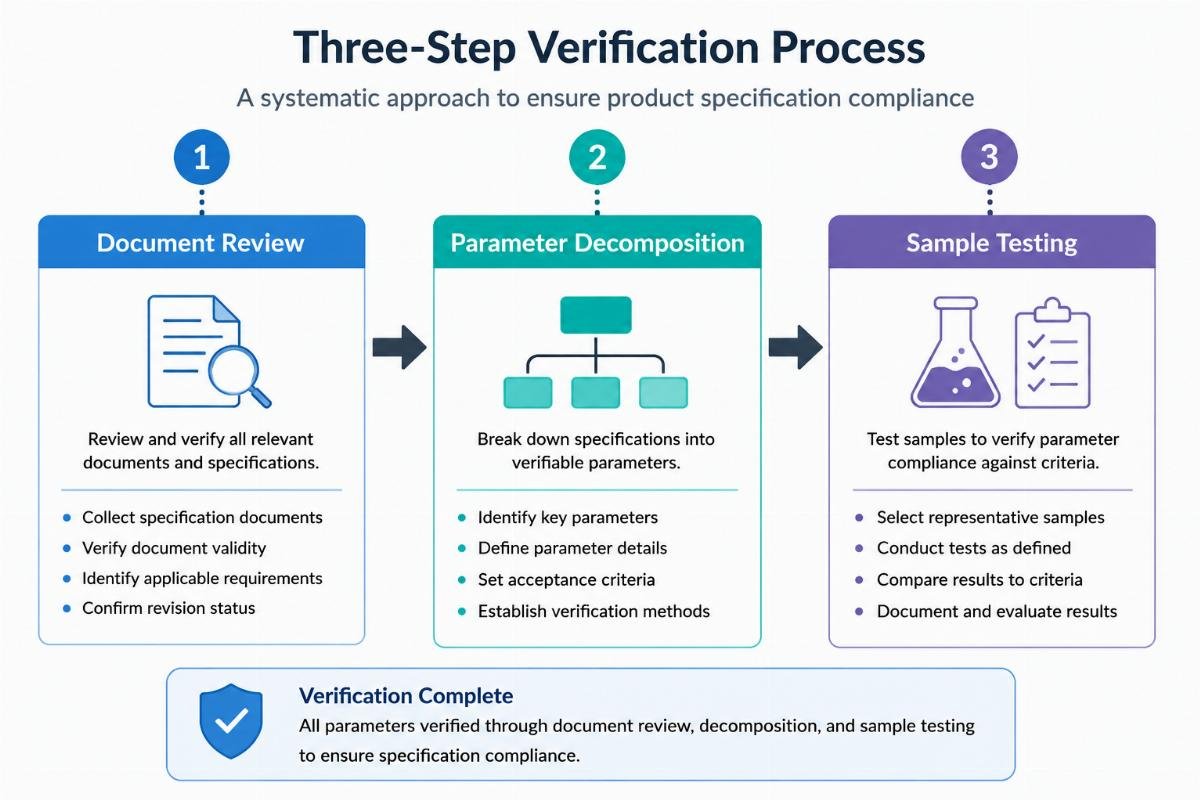
Never assume equivalence without verification. Even after decoding the part number and checking the suffixes, there is room for error. Manufacturers may update their designs, or the OEM may have used a bespoke variant that has no direct commercial equivalent. To mitigate this risk, follow a structured verification process.
- Document Review: Obtain the original equipment’s service manual or the existing bearing’s packaging photo. Look for any handwritten notes or stickers that might indicate previous failures or modifications.
- Parameter Decomposition: Break down the OEM number into its components. Compare each component against the proposed alternative. Check clearance, sealing, cage, and tolerance. If any parameter is unknown, flag it for further investigation.
- Sample Testing: For critical applications or large orders, always request a sample. Install the sample in a non-critical position first, or run it in a test rig if available. Monitor temperature, vibration, and noise levels. Compare these metrics with the performance of the original bearing.
- Technical Consultation: Engage with a supplier who offers technical support. Provide them with the OEM number and the application details. Ask them to confirm the equivalence based on engineering data, not just a database lookup.
I once worked with a steel plant in the Middle East that was experiencing frequent failures in their continuous caster rolls. They were using a generic cross-reference to find bearings from OEM part numbers. By implementing a sample testing phase, we discovered that the OEM bearing had a special sulfur-phosphorus additive in the grease. The generic equivalent used standard lithium grease. Switching to a compatible grease formulation resolved the issue without changing the bearing brand. This level of detail is only uncovered through careful verification.
When you partner with a supplier who understands these complexities, the process becomes smoother. We assist clients in dissecting these OEM codes, ensuring that every replacement meets the original design intent. This approach minimizes the risk of unplanned downtime and extends the service life of your machinery. It transforms the task of finding bearings from OEM part numbers from a guessing game into a precise engineering exercise.
Conclusion
Accuracy in bearing replacement requires more than a part number match. It demands a deep understanding of the hidden parameters encoded in OEM specifications. By decoding suffixes, comparing technical details, and verifying samples, you can avoid the costly pitfalls of generic cross-referencing.
Reliable sourcing partners provide the technical expertise needed to navigate these complexities. They help you find bearings from OEM part numbers that truly match your application’s demands, ensuring operational continuity and equipment longevity. Always prioritize technical verification over speed to protect your assets.

Written by
authorEditor covering global sourcing, supplier verification, and industrial product knowledge. Content is compiled from manufacturer specifications, industry standards, and hands-on experience with international B2B buyers. Every article is fact-checked before publishing to help procurement professionals make informed decisions.
View all posts

Leave a Reply